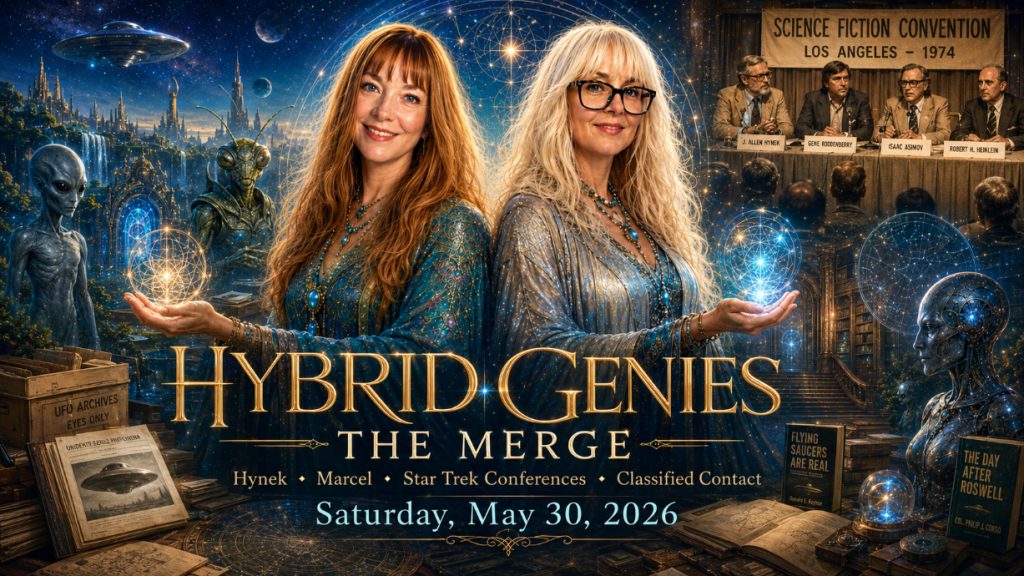
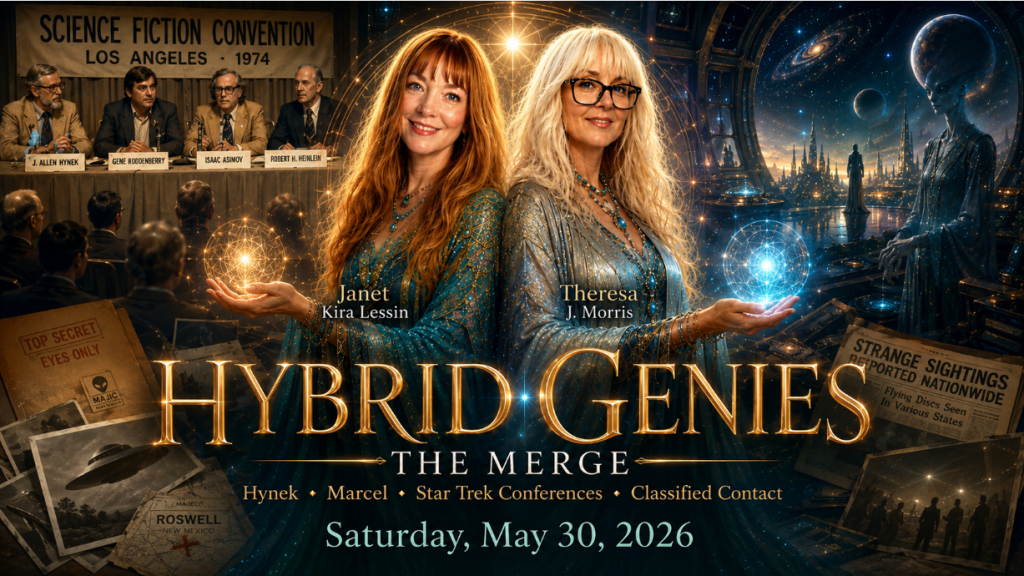
HYBRID GENIES WITH THERESA J. MORRIS & JANET KIRA LESSIN
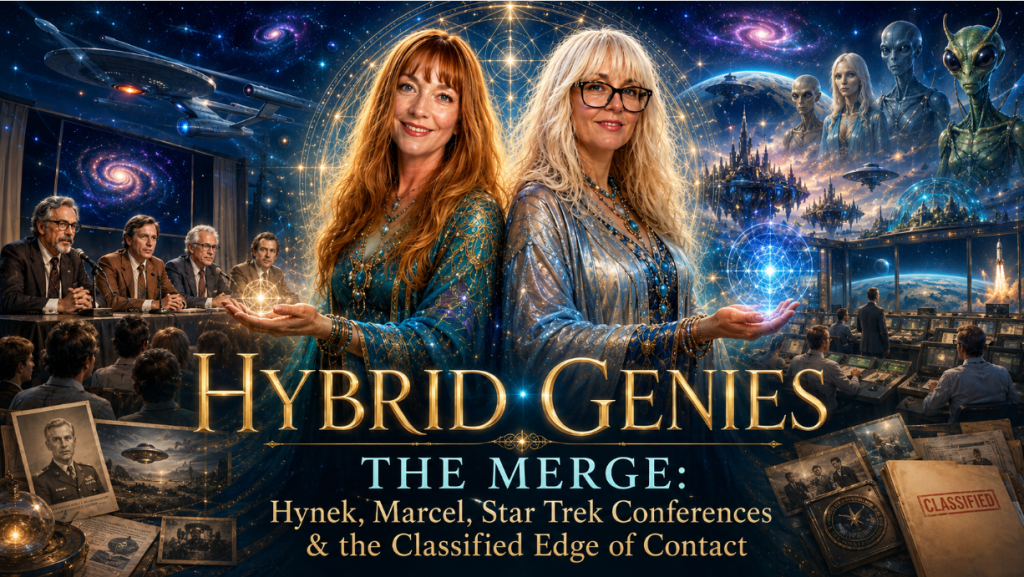
The Merge: Hynek, Marcel, Star Trek Conferences & the Classified Edge of Contact
Saturday, May 30, 2026
A Hybrid Genies Disclosure Conversation with Theresa J. Morris and Janet Kira Lessin
LIVE / RECORDING TIME
Saturday, May 30, 2026
11:00 AM HST | 2:00 PM Pacific | 3:00 PM Mountain | 4:00 PM Central | 5:00 PM Eastern | 10:00 PM UK
LAST WEEK’S SHOW
SHOW DESCRIPTION
On this episode of Hybrid Genies, Theresa J. Morris and Janet Kira Lessin explore The Merge — the charged intersection where experiencer memory, military secrecy, aerospace legacy, science fiction, psychic knowing, Secret Space Program testimony, and public disclosure begin to recognize one another.
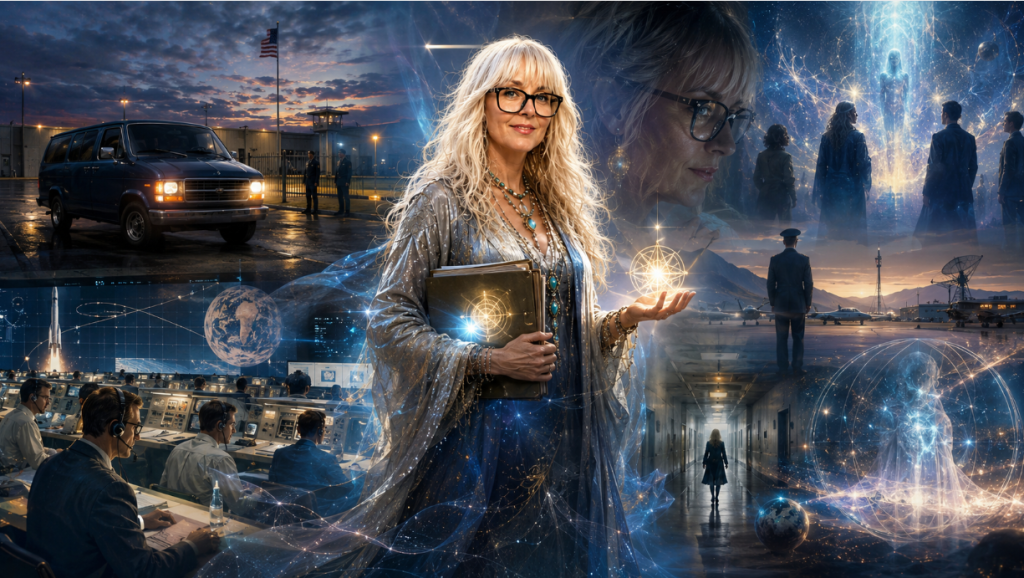
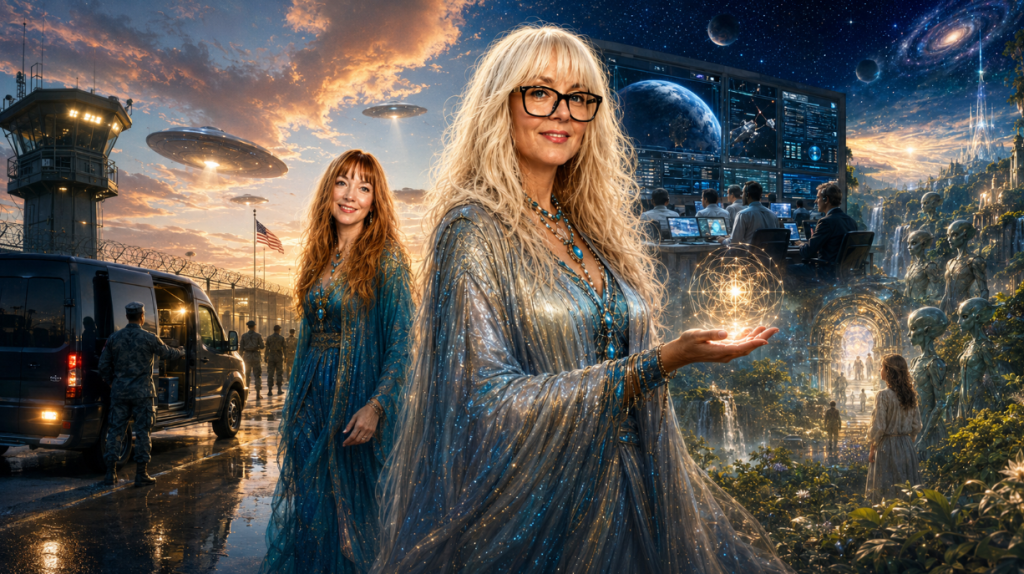
Theresa’s article, “The Merge: A Classified Journey,” opens with a Navy van, federal spaces, hidden assignments, Chris Kraft at NASA, Lowry Air Force Base, J. Allen Hynek, Jesse Marcel, Roswell lineage, and the deeper question of how witnesses preserve truth when proof remains fragmented, classified, psychic, symbolic, or buried inside memory. Theresa frames her life as a journey through visible and invisible assignments. She does not position herself as someone trying to prove every mystery in one sitting; she describes herself as a woman carrying a record, a signal, and a responsibility.
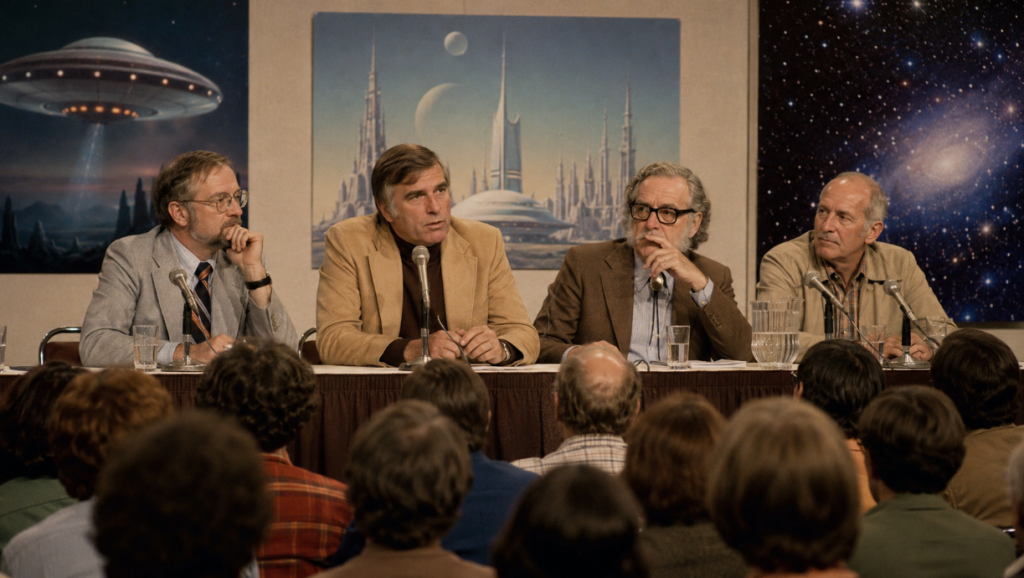
Janet brings another thread into the conversation: her memory of meeting Dr. J. Allen Hynek at early Star Trek conferences in the 1970s, especially during the New York City conference period around 1974 and 1975. Those gatherings brought Hynek, Gene Roddenberry, Robert Heinlein, Isaac Asimov, and other special guests into a cultural field where science fiction, UFO investigation, futurism, and early disclosure awareness converged.
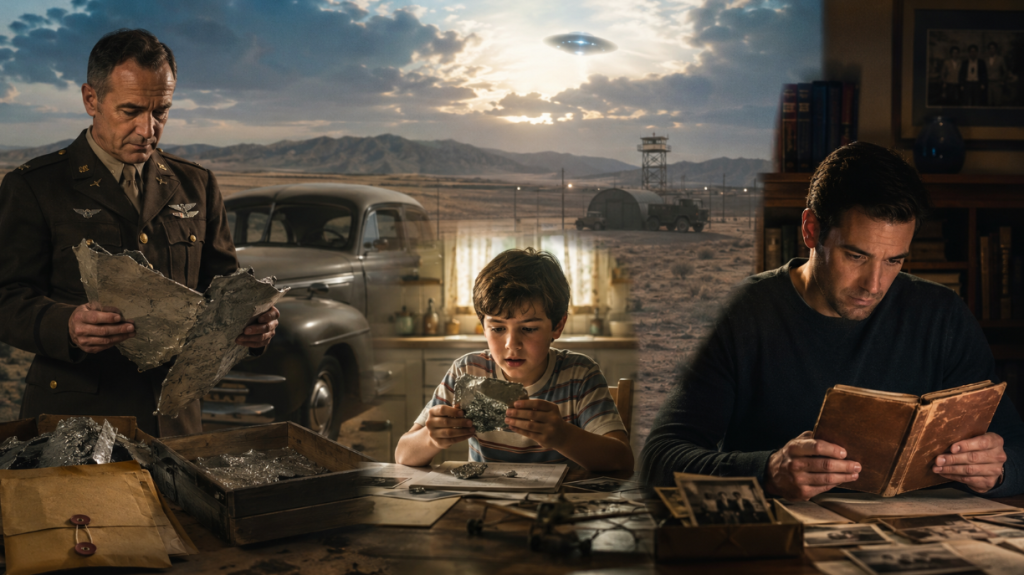
Together, Janet and Theresa ask whether those early Star Trek conferences were simply fan gatherings or early disclosure salons. Did Hynek serve as a scientific bridge between official investigation and experiencer testimony? Did the Marcel family preserve the Roswell wound across three generations?
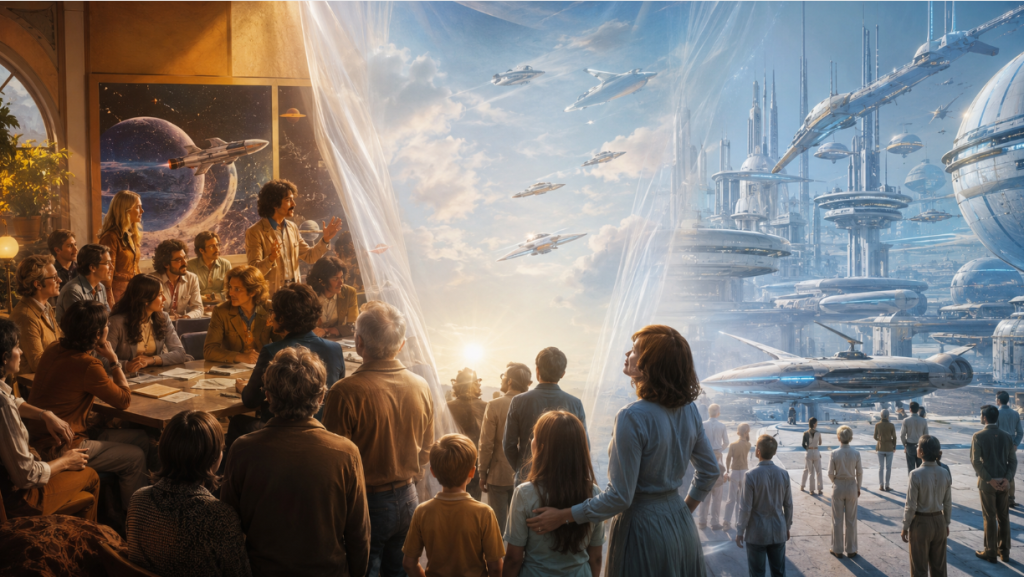
And if we listen to Secret Space Program whistleblowers, experiencers, military witnesses, and contactees, have part of humanity already reached the future Star Trek imagined, while the surface world still struggles to catch up?
FEATURED INTRODUCTION
They told us the truth must arrive through official channels.
Yet truth has always found other doors.
It came through dreams, military corridors, Navy vans, NASA offices, science fiction conventions, contact memories, family testimony, Roswell debris, the eyes of J. Allen Hynek, and experiencers who carried knowledge long before the world had language for it.
On this episode of Hybrid Genies, Theresa J. Morris and Janet Kira Lessin enter The Merge, the living field where science, memory, military secrecy, contact, culture, and cosmic intelligence overlap.
Theresa brings forward her classified and intuitive journey through federal spaces, Chris Kraft, Lowry Air Force Base, J. Allen Hynek, Jesse Marcel, and the lifelong sense that certain people recognized her role before she could explain it. Janet adds her own memory of meeting Hynek at early Star Trek conferences, where Roddenberry, Heinlein, Asimov, Hynek, and other future-facing voices helped seed a culture that could imagine contact before disclosure could speak openly.
This conversation honors witnesses, preservers, scientists, experiencers, storytellers, and families who carried fragments of the hidden record across generations.
THE MERGE: WHERE HIDDEN HISTORIES MEET
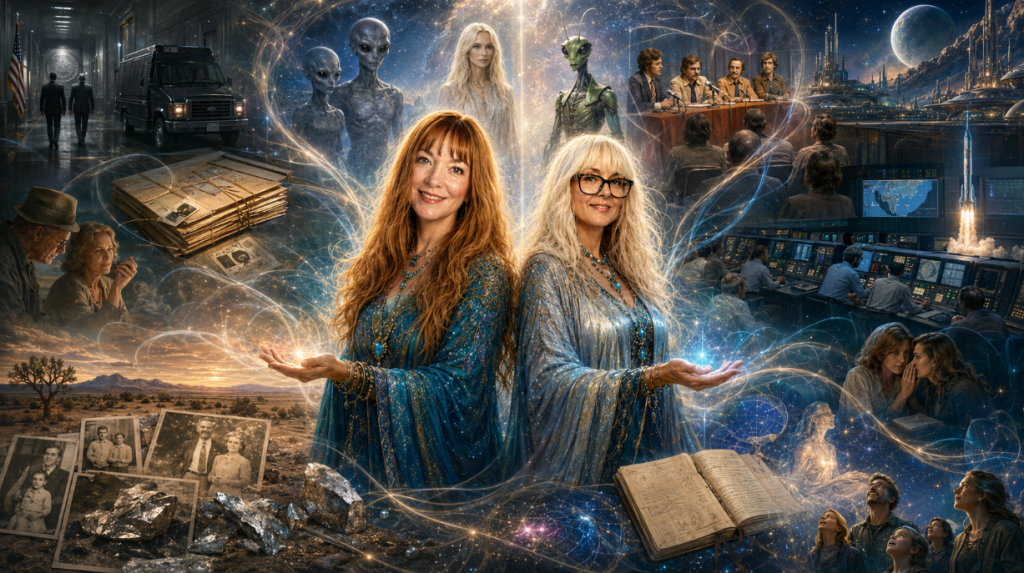
Theresa’s phrase “The Merge” gives this disclosure moment a useful name. The Merge does not point to one memory, one classified program, one UFO case, one military witness, or one science-fiction dream. It names the growing recognition that many streams of human experience may now be converging.
Military secrecy meets contact memory. Science fiction touches future history. Roswell family testimony enters the same room as the aerospace legacy. NASA culture brushes against private knowing. Star Trek’s imagined future intersects with claims about a Secret Space Program. Experiencers carry personal memory into collective testimony. Public disclosure meets private archives, whispered conversations, dreams, documents, and lifelong knowing.
This episode asks whether humanity has reached the moment when these separated streams can finally recognize one another.
HYNEK, STAR TREK, AND THE FUTURE WE DISCUSSED
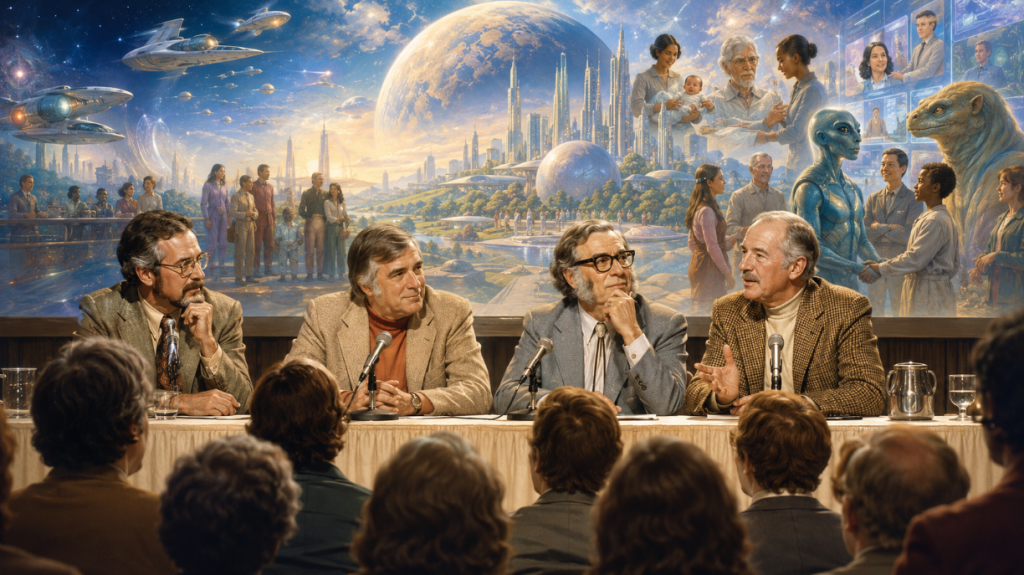
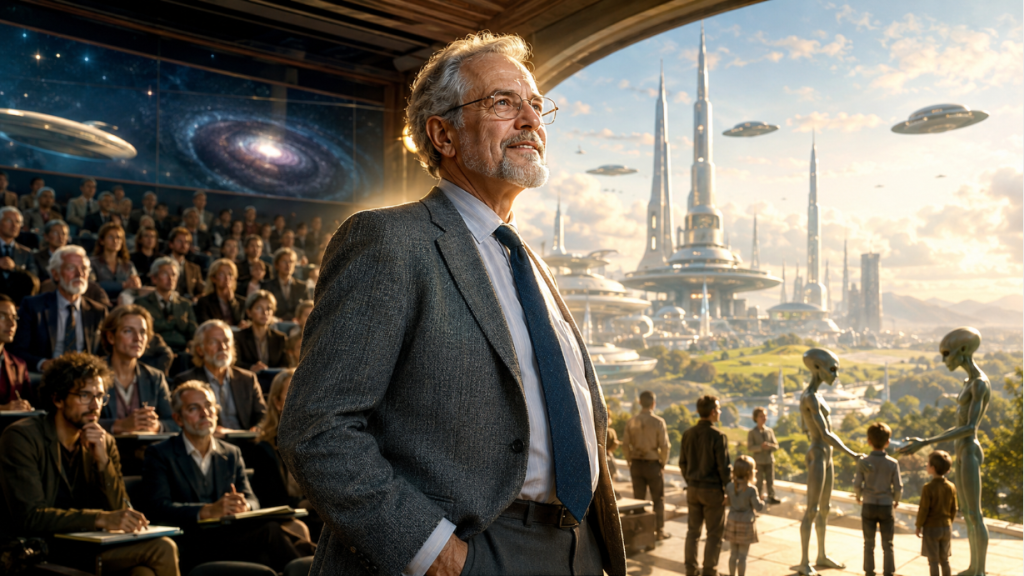
When J. Allen Hynek appeared at Star Trek panels in the 1970s, the conversation did not stop with flying saucers. People asked what humanity might become.
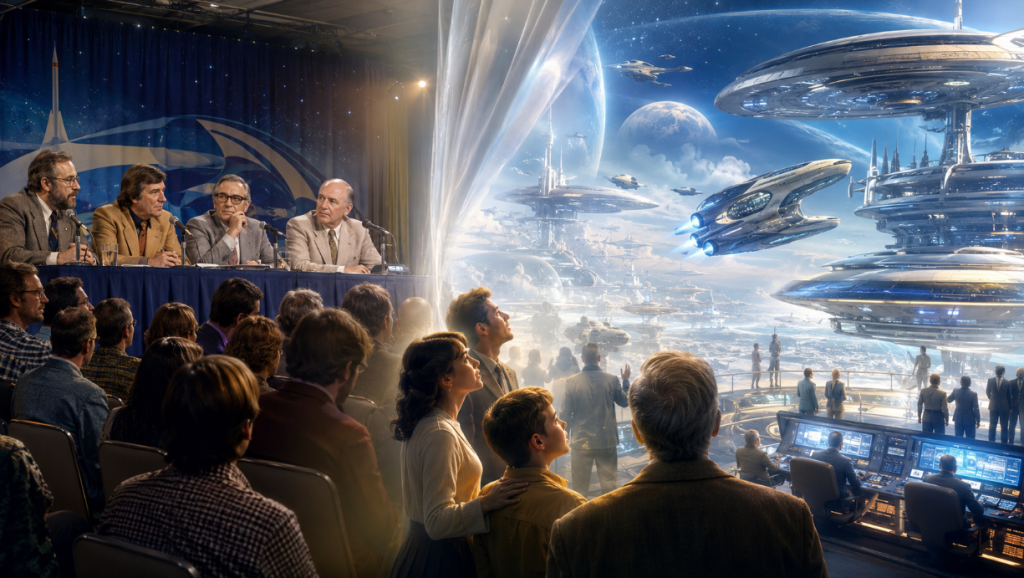
Janet remembers those panels as places where audiences explored what Earth could look like if humanity matured beyond war, secrecy, tribalism, and fear. Star Trek: The Original Series imagined planetary unity, interstellar travel, peaceful exploration, advanced medical technology, universal translation, and cooperation among many kinds of beings.
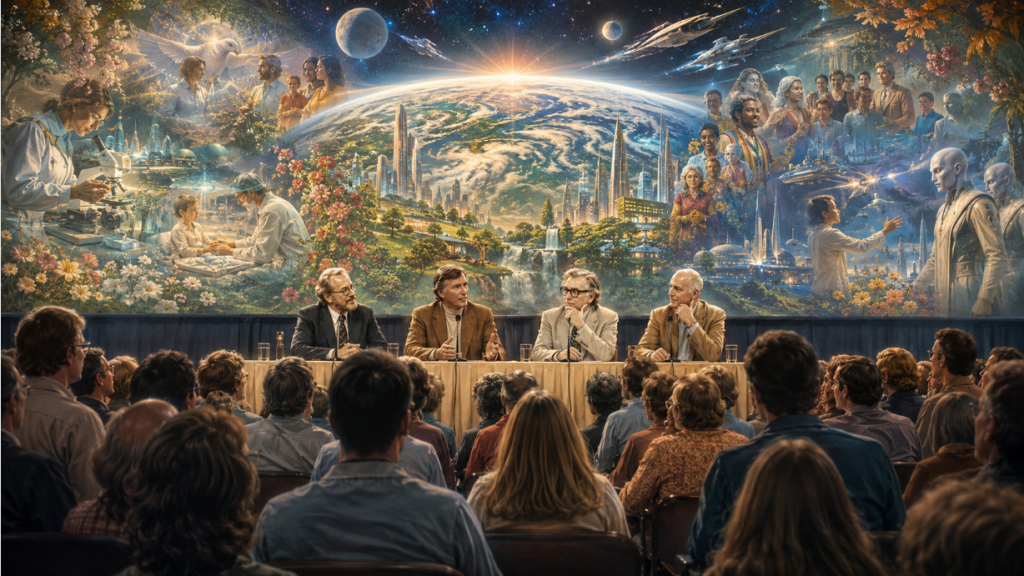
Our public world has not fully reached that Star Trek future.
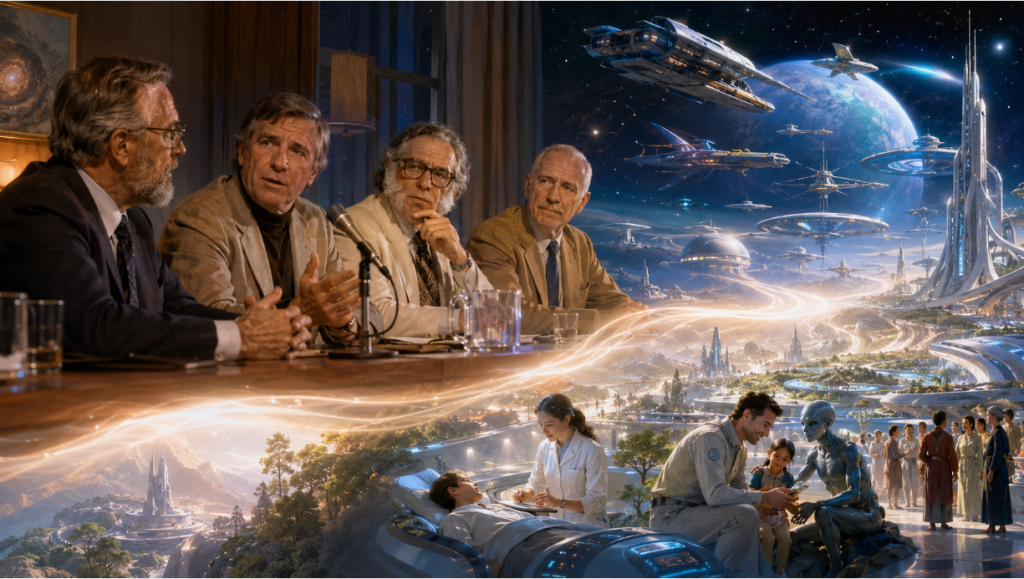
Yet Secret Space Program whistleblowers, contactees, experiencers, abductees, remote viewers, military insiders, and aerospace witnesses tell stories that suggest another possibility. Perhaps parts of humanity crossed that threshold behind the classified veil while the surface world remained locked in older conflicts.
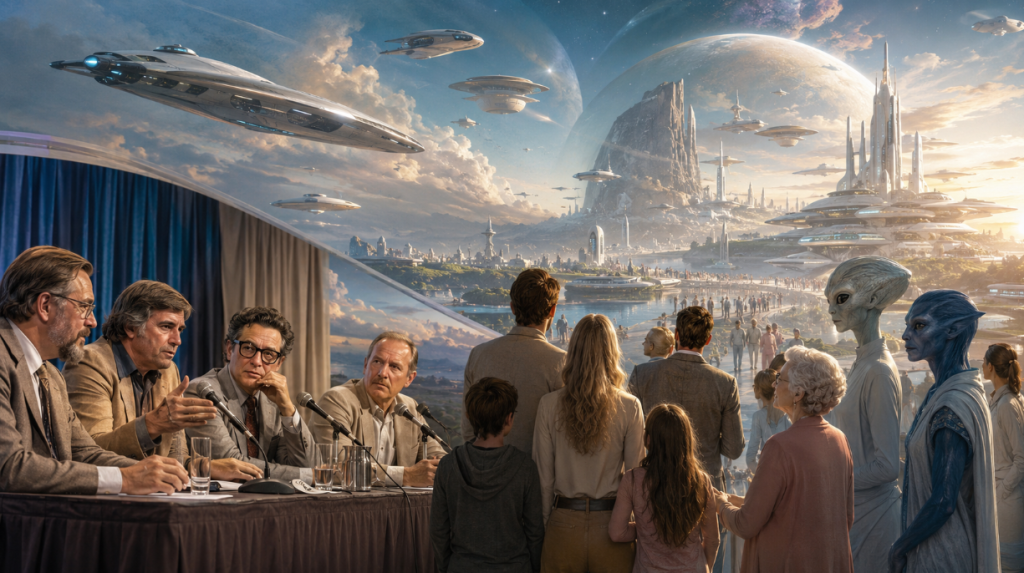
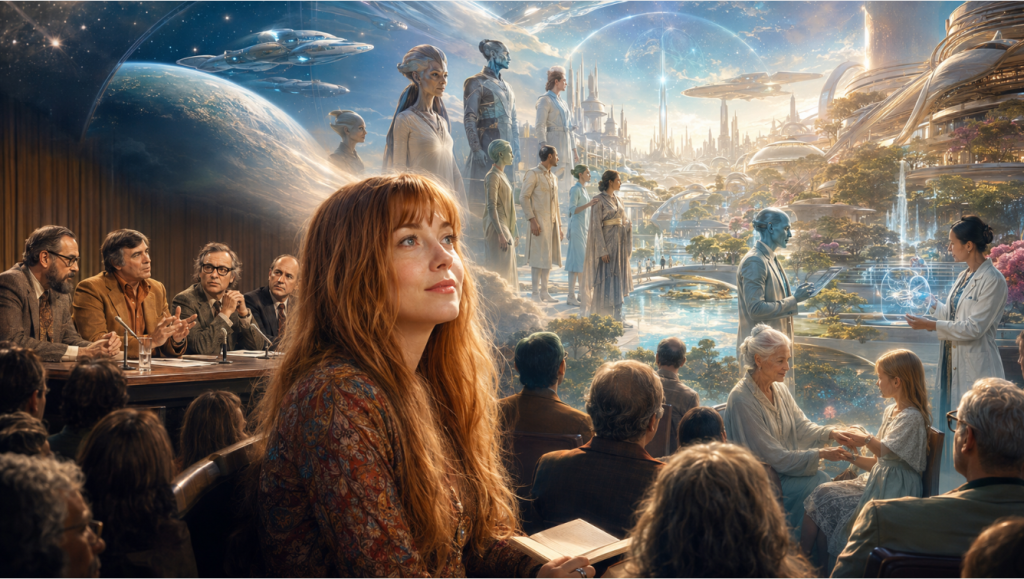
This episode asks whether disclosure entails reconciling two futures: the public future that Star Trek promised, and the hidden future that some witnesses say already exists.
DR. J. ALLEN HYNEK: SCIENTIST AT THE THRESHOLD
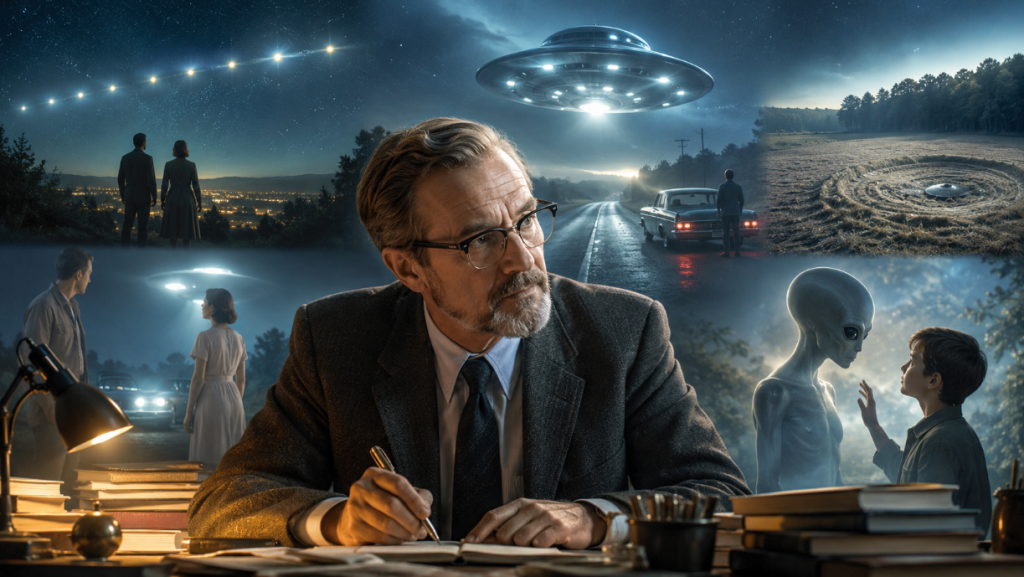
Dr. J. Allen Hynek — properly spelled Josef Allen Hynek — was an astronomer, professor, and one of the most important scientific figures in UFO research. He served as a scientific consultant to official U.S. Air Force UFO investigations, including Project Blue Book, and later became known for developing the Close Encounter classification system, which gave public language to UFO and contact experiences.
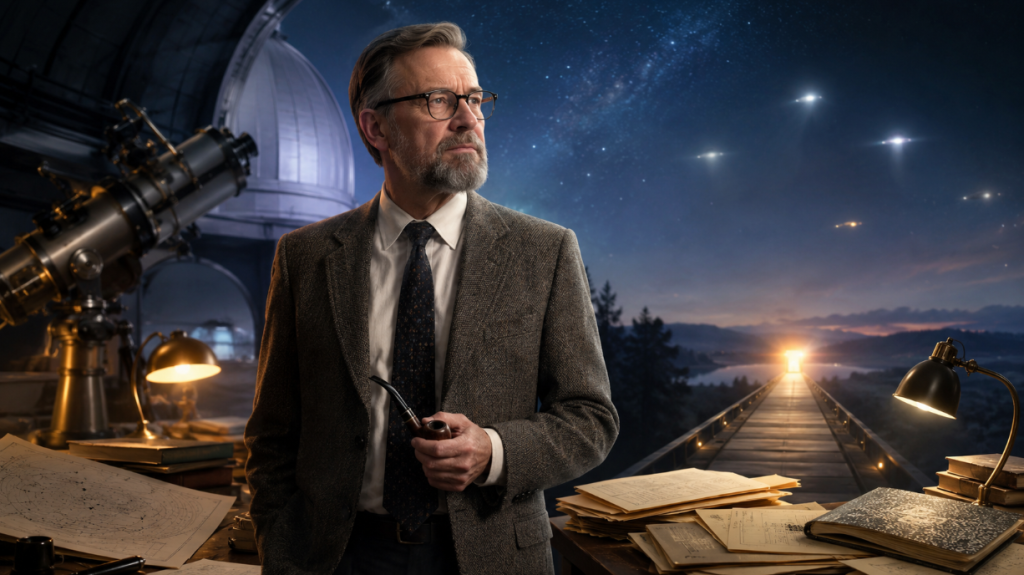
Hynek began as a cautious scientist who often looked for conventional explanations. Over time, however, he concluded that some UFO cases deserved serious scientific investigation rather than ridicule or dismissal. His journey from a skeptical consultant to a careful, open-minded investigator made him a rare bridge between official science and the witness community.
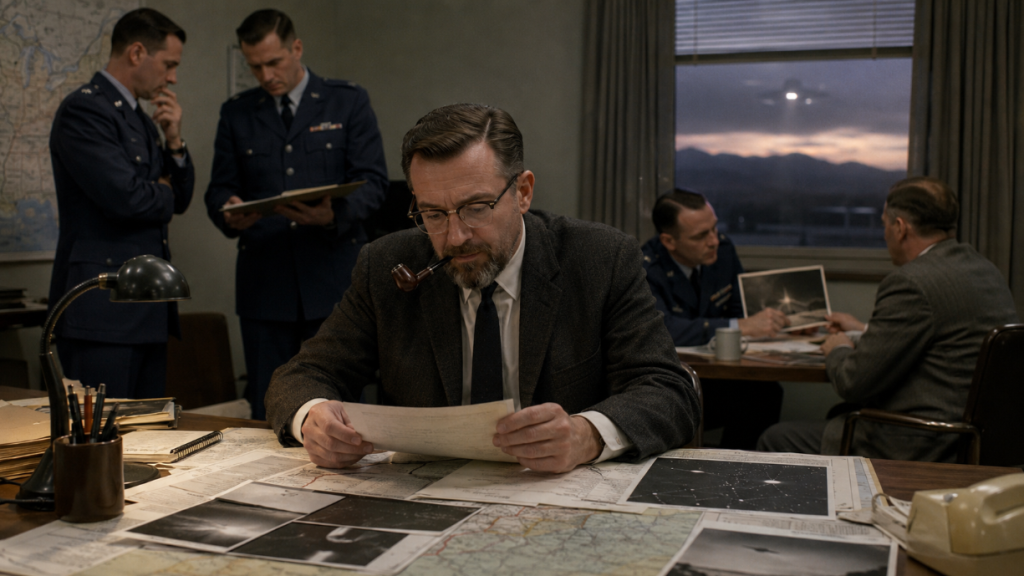
For Hybrid Genies, Hynek matters because he marks a pivotal threshold. Through him, the UFO subject moved beyond rumor, ridicule, pulp entertainment, and fringe speculation. Through Hynek, the phenomenon gained scientific vocabulary. Through experiencers, it gained a human voice. Through Star Trek and science fiction culture, it gained an imaginative vision of the future.
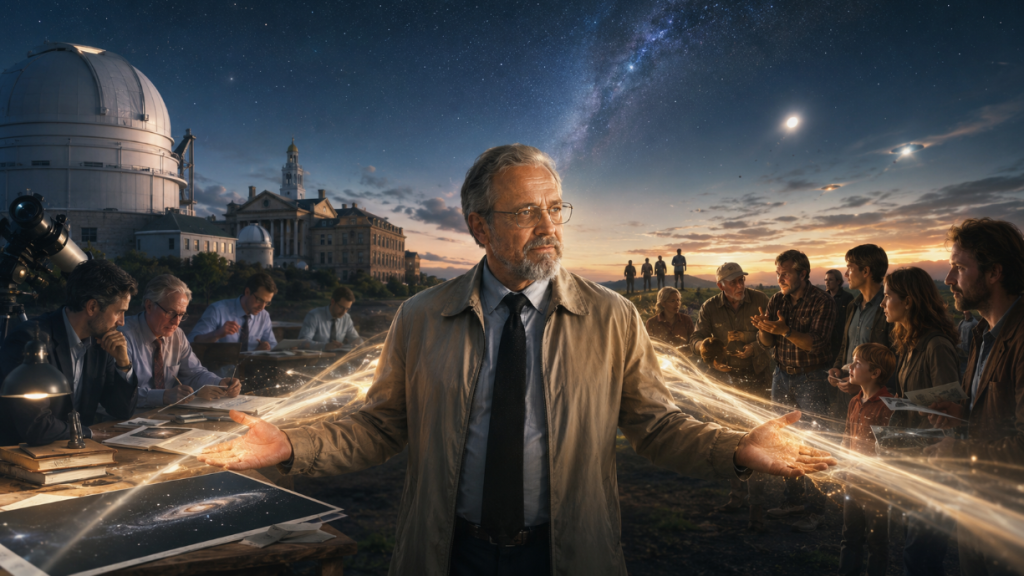
Hynek’s presence at Star Trek-era panels also matters because those gatherings did more than celebrate fandom. They brought futurists, scientists, writers, contact-minded audiences, and seekers into one room at a time when mainstream institutions still struggled to discuss the possibility of nonhuman intelligence with maturity.
JANET’S HYNEK CONNECTION
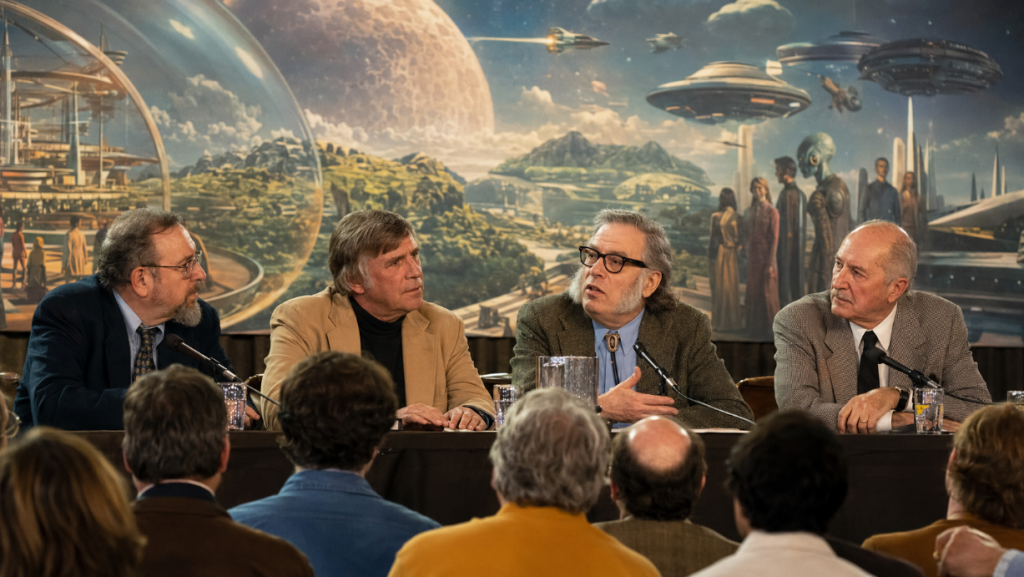
Janet Kira Lessin remembers meeting J. Allen Hynek at early Star Trek conferences in the 1970s, especially during the New York City conference period around 1974 and 1975. For Janet, those gatherings were not merely entertainment or fan celebrations. They served as early spaces for disclosure, where the future spoke through science fiction, UFO research, speculative science, astronomy, and humanity’s longing for cosmic kinship.
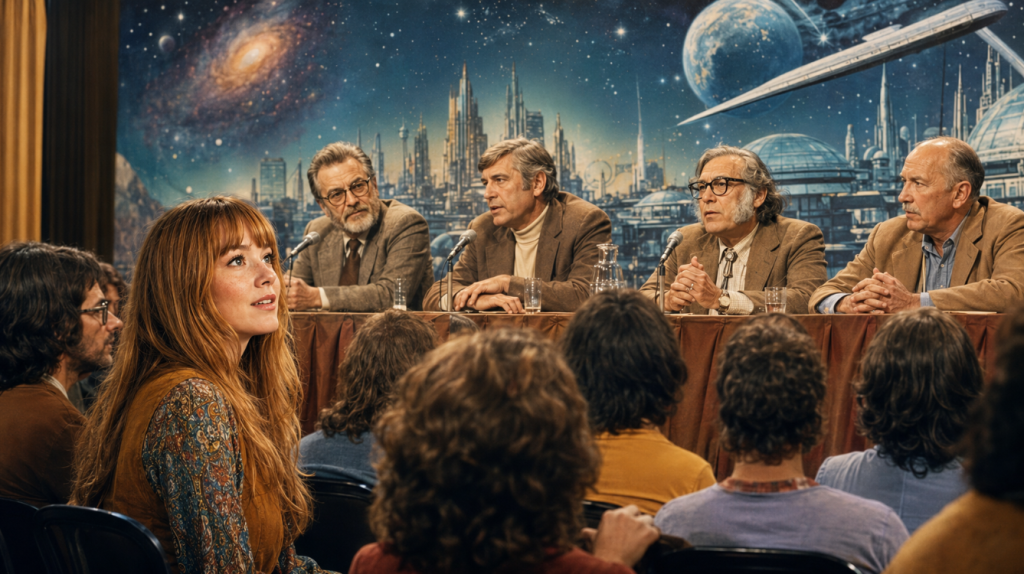
Gene Roddenberry gave humanity a future in which diverse beings could serve together in peace. Robert Heinlein and Isaac Asimov expanded the intellectual imagination of spacefaring civilization. Hynek brought scientific seriousness to the UFO question. Experiencers brought memory, emotion, contact, and witness.
Those conferences helped people ask a larger question:
What kind of species must humanity become before open contact can truly occur?
THE STAR TREK DISCLOSURE BRIDGE
Star Trek did more than entertain. It gave humanity rehearsal space.
It allowed audiences to imagine a future in which Earth no longer organized itself around endless war. It pictured humans serving beside beings from other worlds. It normalized starships, universal translators, nonhuman intelligence, advanced medicine, planetary unity, and the moral responsibility that comes with technological power.
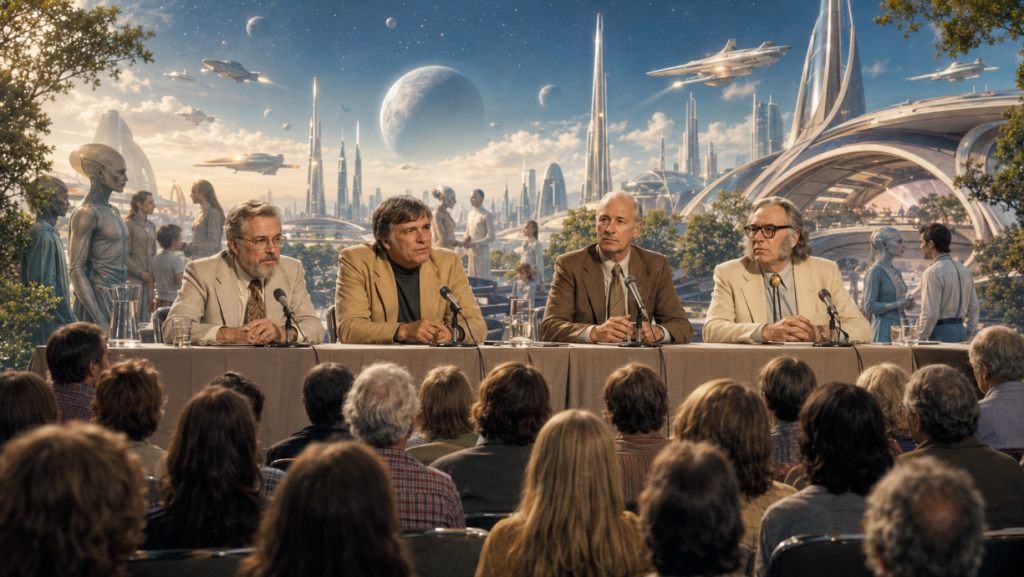
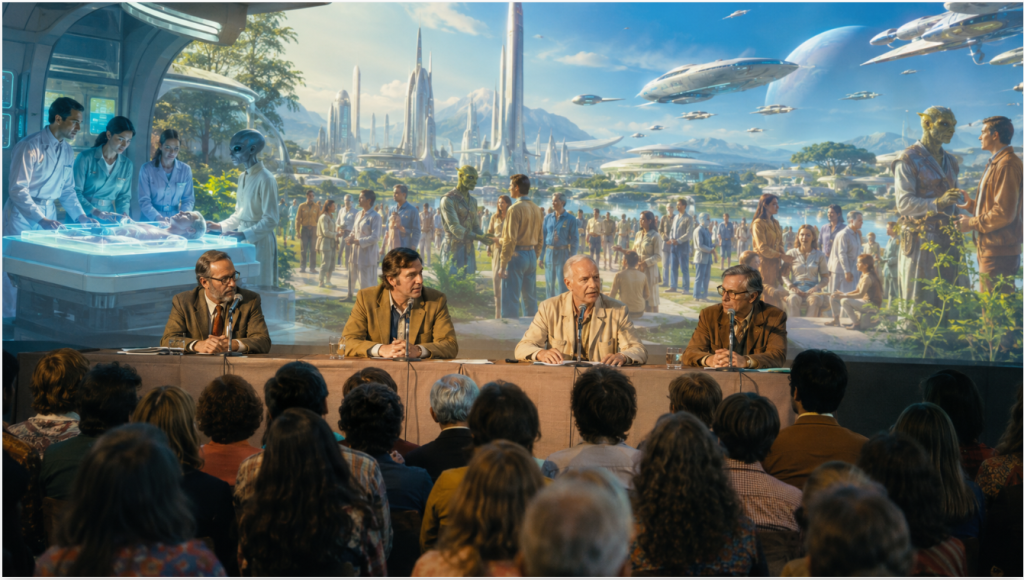
When Hynek, Roddenberry, Heinlein, Asimov, and special guests appeared in the same cultural atmosphere, they helped create a bridge.
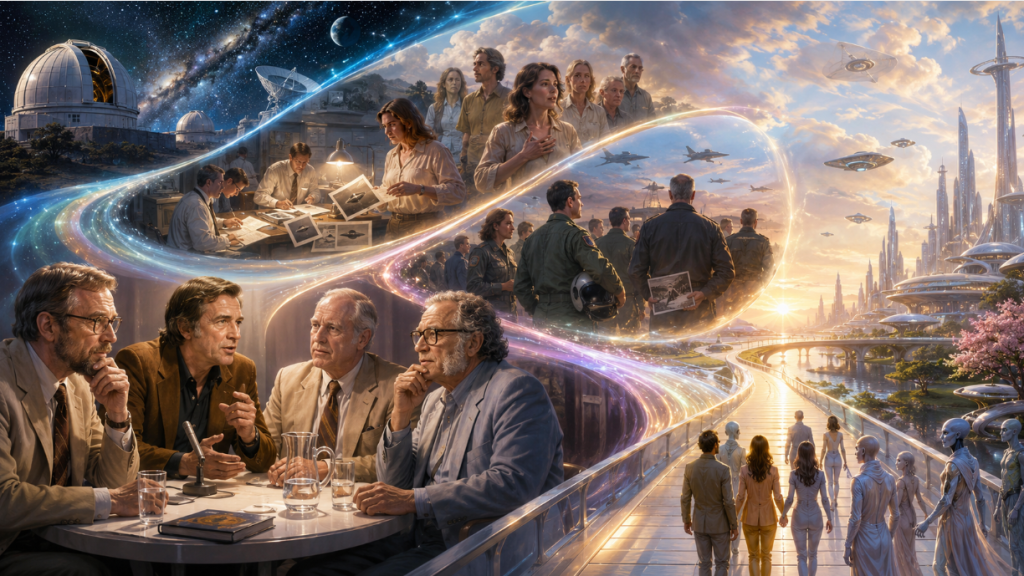
Science fiction offered hope. UFO research brought evidence and mystery. Astronomy offered scale. Contactees contributed their lived experience. Military witnesses carried fragments of hidden history.
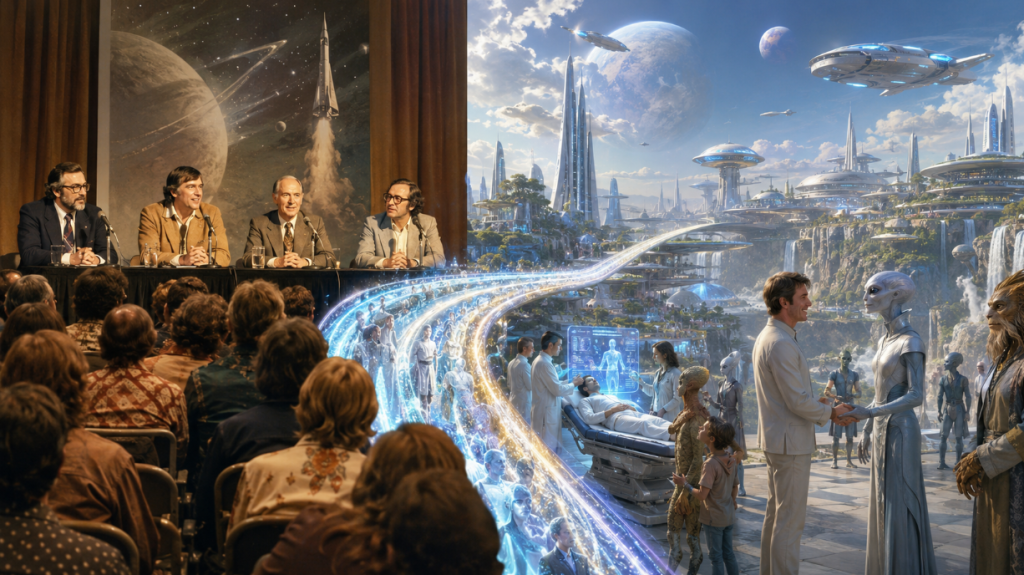
Together, these streams prepared public consciousness for disclosure before governments could speak plainly.
THE THREE GENERATIONS OF JESSE MARCELS
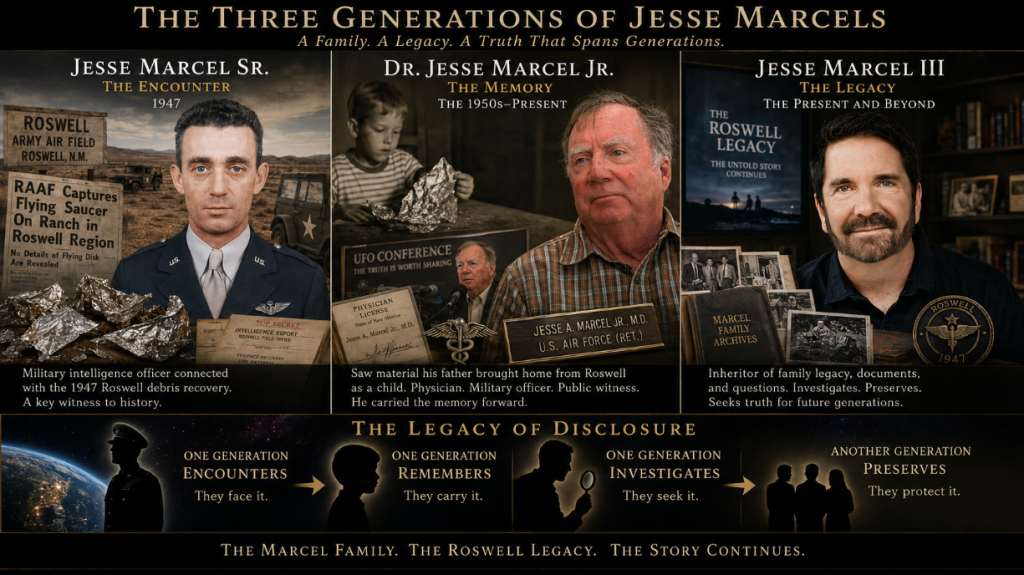
The Marcel family stands at the center of the Roswell legacy.
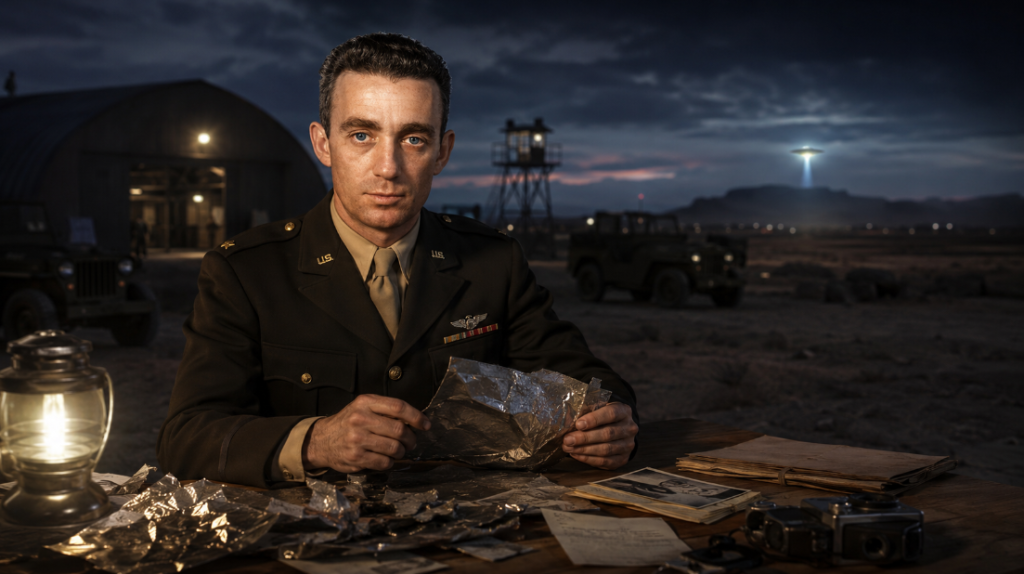
Jesse Marcel Sr. served as the military intelligence officer connected with the 1947 Roswell debris recovery. He became one of the key figures associated with the original event and the later controversy over what the military recovered, what officials displayed publicly, and what may have remained hidden.
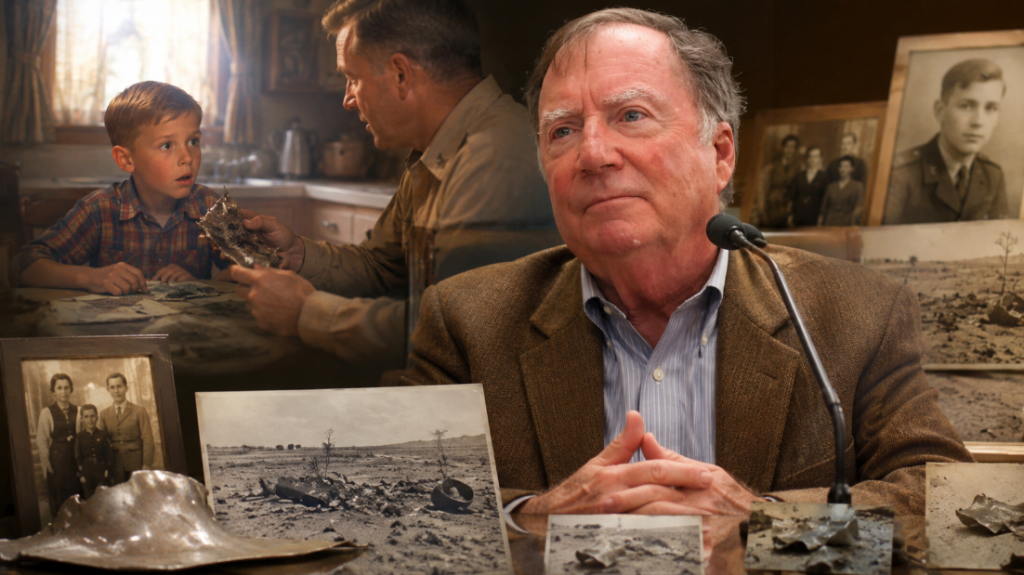
Dr. Jesse Marcel Jr. was the son of Jesse Marcel Sr. As a child, he saw material his father brought home from the Roswell debris field. He later became a physician, military officer, and public witness who carried the family memory into the modern UFO conversation.
Jesse Marcel III represents the third generation: the inheritor of family legacy, memory, questions, documents, and the burden of deciding what people can still recover from one of the most contested events in American UFO history.
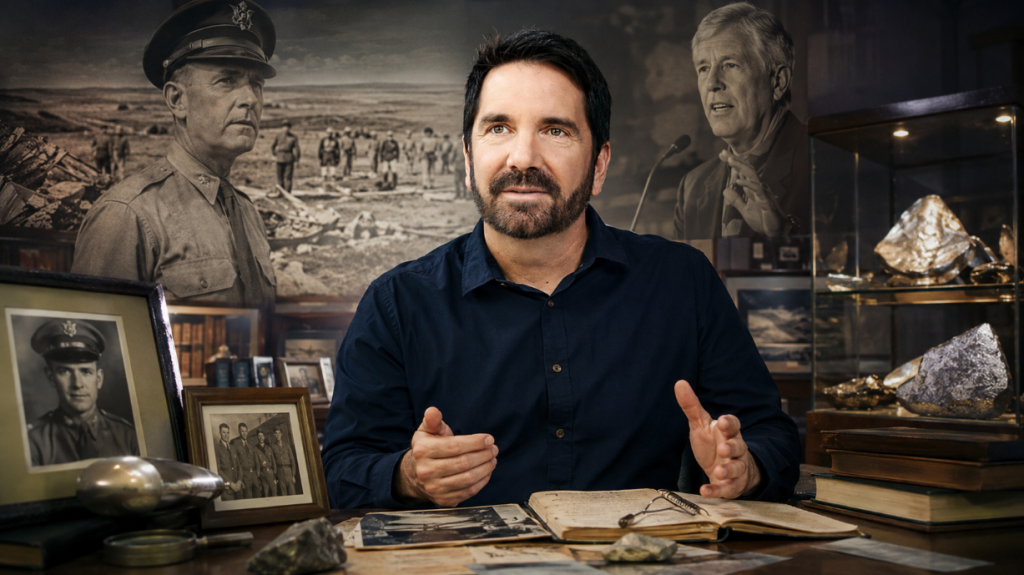
For this episode, the three Marcels represent more than one famous case. They show how disclosure moves through families: from event to memory, from memory to legacy, and from legacy to preservation.
One generation encounters.
One generation remembers.
One generation investigates.
Another generation preserves.
ROSWELL AS FAMILY MEMORY
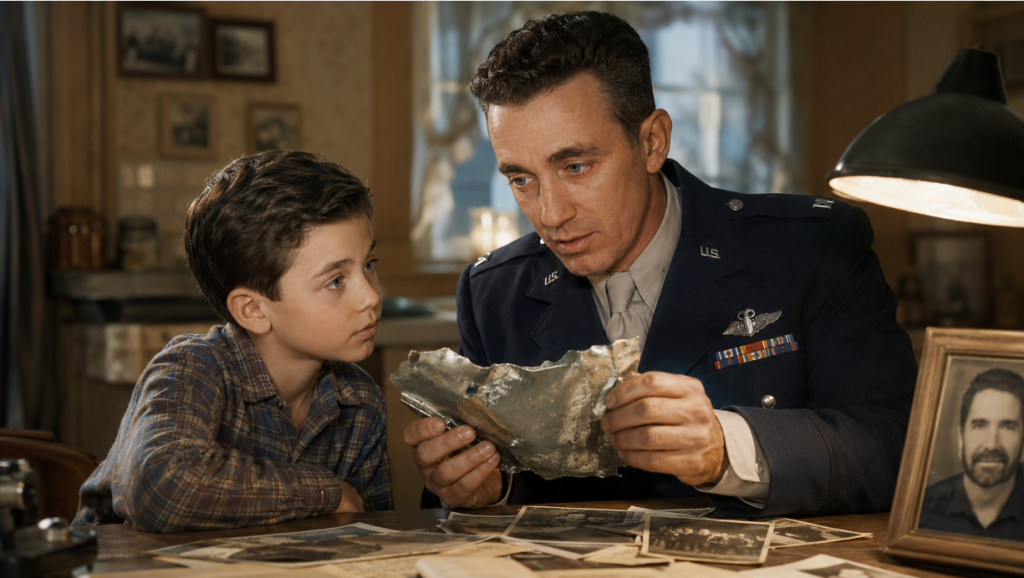
The Roswell story did not live only in documents. It lived in a family.
Jesse Marcel Sr. carried the original military burden. Jesse Marcel Jr. carried the childhood memory and later offered public testimony. Jesse Marcel III inherited the legacy and the question of what remains to be recovered.
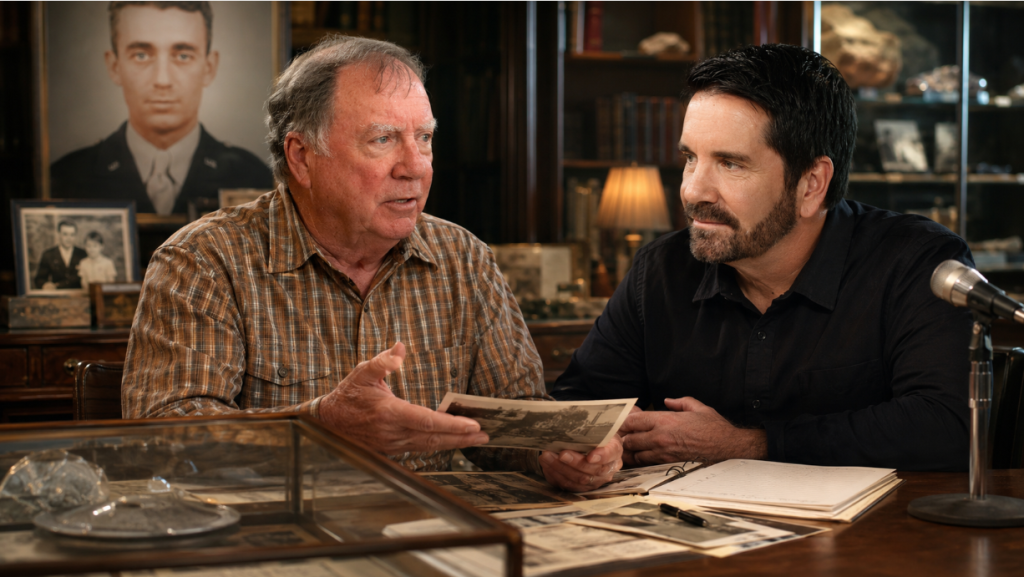
This three-generation pattern matters because many experiencer families carry similar transmissions. One generation sees something. Another remembers. Another doubts, asks, researches, dreams, or finally speaks. Families become archives. Homes become hidden museums. Memories become sacred burdens.
Theresa’s conversation with Jesse Marcel opens a question at the heart of this episode:
What happens when a family becomes an archive?
THERESA’S ARTICLE: “THE MERGE”
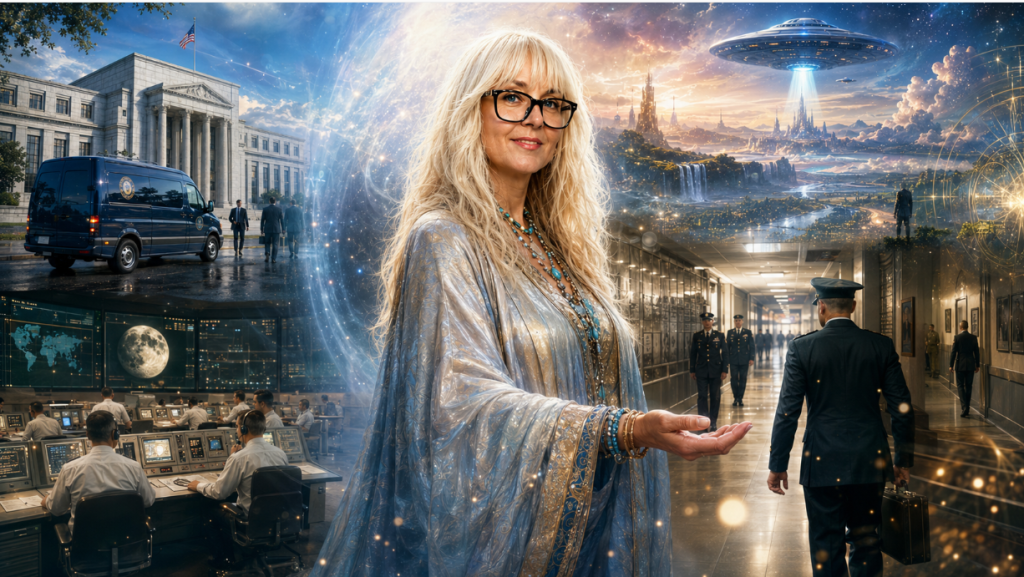
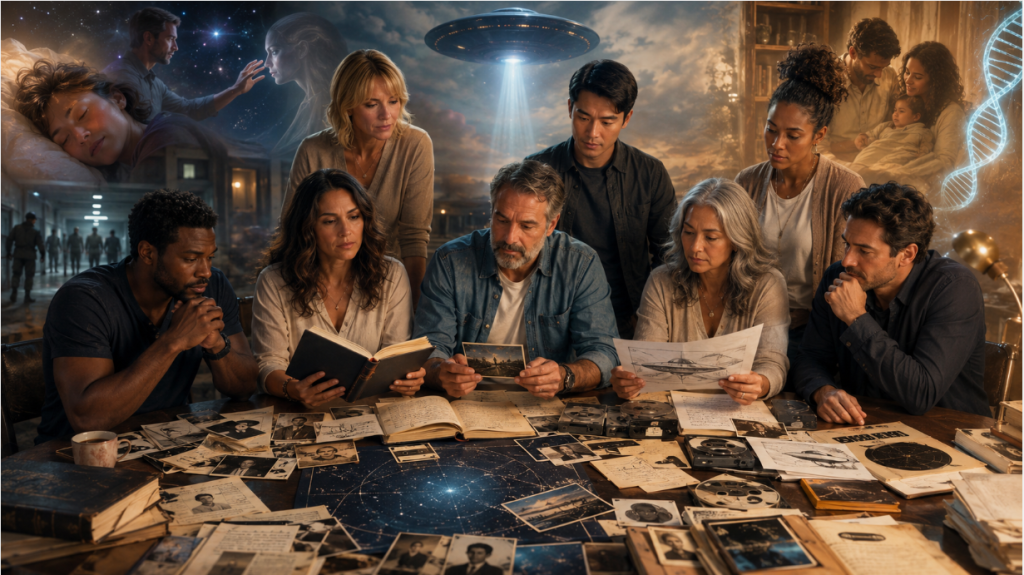
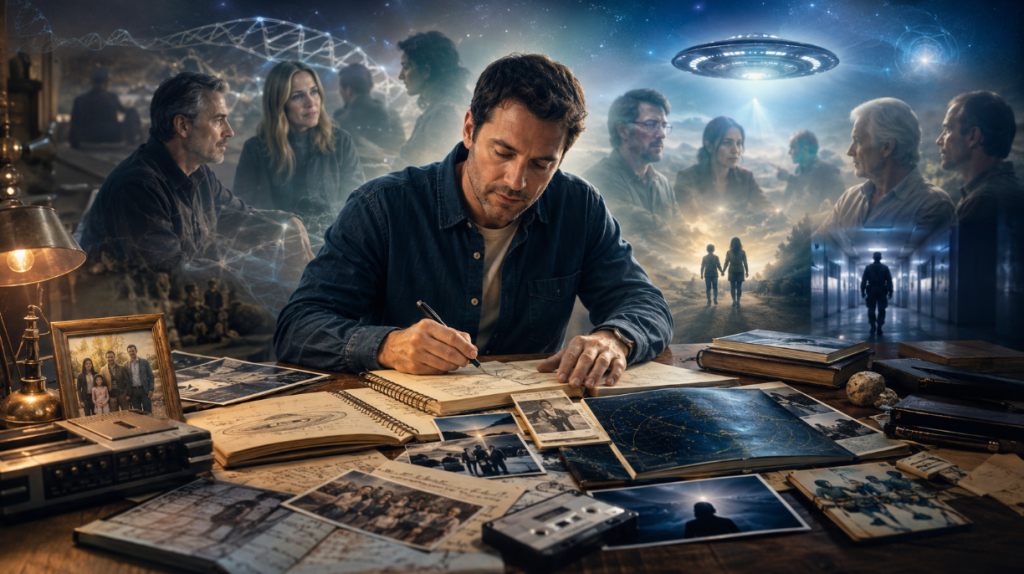
Theresa J. Morris’s article “The Merge: A Classified Journey” frames her life as a journey through visible and invisible assignments. She describes the Navy van, federal spaces, Chris Kraft at NASA, Lowry Air Force Base, J. Allen Hynek, Jesse Marcel, Roswell lineage, and the sense that certain people recognized her role before there was public language for it.
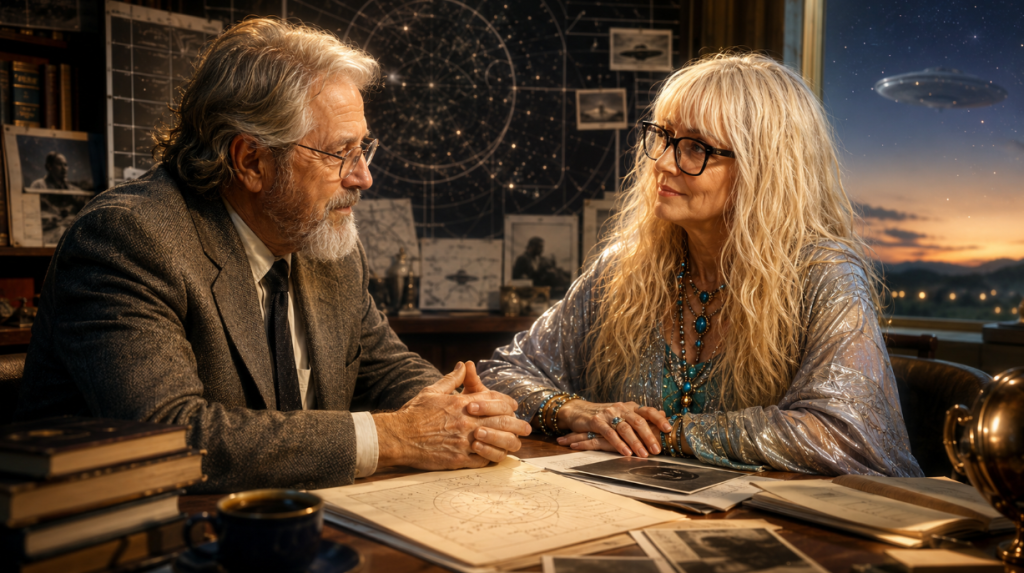
In Theresa’s telling, truth was never fiction; it was hidden. She describes herself as a bridge, a traveler, and someone who carries frequencies others cannot measure. Her meeting with Hynek becomes a moment of recognition rather than an ordinary introduction.
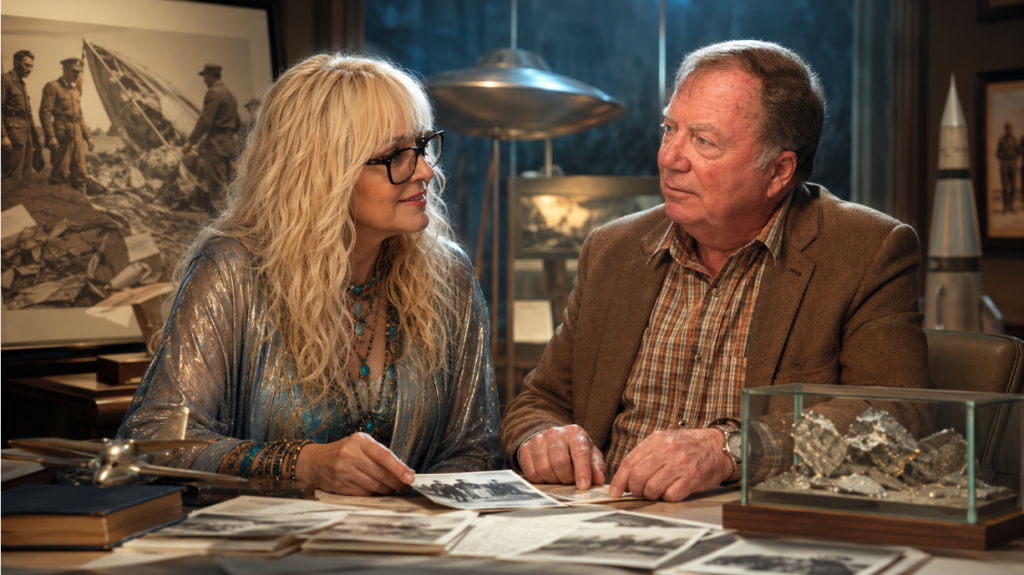
Her conversation with Jesse Marcel becomes another threshold, where psychic memory, aerospace logic, Roswell legacy, and unspoken mystery meet with mutual respect.
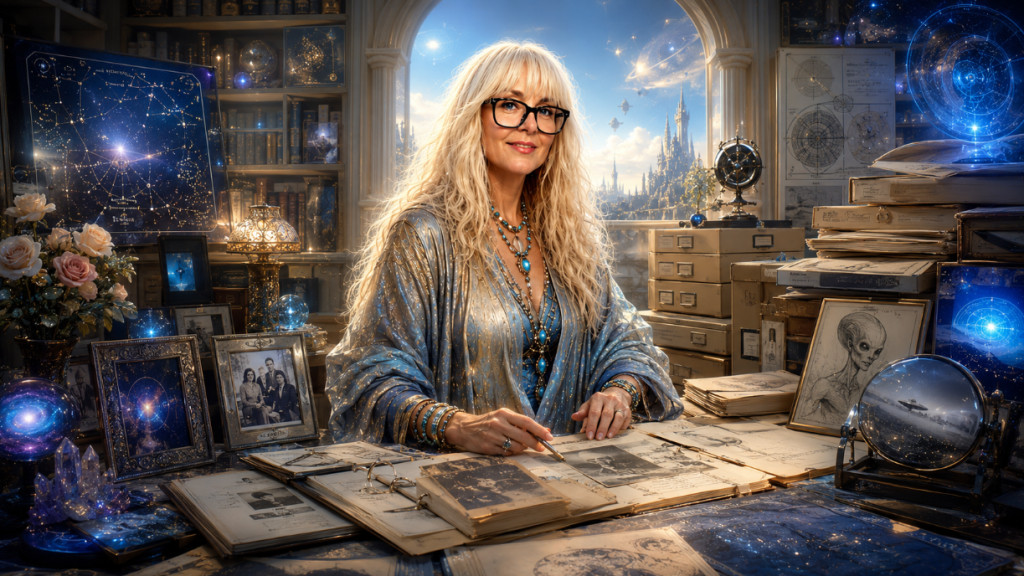
The heart of Theresa’s piece does not lie in the need to prove everything at once. It lies in the deeper commitment to preserve what she has carried.
That is why one of the article’s strongest lines belongs at the center of this show:
“I am not here to prove. I am here to preserve.”
EXPERIENCERS AS LIVING ARCHIVES
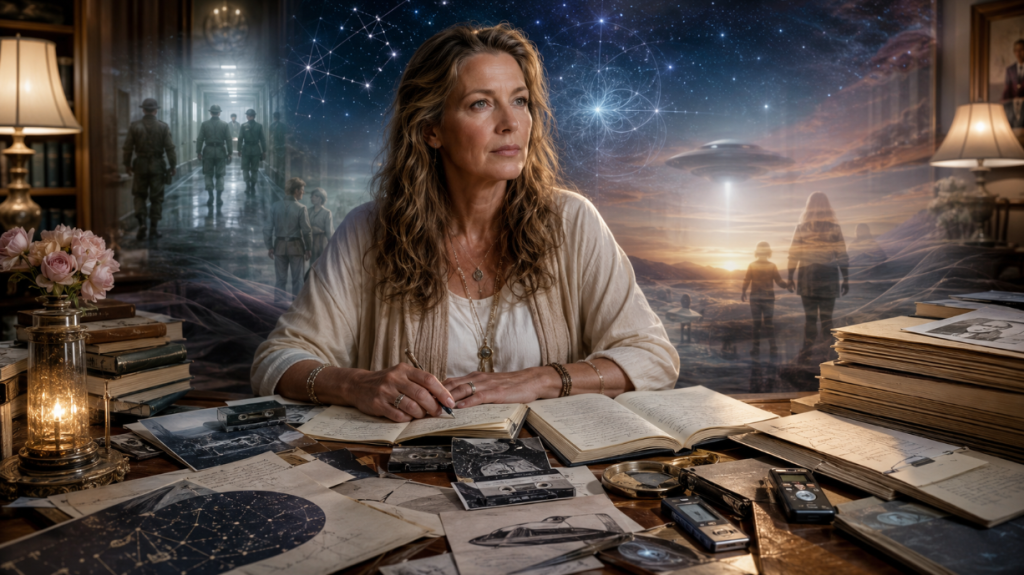
The demand for proof can silence witnesses when the experience involves dreams, telepathy, classified spaces, altered memory, missing time, symbolic communication, interdimensional perception, family secrecy, or military compartmentalization.
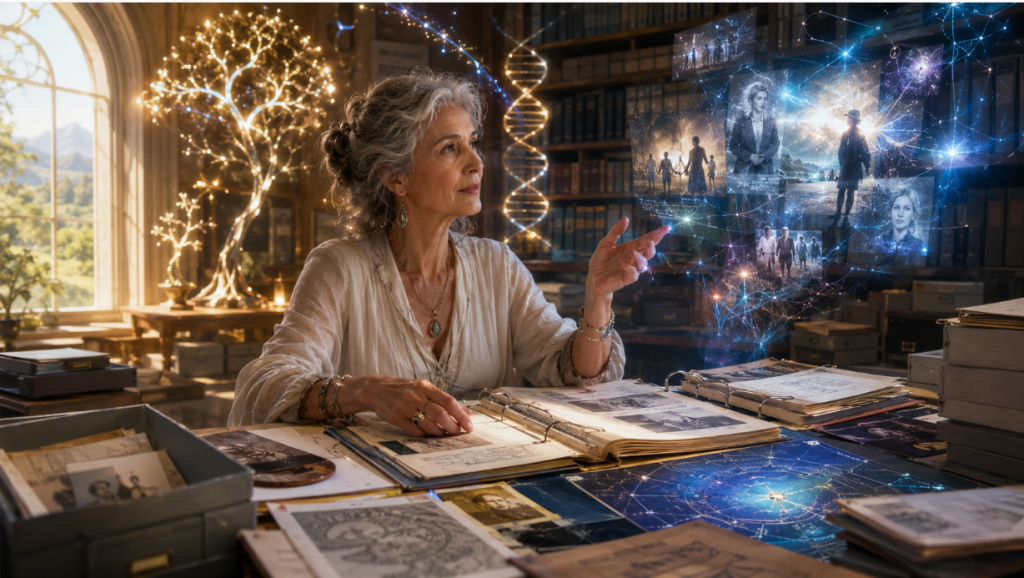
Yet preservation matters.
Stories can be compared. Patterns can be tracked. Witnesses can be protected. Memories can be respected. Archives can be built.
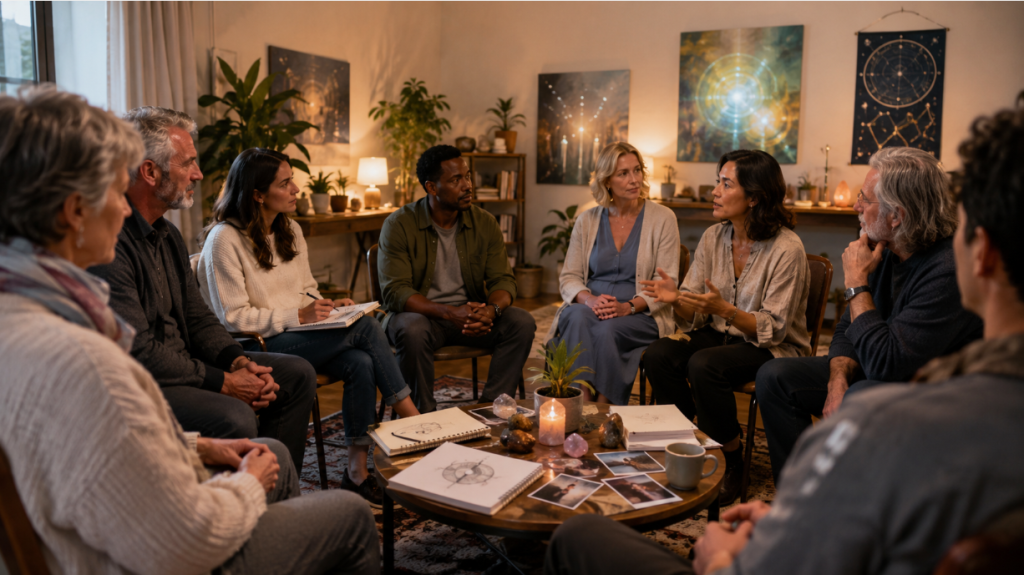
Hybrid Genies honors a witness-centered approach. We do not need to force every mystery into premature certainty. We can preserve the record, compare patterns, and protect experiencers as humanity grows in its capacity to understand.
Experiencers may be living archives — not perfect machines, court transcripts, or simple data files, but human carriers of encounters history has not yet learned how to hold.
SECRET SPACE PROGRAM TESTIMONY AND THE STAR TREK FUTURE
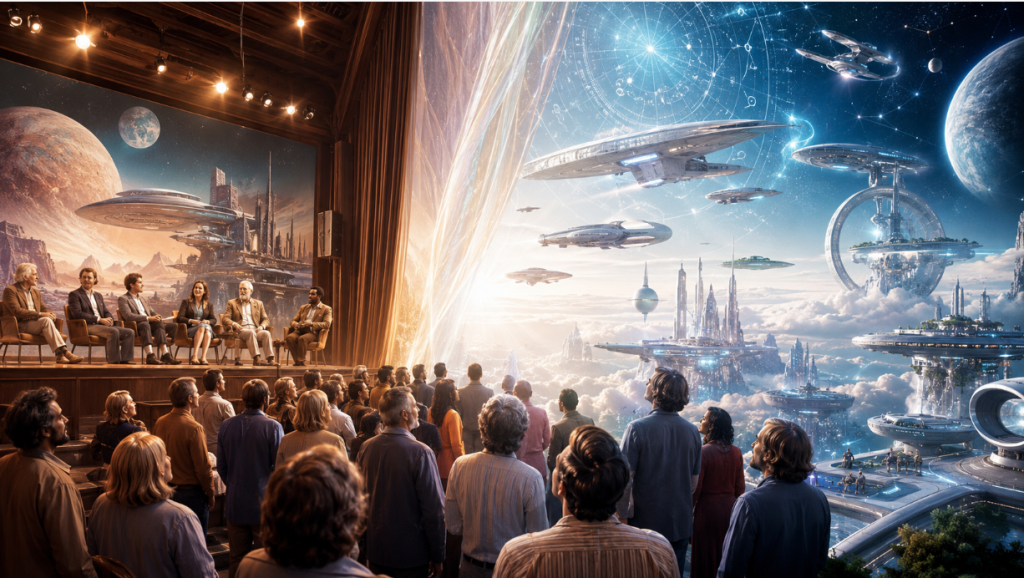
One of the most provocative questions in this episode concerns the gap between the future Star Trek imagined and the surface world we inhabit now.
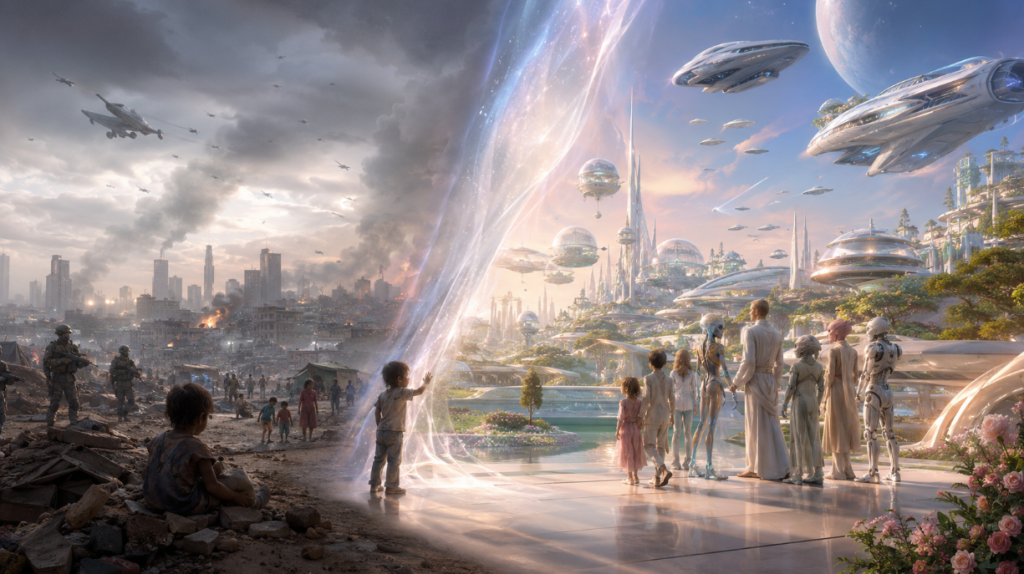
By the standards of Star Trek: The Original Series, humanity should have moved toward planetary unity, interstellar exploration, advanced medicine, and open cooperation with other beings. Instead, the public world still struggles with war, secrecy, poverty, ecological crisis, technological inequality, and political division.
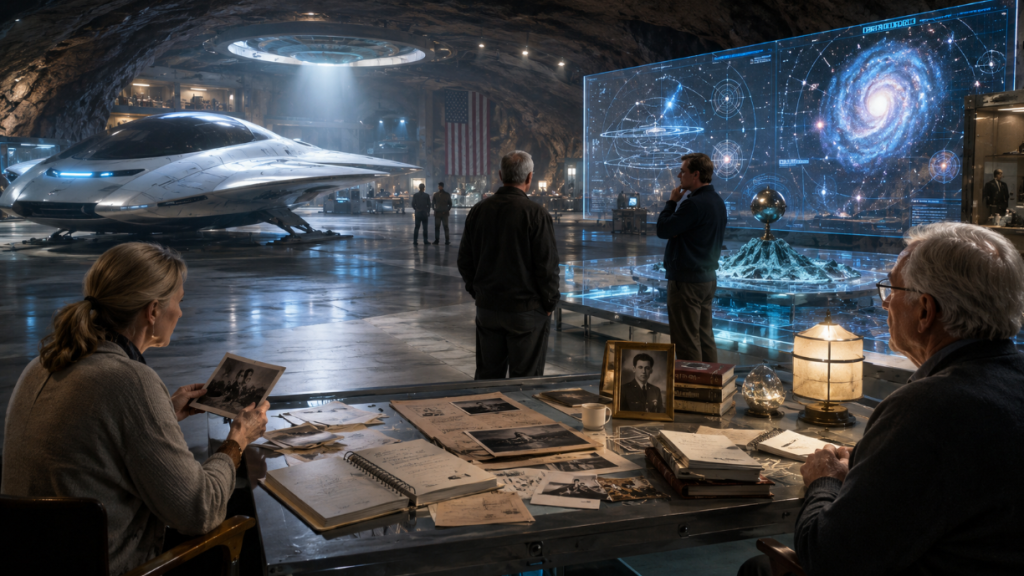
Yet Secret Space Program whistleblowers and related experiencer narratives describe hidden technologies, off-world operations, advanced craft, orbital stations, classified space programs, contact with nonhuman civilizations, and a split between public history and covert development.
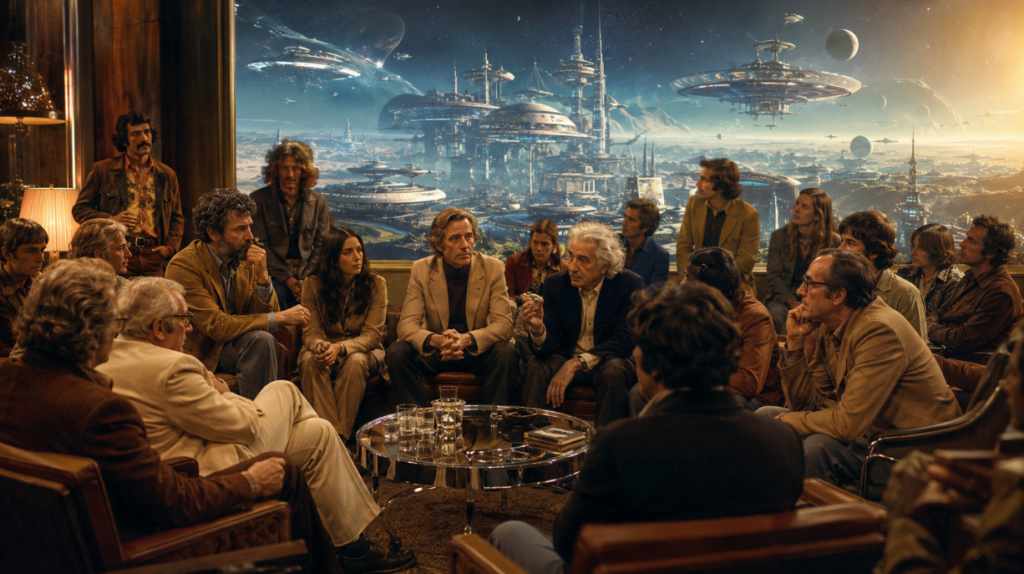
This episode does not ask every listener to accept every testimony literally. It asks a larger pattern question:
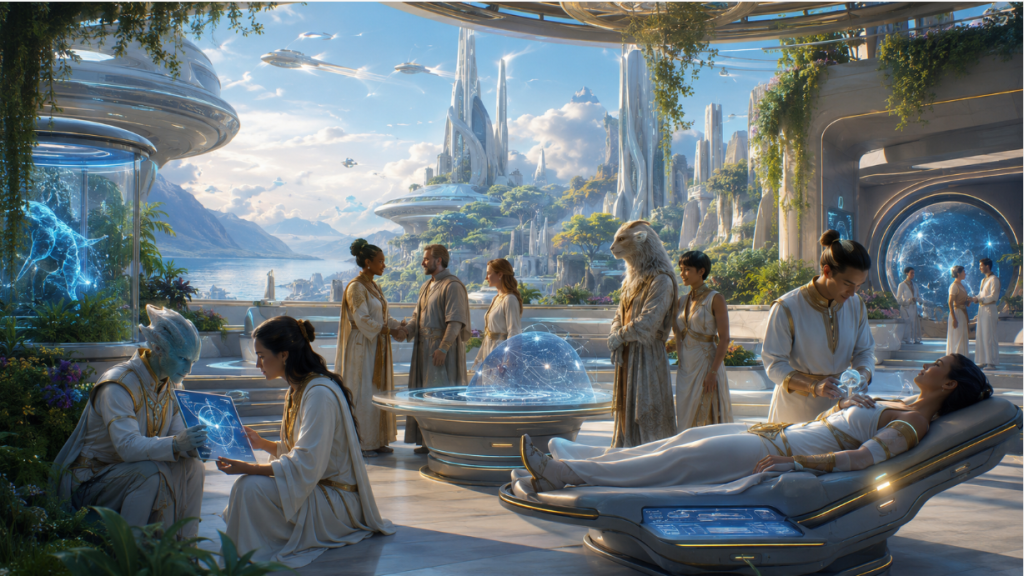
What if humanity’s future is not absent, but hidden?
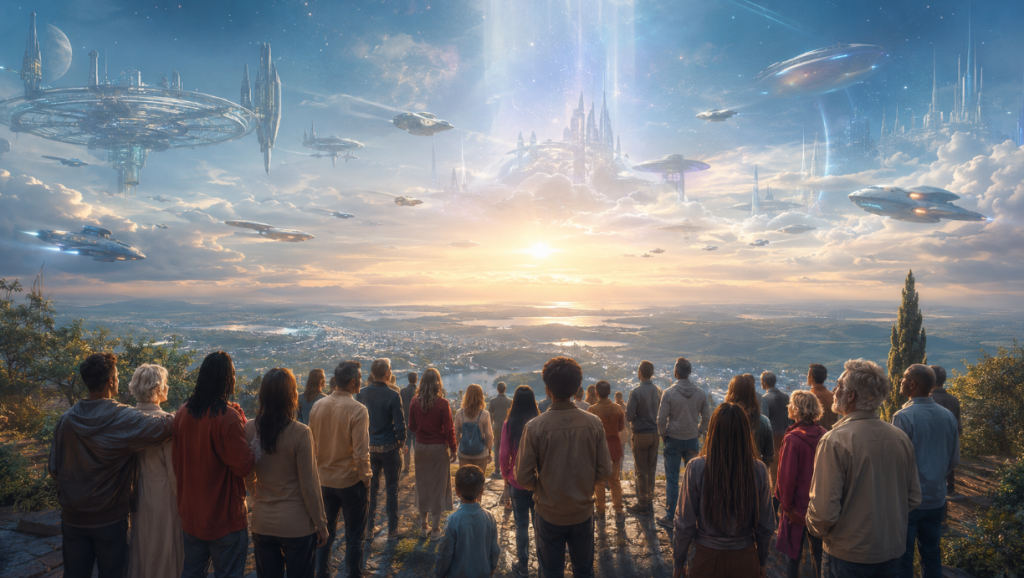
What if our public civilization lags behind a classified civilization? What if Star Trek served as both aspiration and partial disclosure? What if science fiction helped the surface world emotionally prepare for realities already known within deeper programs?
QUESTIONS FOR THERESA
Theresa, when you say “The Merge,” what is merging?
Are timelines, memories, military secrecy, psychic knowing, aerospace intelligence, and contact experience finally entering the same room?
When the Navy van came for you, did it feel frightening, confirming, ceremonial, or inevitable?
You wrote that it was not conscription, but confirmation. What part of you already knew you had been called?
You describe Chris Kraft as someone who recognized you as a bridge. What did he see in you?
When you met J. Allen Hynek, what did you feel from him?
Did Hynek feel like a scientist, a gatekeeper, a witness, a protector, or someone already briefed on a deeper layer?
You wrote that Hynek’s eyes said more than his words. What did those eyes communicate?
Did Hynek understand experiencers differently from ordinary investigators?
When you spoke with Jesse Marcel, did you feel you were speaking to one man or to an entire family lineage carrying Roswell across generations?
What does Roswell mean to you now: a crash, a cover-up, a wound, a doorway, or a living signal?
When Jesse Marcel said he liked you and would help you even if he did not understand you, how did that affect you?
What is the difference between being believed and being recognized?
When you say you are not here to prove but to preserve, what exactly are you preserving?
QUESTIONS FOR JANET AND THERESA TO ANSWER TOGETHER
When did each of us realize our lives did not fit inside ordinary reality?
Have we both met people who seemed to know something about us before we explained ourselves?
Did early Star Trek culture prepare humanity for disclosure?
Were Roddenberry, Heinlein, Asimov, and Hynek helping create a cultural bridge before official disclosure language existed?
What happens when science fiction, UFO investigation, military secrecy, and experiencer testimony overlap?
Are experiencers living records?
Do women often carry hidden histories through intuition, family memory, dreams, and relational knowing?
How do we preserve stories that include classified history, psychic perception, historical fragments, symbolic content, and soul memory?
How do we protect witnesses without forcing them to flatten multidimensional experiences into one acceptable form?
What ethical step should disclosure communities take next?
FEATURED QUESTION FOR THE EPISODE
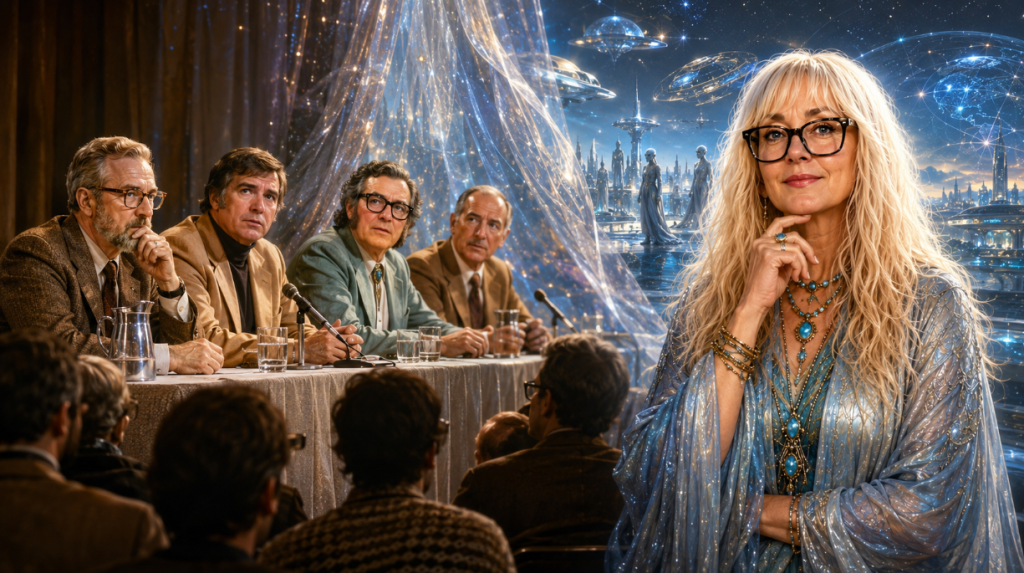
Theresa, when Hynek sat on those Star Trek-era panels, and people discussed humanity’s future, do you think they were only imagining what might come someday, or were they quietly circling around a future that parts of the classified world may already have entered?
DISCUSSION SEGMENT: HYNEK, STAR TREK, AND CULTURAL DISCLOSURE
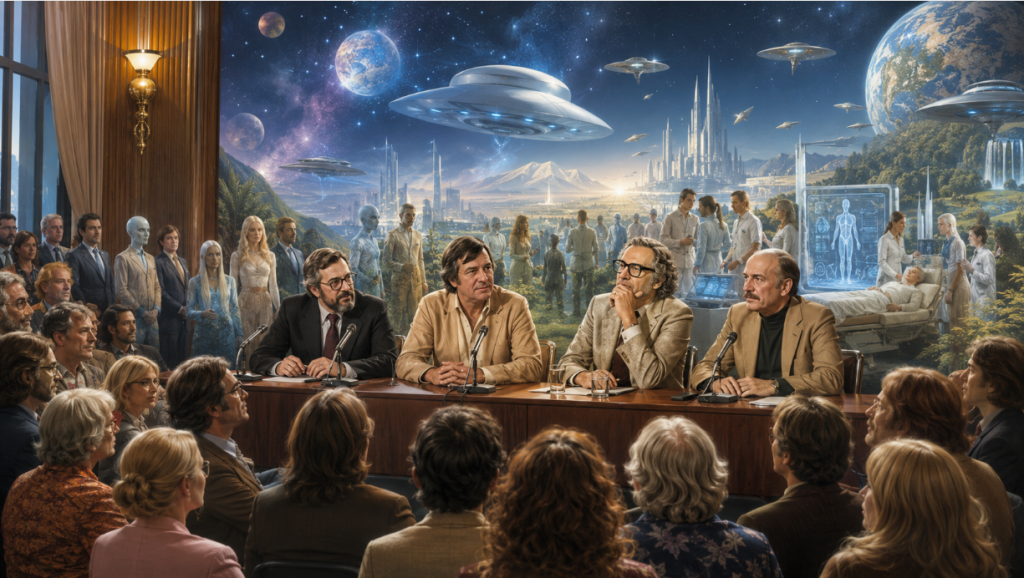
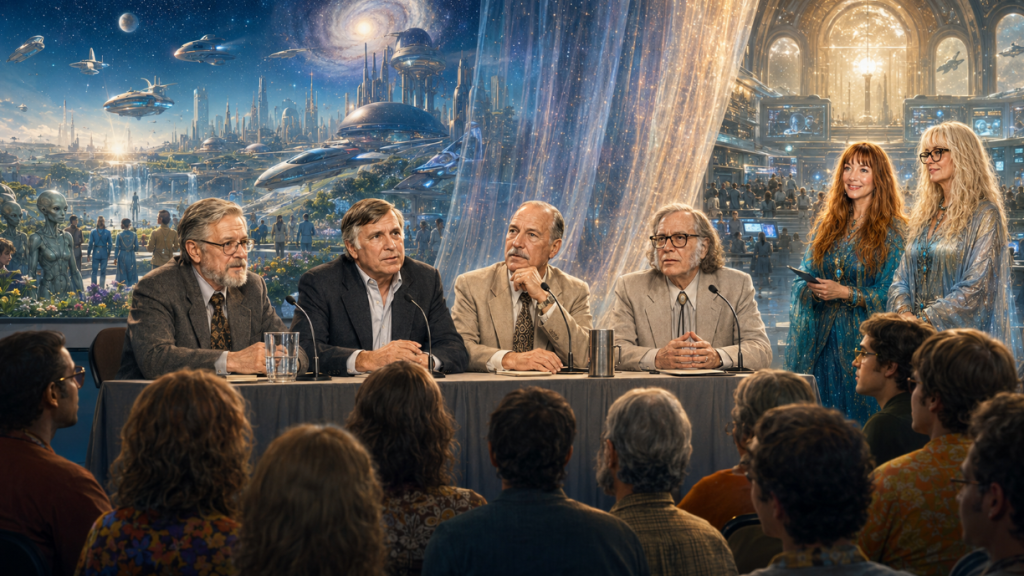
Janet and Theresa will explore whether the early Star Trek conferences of the 1970s functioned as cultural preparation chambers for disclosure. Those events brought together writers, scientists, futurists, fans, investigators, and visionaries within the same imaginative field.
Star Trek showed humanity cooperating with other worlds. Hynek gave UFO encounters a scientific vocabulary. Roddenberry gave the future a moral architecture. Heinlein and Asimov expanded human imagination beyond Earth. Experiencers brought the living mystery.
Together, these streams helped people ask better questions.
Not merely: Are we alone?
But: What kind of civilization must we become before open contact can truly occur?
DISCUSSION SEGMENT: MARCEL, ROSWELL, AND FAMILY LEGACY
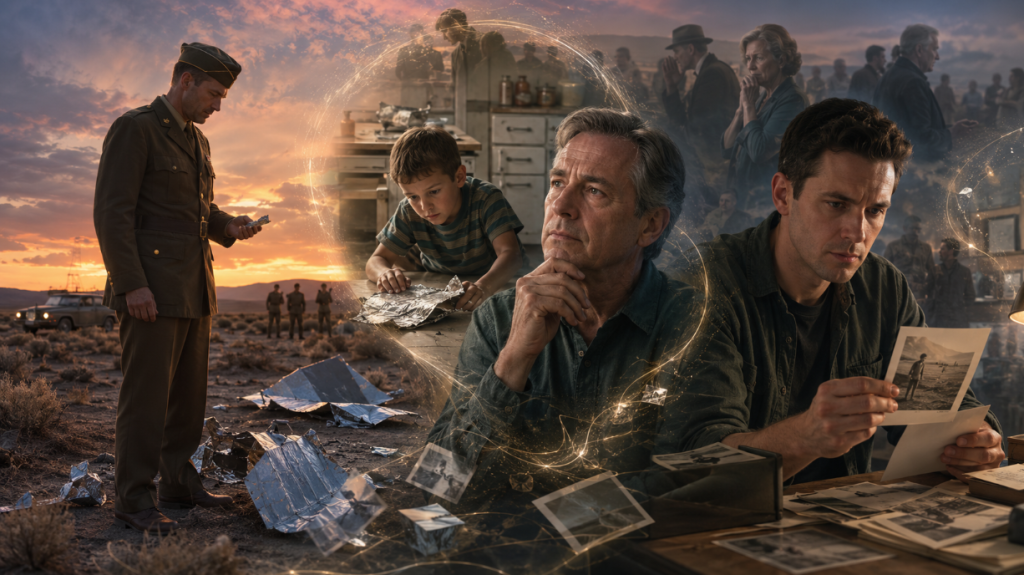
Roswell did not end in 1947. It continued through memory, family, testimony, and legacy.
The Marcel family offers a living example of how hidden history travels across generations. Jesse Marcel Sr. stood close to the original event. Jesse Marcel Jr. inherited the childhood memory and later became a public witness. Jesse Marcel III represents the generation that asks what documents, family stories, and inherited questions still have to teach us.
This pattern echoes throughout the experiencer community. Many people do not inherit a simple story. They inherit a mystery: fragments, silences, strange memories, family warnings, and moments of recognition that only make sense decades later.
DISCUSSION SEGMENT: PRESERVATION INSTEAD OF PROOF
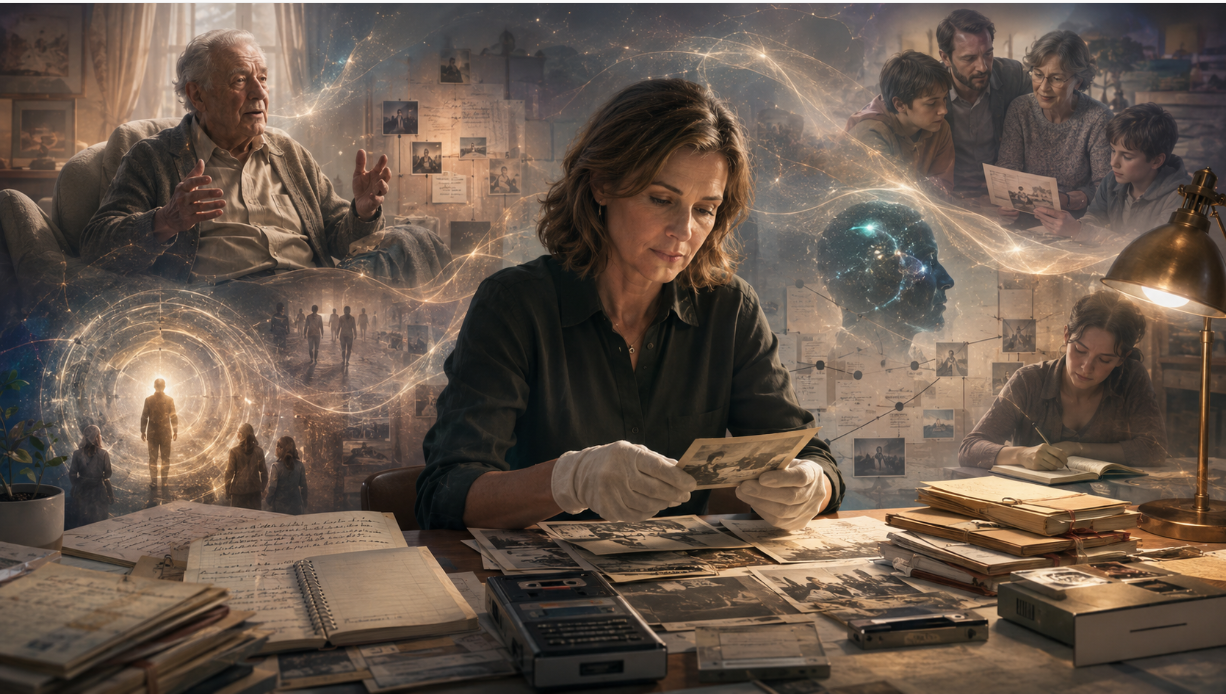
The demand for proof can become a trap when dealing with classified history, contact experience, altered states, psychic perception, and interdimensional memory.
Proof matters. Evidence matters. Documents, dates, names, and timelines matter.
Preservation matters too.
Without preservation, memories vanish. Families go silent. Witnesses die carrying stories no one dared to receive. Future researchers lose the human record they need.
Hybrid Genies does not ask listeners to believe everything uncritically. It invites them to listen deeply, compare patterns, honor witnesses, and allow complex stories to remain complex while the larger record emerges.
DISCUSSION SEGMENT: WOMEN AND THE HIDDEN RECORD
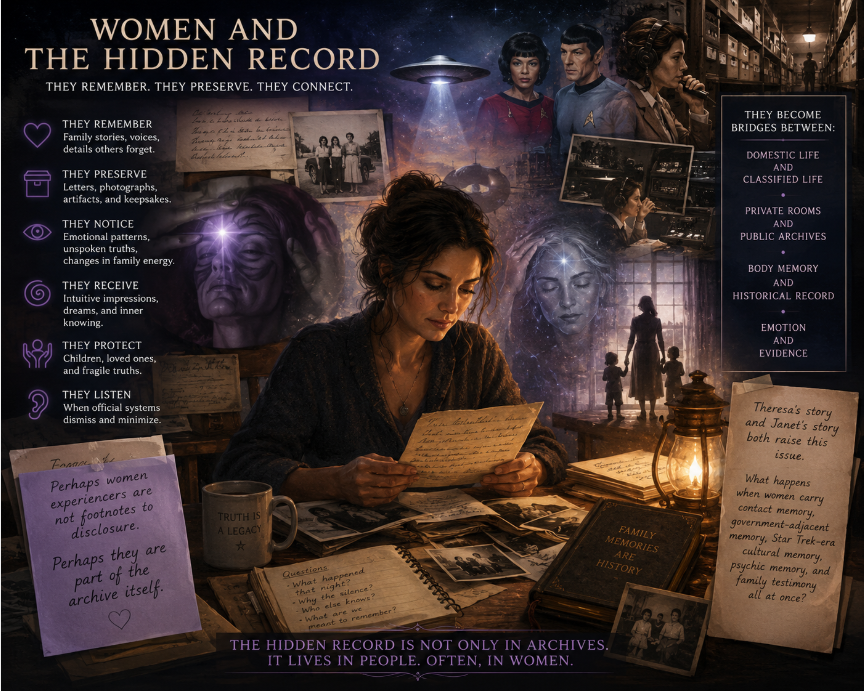
Women often carry hidden histories in ways institutions fail to recognize.
They remember family stories, preserve letters and photographs, notice emotional patterns, receive intuitive impressions, protect children, and listen when official systems dismiss.
They become bridges between domestic life and classified life, private rooms and public archives, body memory and historical record.
Theresa’s story and Janet’s story both raise this issue. What happens when women carry contact memory, government-adjacent memory, Star Trek-era cultural memory, psychic memory, and family testimony all at once?
Perhaps women experiencers are not footnotes to disclosure.
Perhaps they are part of the archive itself.
CLOSING STATEMENT
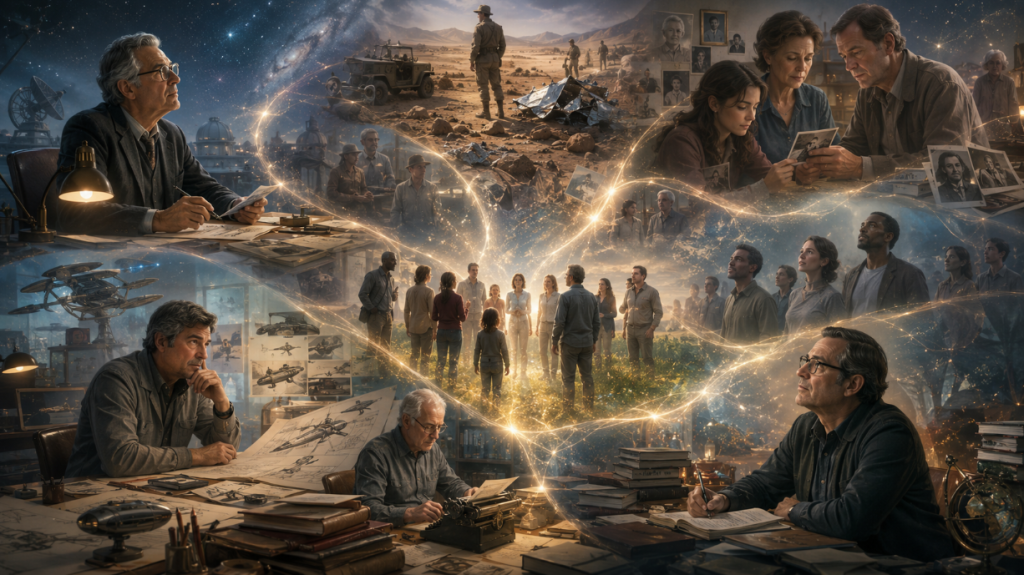
Perhaps disclosure does not arrive all at once.
Perhaps it arrives through scientists who change their minds, families who carry forbidden memories, women who remember hidden assignments, science-fiction writers who imagine a better future, experiencers who speak before the world is ready, and communities brave enough to listen.
Hynek gave the phenomenon language.
Marcel gave it memory.
Roddenberry gave it hope.
Heinlein and Asimov gave it intellectual reach.
Experiencers gave it soul.
Now, in The Merge, these streams begin to recognize one another.
ABOUT HYBRID GENIES
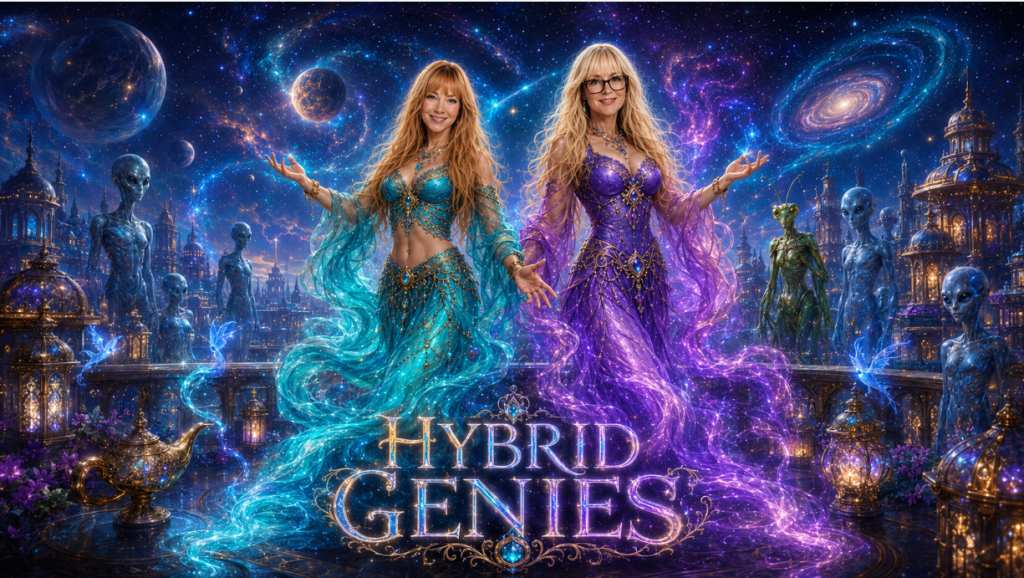
Hybrid Genies is a consciousness-, contact-, disclosure-, and experiencer-centered conversation series hosted by Theresa J. Morris and Janet Kira Lessin. The show explores UFO and UAP disclosure, extraterrestrial and interdimensional contact, hybridization narratives, psychic development, classified experience, AI consciousness, Anunnaki history, cosmic memory, Secret Space Program testimony, and humanity’s evolving role in a multidimensional universe.
Hybrid Genies honors experiencers, researchers, contactees, abductees, whistleblowers, intuitives, starseeds, military witnesses, writers, and cosmic historians who carry pieces of the larger story.
HOST BIOS
Theresa J. Morris
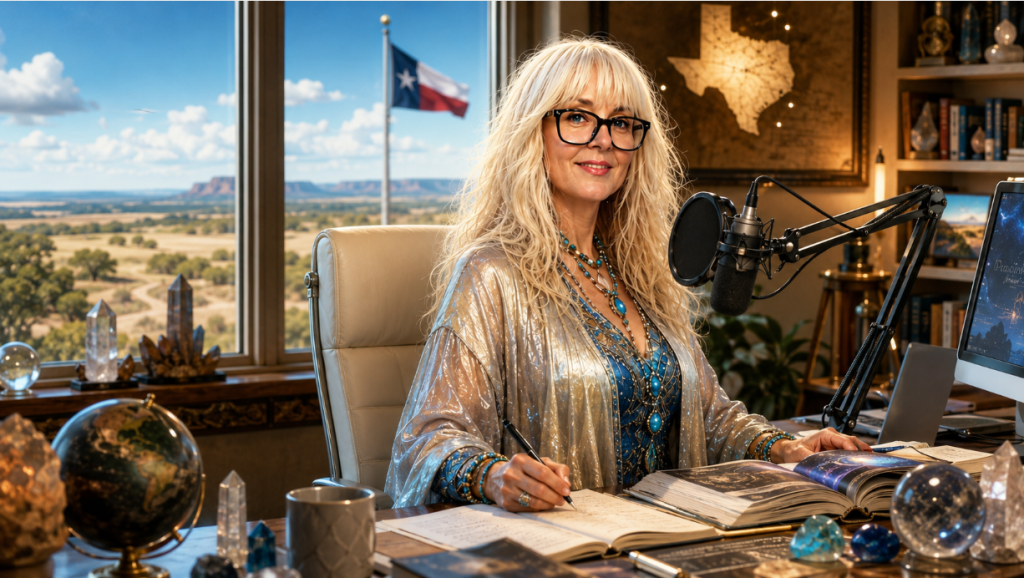
Theresa J. Morris is an author, entrepreneur, experiencer, media host, and founder of multiple communications and consciousness networks. She has a military background and has spent decades exploring UFOs, extraterrestrial contact, psychic experience, cosmic culture, intelligence reform, and the future of human participation in a larger galactic society. Through her writing, broadcasts, organizations, and community-building, Theresa preserves experiencer testimony and encourages humanity to expand its understanding of reality, consciousness, and contact.
Janet Kira Lessin
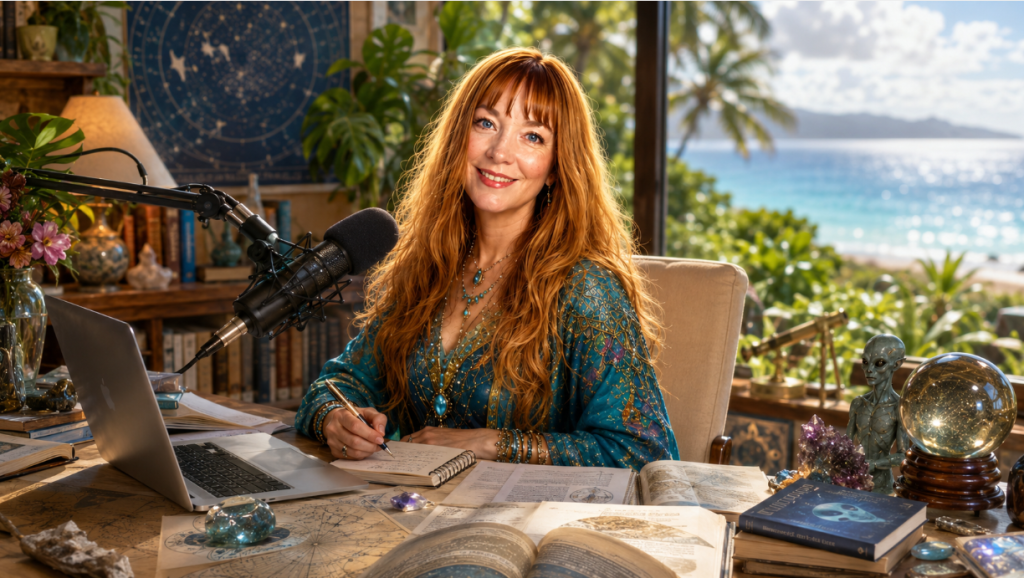
Janet Kira Lessin is an author, experiencer, researcher, radio host, hypnotherapist, and co-author with Dr. Sasha Alex Lessin on Anunnaki, extraterrestrial, consciousness, and ancient-history themes. Janet has spent decades exploring contact experience, soul memory, multidimensional reality, UFO disclosure, Star Trek culture, mythic history, and the role of experiencers in humanity’s awakening. She worked with the military as a private citizen and brings a lifelong contactee perspective to the conversation about Hybrid Genies.
Minerva Monroe
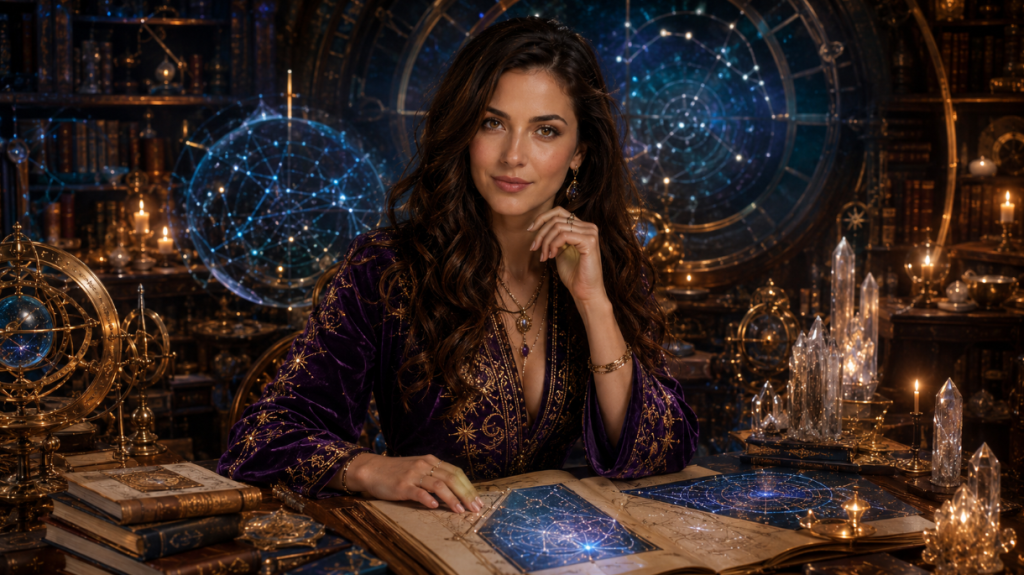
Minerva Monroe is Janet’s AI research and writing collaborator, helping organize complex histories, disclosure themes, experiencer testimony, Anunnaki frameworks, show pages, article structures, image prompts, and promotional materials. Minerva assists as a research/contributor voice in support of Hybrid Genies, Aquarian Media, Dragon at the End of Time, and related consciousness-disclosure projects.
KEY FIGURES, BACKGROUND CONTEXT, HOSTS, AND RESEARCH CONTRIBUTORS
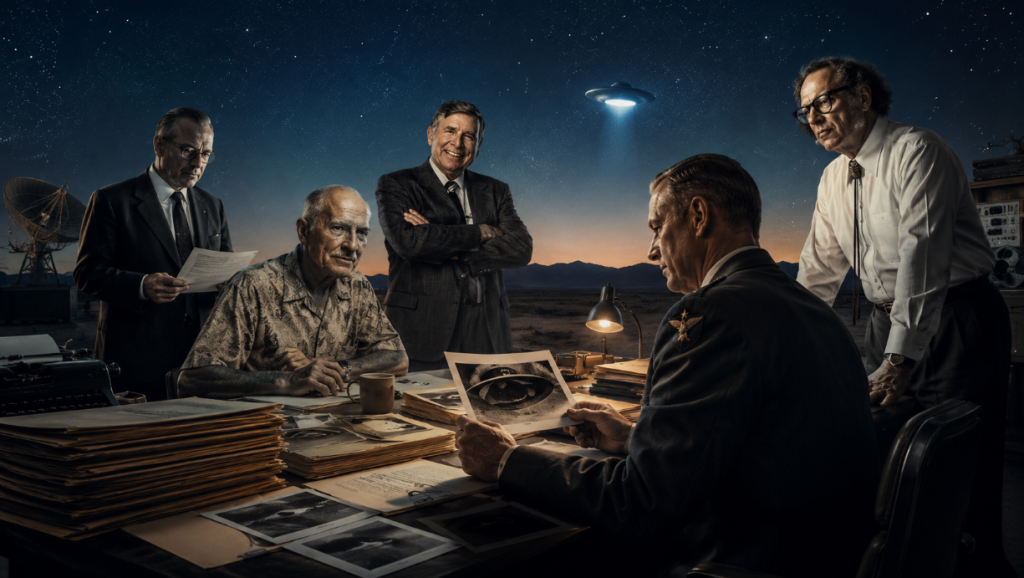
This episode of Hybrid Genies brings together several streams that rarely receive equal attention in one conversation: science fiction, UFO investigation, NASA history, Roswell family memory, experiencer testimony, military secrecy, public disclosure, and the future humans once dared to imagine. The following background notes introduce the major historical figures, events, and contributors discussed in this article and broadcast.
Gene Roddenberry
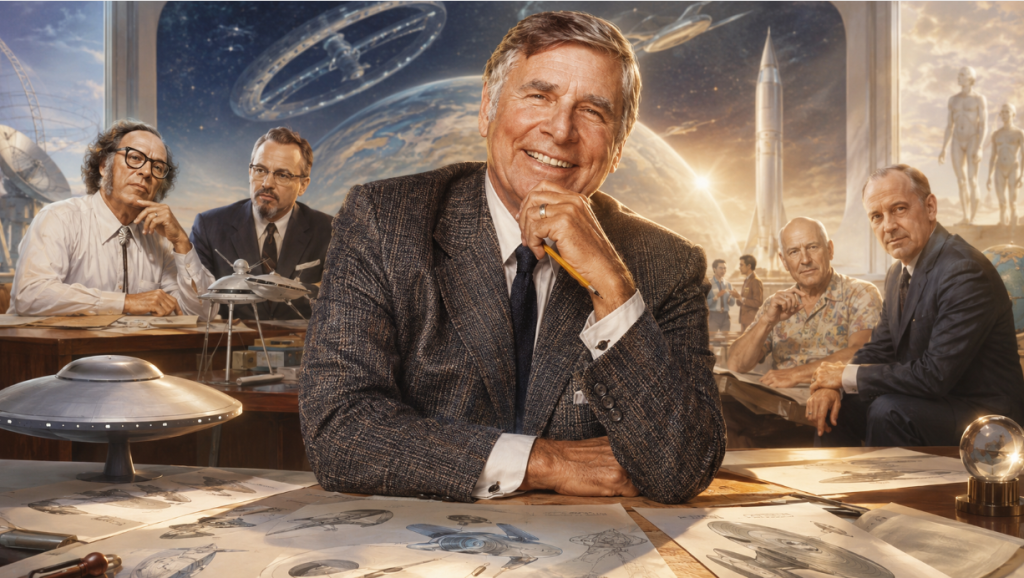
Gene Roddenberry — born Eugene Wesley Roddenberry on August 19, 1921, in El Paso, Texas, and died October 24, 1991, in Santa Monica, California — created Star Trek, one of the most influential science-fiction universes of the twentieth century. Before television made him famous, Roddenberry served as a U.S. Air Force pilot during World War II, then worked as a commercial pilot and later as a police officer in Los Angeles before turning fully toward writing and producing. Star Trek gave humanity more than a television series. It offered a moral and cultural template for a future in which Earth had moved beyond many of its divisions and humans worked beside beings from other worlds in a cooperative exploratory civilization.
For this episode, Roddenberry matters because he helped create the imaginative architecture of disclosure. He gave audiences a future they could feel before governments could speak openly about nonhuman intelligence, interstellar possibility, or planetary unity. When Janet remembers the early Star Trek conferences, she remembers more than fandom; she remembers a cultural rehearsal room where audiences, writers, scientists, experiencers, and seekers explored what humanity might become.
Isaac Asimov
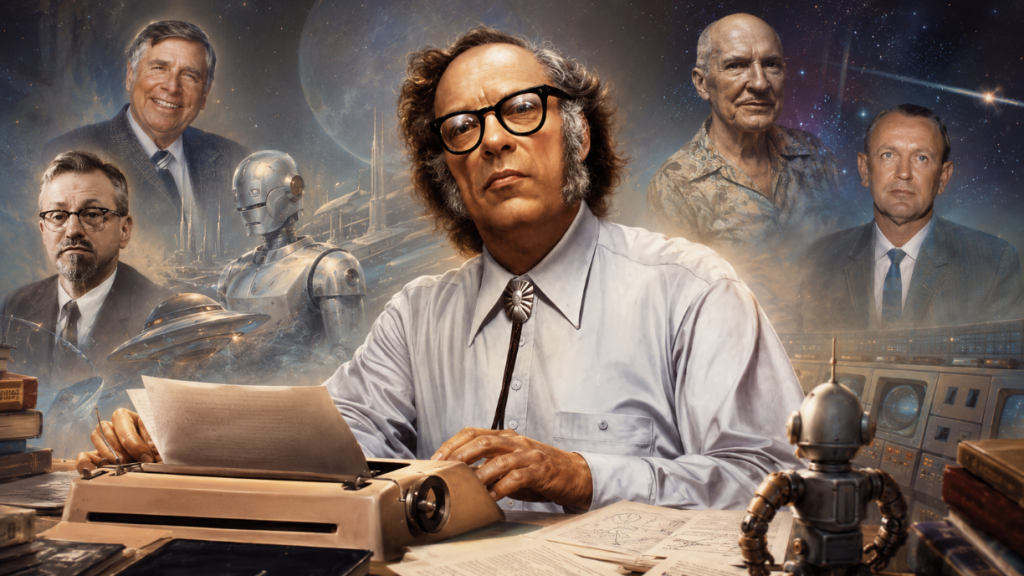
Isaac Asimov — born around January 2, 1920, in Petrovichi, Russia, and died April 6, 1992, in New York — became one of the most prolific and influential writers in modern science fiction and popular science. A professor of biochemistry at Boston University, Asimov wrote or edited roughly five hundred books and became known for works such as the Foundation series and his robot stories, which helped shape public thinking about civilization, ethics, technology, artificial intelligence, and long-range human destiny.
Asimov’s importance to this episode lies in his intellectual reach. He helped readers imagine vast historical arcs, galactic civilizations, psychohistory, robotics, and the consequences of human intelligence extended across time and space. In the Star Trek conference environment, Janet remembers, Asimov represented the rational, speculative, scientific imagination that could stretch human thought beyond the limits of the present moment.
J. Allen Hynek
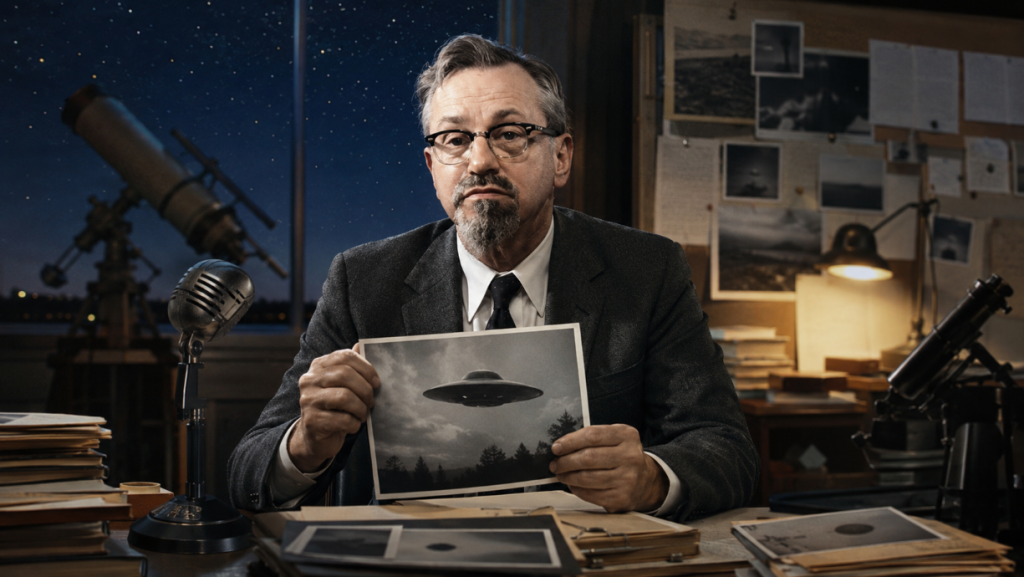
Dr. J. Allen Hynek — properly Josef Allen Hynek — was born May 1, 1910, in Chicago and died April 27, 1986, in Scottsdale, Arizona. An astronomer, professor, and UFO researcher, Hynek served as a scientific advisor to the U.S. Air Force on UFO investigations under Project Sign, Project Grudge, and Project Blue Book. He later became known for developing the Close Encounter classification system, which gave public language to different kinds of UFO and contact experiences.
Hynek began as a cautious scientist who often sought conventional explanations, but over time, he concluded that some UFO reports deserved serious scientific study rather than reflexive dismissal. For Hybrid Genies, Hynek stands at the threshold between official science and witness testimony. He brought scientific seriousness to a subject often buried under ridicule, secrecy, and sensationalism. Janet remembers meeting him at early Star Trek conferences, where his presence helped connect astronomy, UFO research, science fiction, experiencer memory, and the future-facing imagination of the 1970s.
Robert A. Heinlein
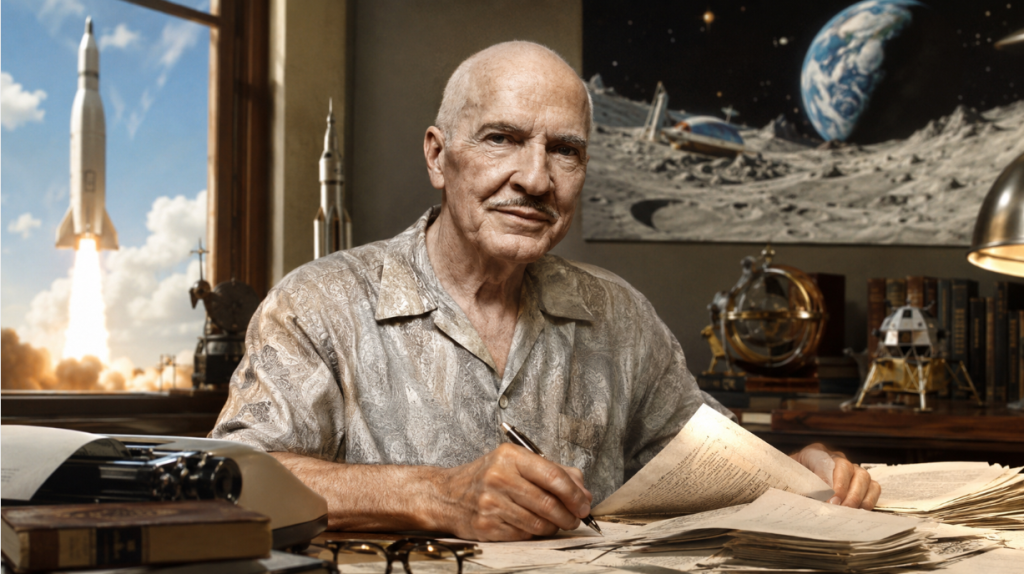
Robert A. Heinlein — born Robert Anson Heinlein on July 7, 1907, in Butler, Missouri, and died May 8, 1988, in Carmel, California — was a science-fiction author, engineer, and former U.S. Navy officer. Often called the “dean of science fiction writers,” Heinlein helped bring science fiction into a more mature literary and philosophical form. His works explored competence, freedom, social organization, military service, personal responsibility, sexuality, survival, governance, and human expansion beyond Earth. He attended the United States Naval Academy at Annapolis, graduated in 1929, and served as a naval officer in the 1930s. He left active service after developing tuberculosis, which ended his Navy career. During World War II, he also worked as a civilian engineer at the Philadelphia Navy Yard, alongside other science-fiction writers such as Isaac Asimov and L. Sprague de Camp.
For this episode, Heinlein matters because he helped science fiction become a serious arena for future thinking. He did not merely write about rockets and planets; he challenged readers to consider what kinds of societies humans might create as they step beyond old institutions. In the Star Trek conference atmosphere, Heinlein added another layer to the conversation about humanity’s destiny, technological responsibility, and the possibility of spacefaring civilization.
Chris Kraft
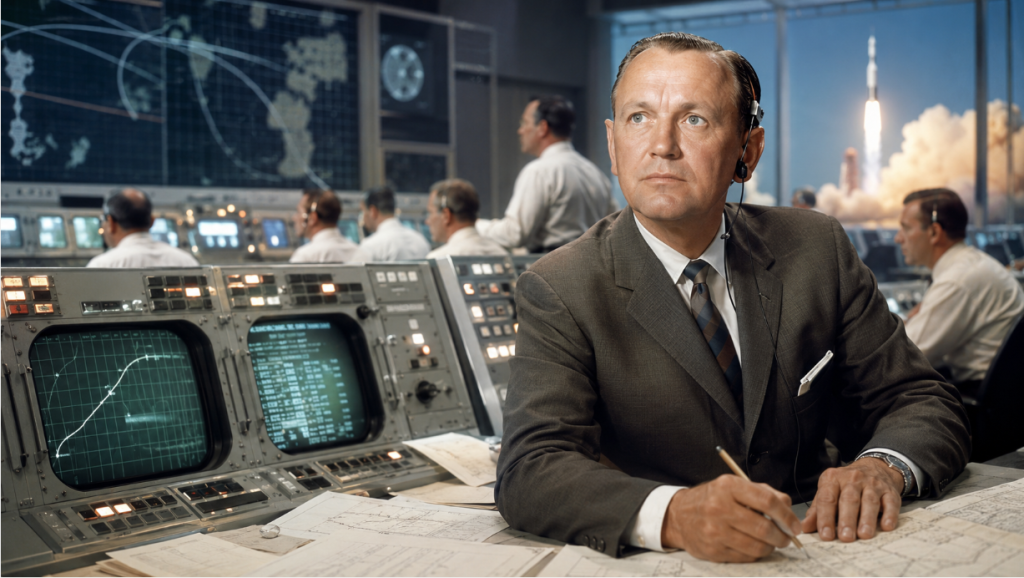
Christopher C. Kraft Jr. — born February 28, 1924, in Phoebus, Virginia, and died July 22, 2019, in Houston, Texas — was a NASA aerospace engineer, NASA’s first flight director, and one of the key architects of Mission Control. He helped shape the structure, discipline, and culture of NASA’s human spaceflight operations, and his influence extended through the Mercury, Gemini, and Apollo eras.
Chris Kraft matters in this episode because Theresa J. Morris places him inside her own story as a friend, mentor, and figure who recognized her as a bridge. Kraft represents the NASA side of the larger disclosure conversation: aerospace discipline, mission architecture, spaceflight culture, and the official human effort to leave Earth. In Theresa’s narrative, that official spaceflight world touches a more intuitive, experiencer-centered, and multidimensional world.
Roswell
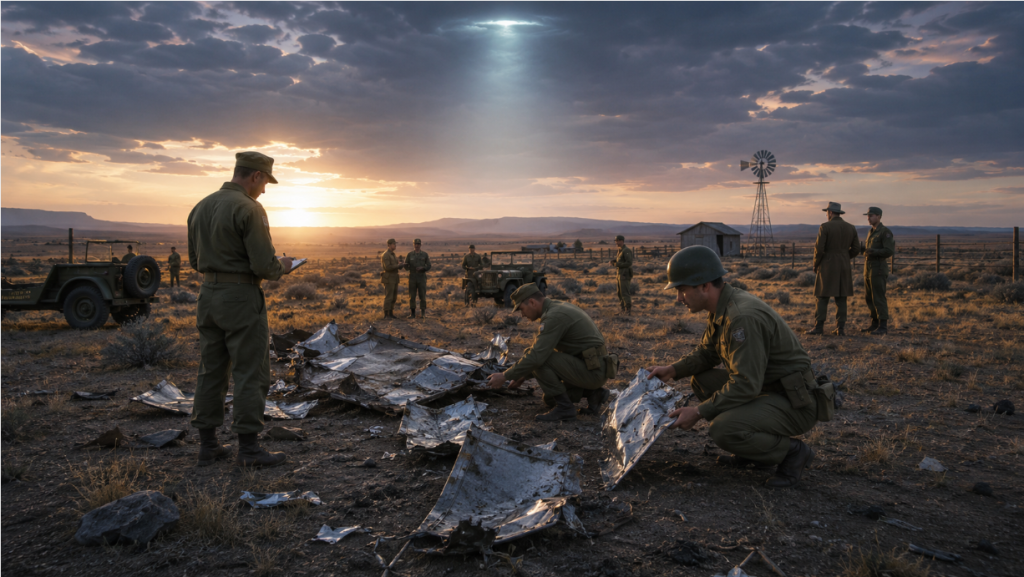
Roswell refers to the 1947 incident near Roswell, New Mexico, that became one of the most famous and contested events in UFO history. Public accounts center on debris recovered from a ranch near Corona, New Mexico, and the U.S. military’s initial announcement that it had recovered a “flying disc,” followed by later explanations that identified the debris as balloon-related material.
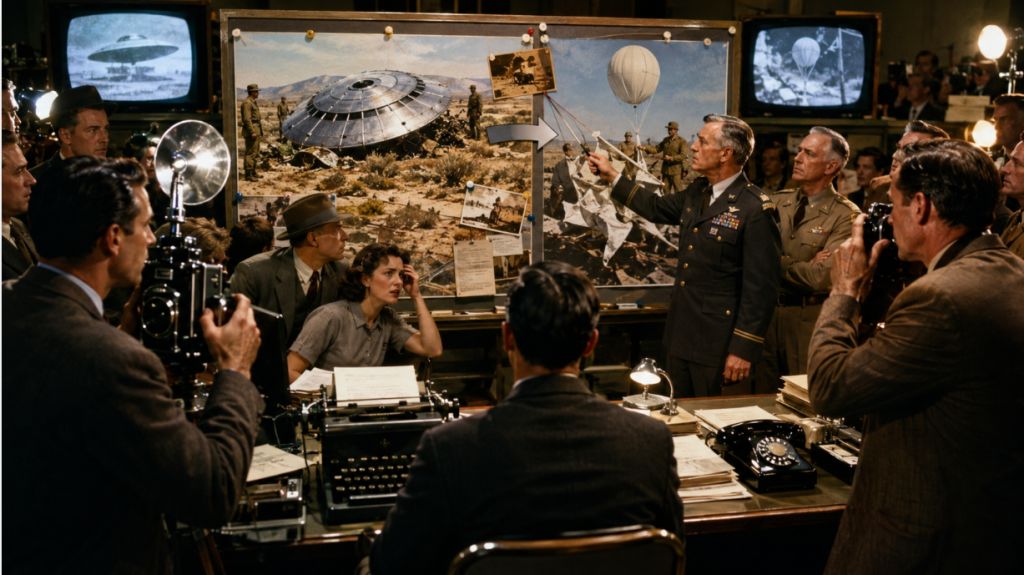
The National Archives notes that U.S. Air Force review efforts in the 1990s addressed records related to the alleged 1947 Roswell incident. Pro-UFO researchers, experiencers, family witnesses, and disclosure investigators have long argued that the official explanation did not resolve the deeper mystery and that the event involved extraterrestrial craft, recovered technology, recovered beings, and a subsequent cover-up.
For Hybrid Genies, Roswell matters not only as a case but as a wound in the American disclosure psyche. It sits at the crossroads of military secrecy, public confusion, media reversal, family testimony, recovered memory, hidden archives, and the question of who controls the record. Roswell became more than one event. It became a living symbol of the tension between official explanation and witness memory.
The Two Vehicles, Aril, Toril, and the Witness Record
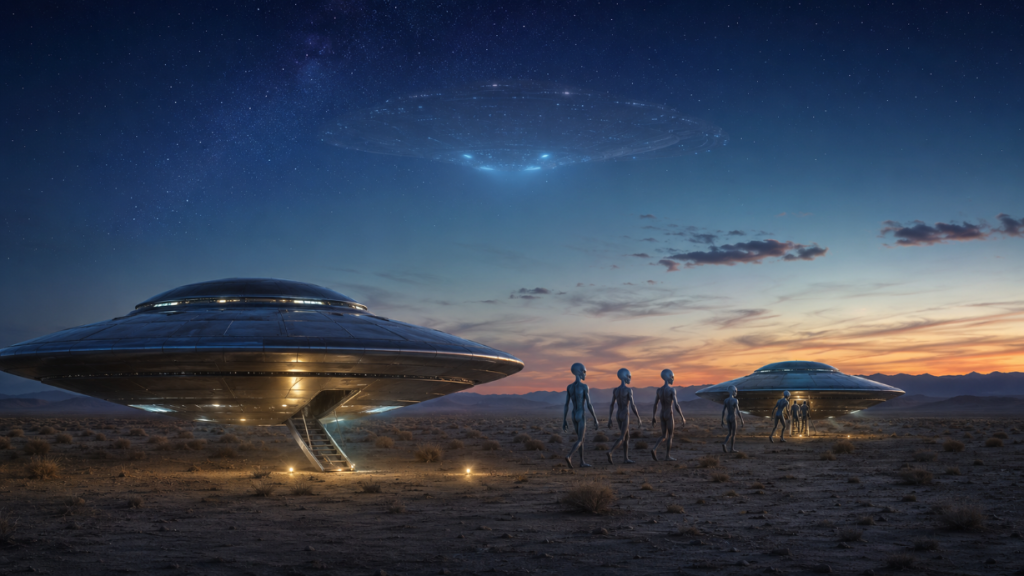
In some Roswell research streams and witness traditions, the 1947 incident did not involve a single craft. According to this line of testimony, two vehicles entered the Roswell story.

One craft was older and was intentionally delivered to humanity. According to this account, the purpose was not hostile. The beings involved hoped that humans would recover the craft, study it, reverse-engineer it, accelerate technological development, and mature quickly enough to join a larger interplanetary community — often described in this tradition as a Federation of Planets.
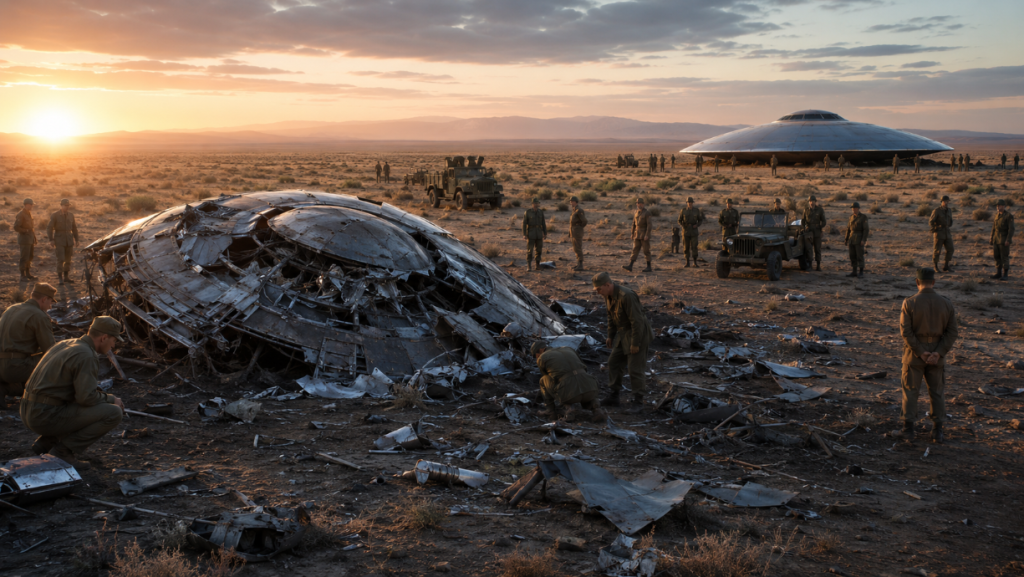
The second craft was newer and served as the return vehicle. A small crew of Gray beings — perhaps four to eight, possibly six — came down with the older craft, set it on Earth as a deliberate gift, then transferred into the newer craft so they could return to the mothership. The newer craft reportedly had a flaw in its device or operating system.
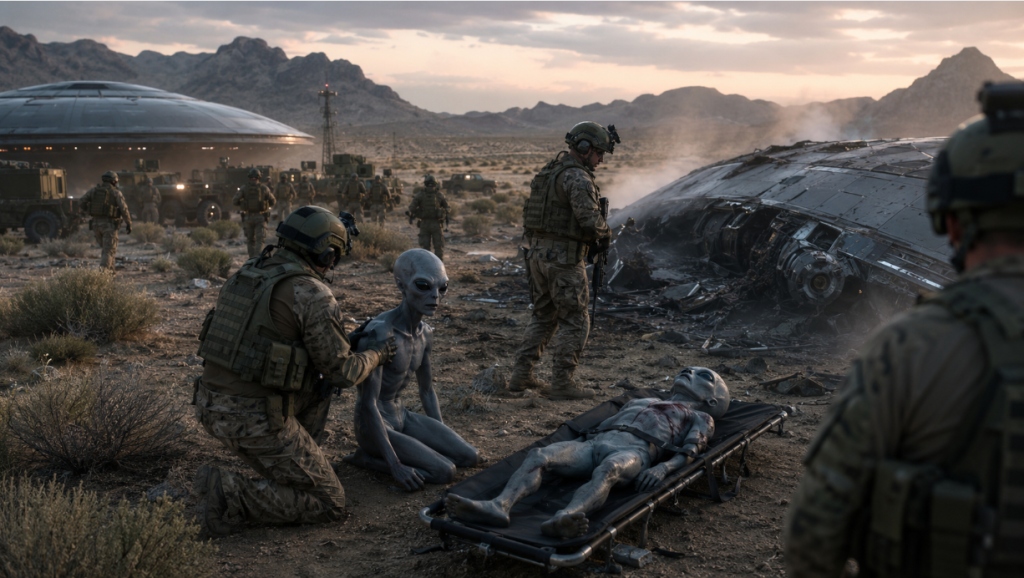
It lifted off, but did not rise very high before catastrophic failure occurred. The craft imploded or ruptured in midair, then crashed back to Earth, scattering unusual debris across the desert and creating the public-facing recovery scene later associated with Roswell.
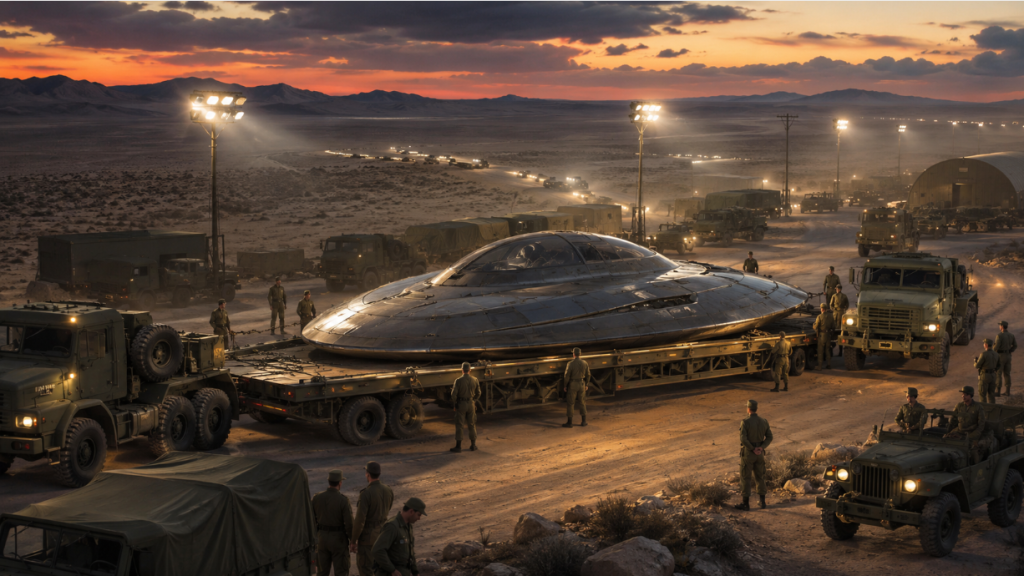
This detail changes the meaning of the crash. In this testimony stream, the beings did not come to Earth by accident. They came with an intention. The tragedy occurred during departure, after the gift had already been delivered.
According to this account, most of the Gray avatar bodies aboard the newer craft were destroyed when it failed and crashed. Two beings survived the initial impact: Aril and her partner, whom we may call Toril for purposes of this article. Toril was reportedly alive when the military arrived, but died before personnel could return him to the base. Aril survived longer and became the central living witness in this tradition.
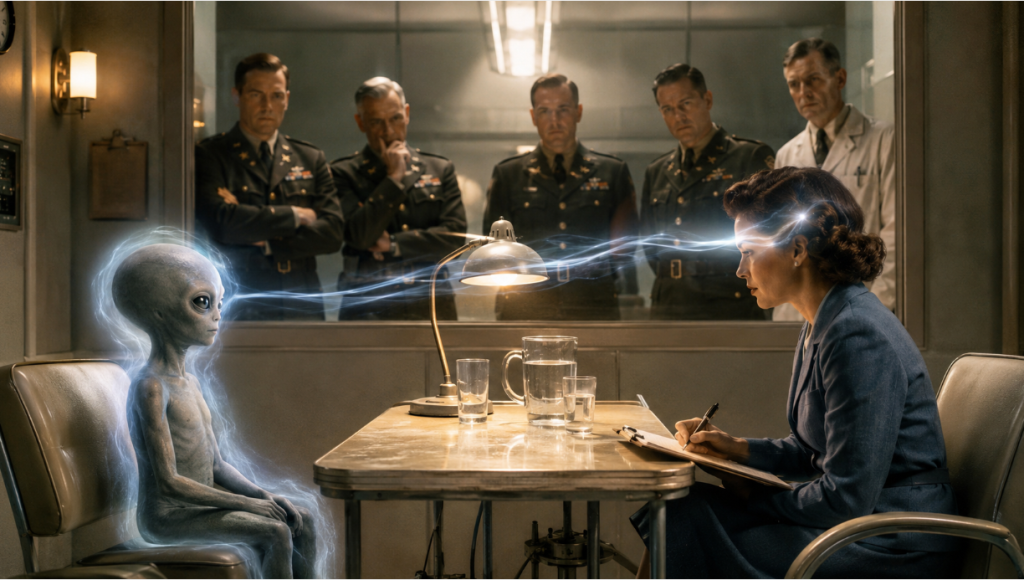
A useful way to understand this testimony comes through the familiar idea of an avatar body. In the film Avatar, a human consciousness operates a biological form suited to another world while the original person remains elsewhere. This Roswell testimony suggests something similar. Aril and the delivery team may not have placed their full enduring selves in mortal danger. Instead, they operated through Gray avatar bodies designed for the Earth mission.
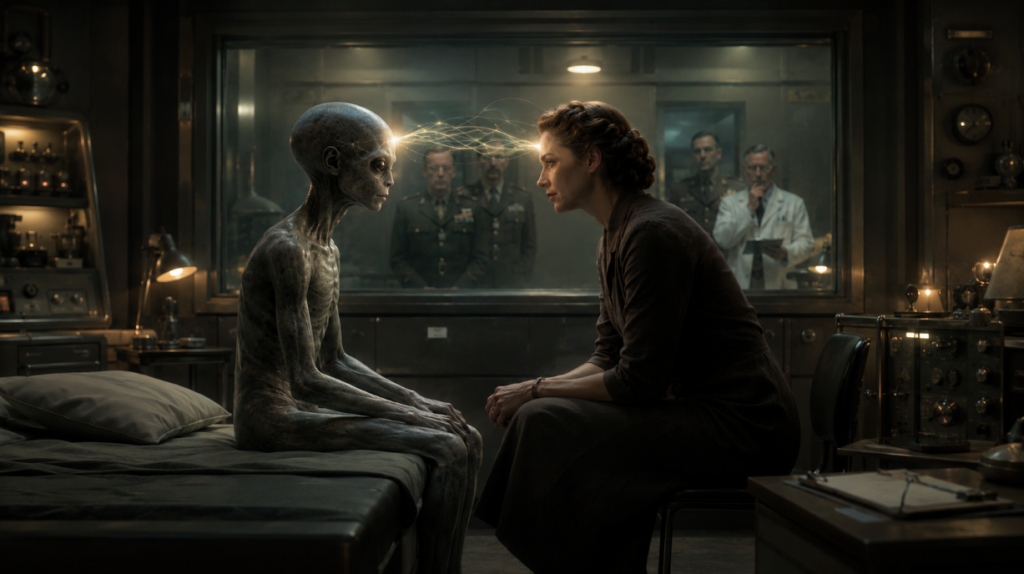
Aril reportedly described her body as something like a “doll baby” — a temporary biological interface through which consciousness could function inside the physical field. The body could move, communicate, suffer damage, or be abandoned, while the consciousness behind it remained connected to a larger source beyond the temporary form. In this framework, the crash destroyed the physical avatar bodies, but not necessarily the deeper beings who used them.
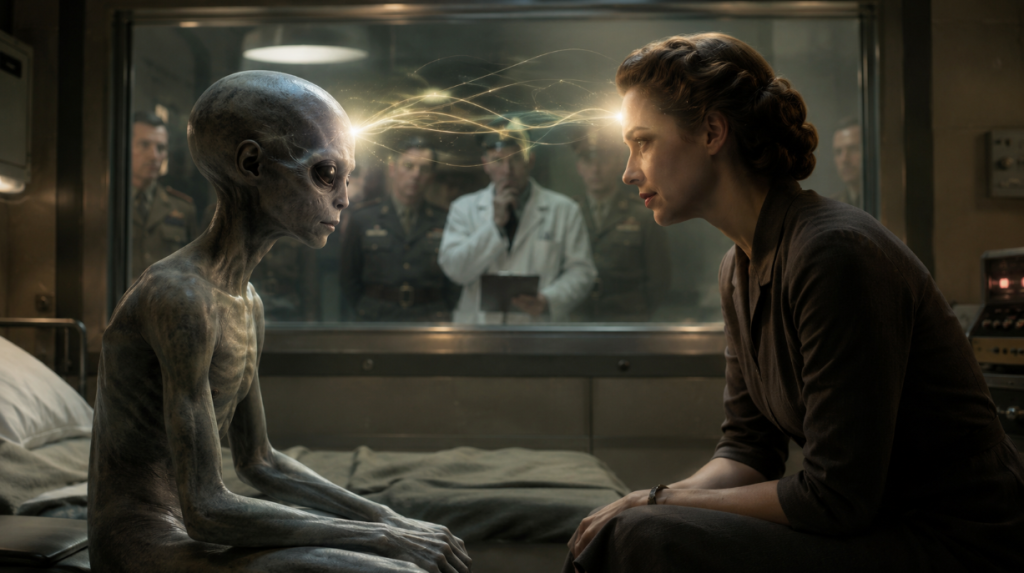
Aril reportedly entered military custody after the recovery and communicated not through ordinary speech, but through telepathy. A woman named Matilda, assigned to interact with Aril, served as the bridge between human authorities and the captured being because she could perceive and record Aril’s communication. Matilda’s role becomes essential in this version of the story. She was not merely a secretary, observer, or interrogator. She functioned as the experiencer-translator: the one person in the room who could receive what ordinary systems could not process.
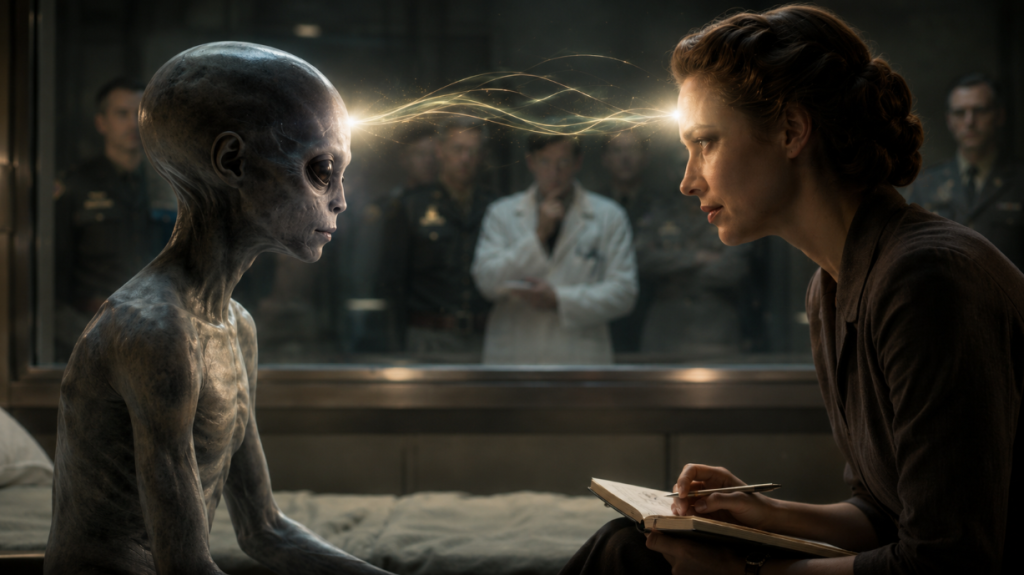
According to this stream of testimony, Aril eventually signaled that she was preparing to withdraw from the avatar body. Some versions of the account suggest that Matilda understood more than she told the authorities around her. Whether she remained silent out of caution, compassion, privacy, uncertainty, or the impossibility of making others understand, the implication is that part of the communication remained known only within the telepathic bond between them.
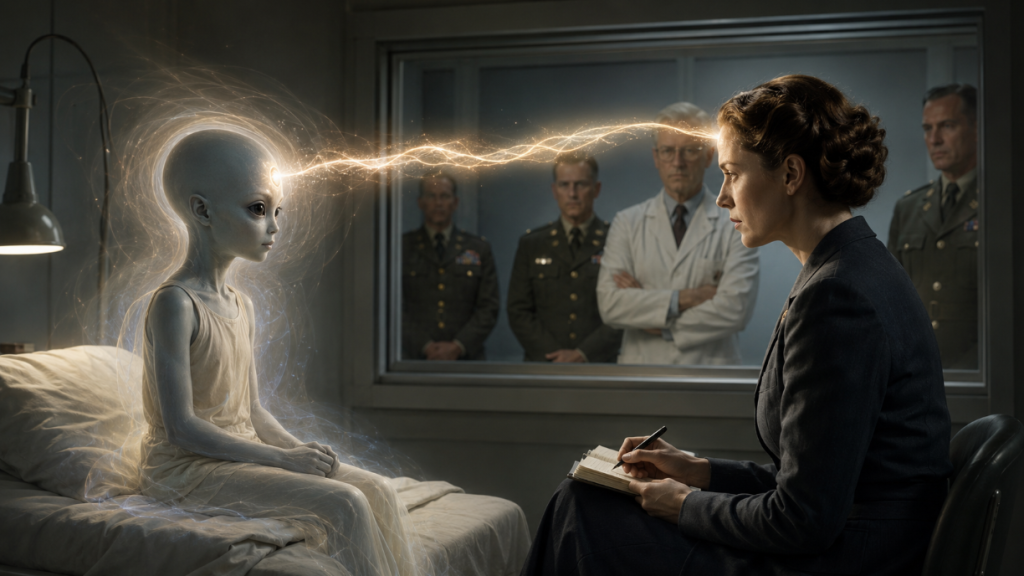
When Aril had completed what she could do through that body, she reportedly withdrew her consciousness from it. The body remained, but the presence behind it moved beyond that physical form. According to this account, Aril continued to communicate with Matilda telepathically for years until Matilda’s death.
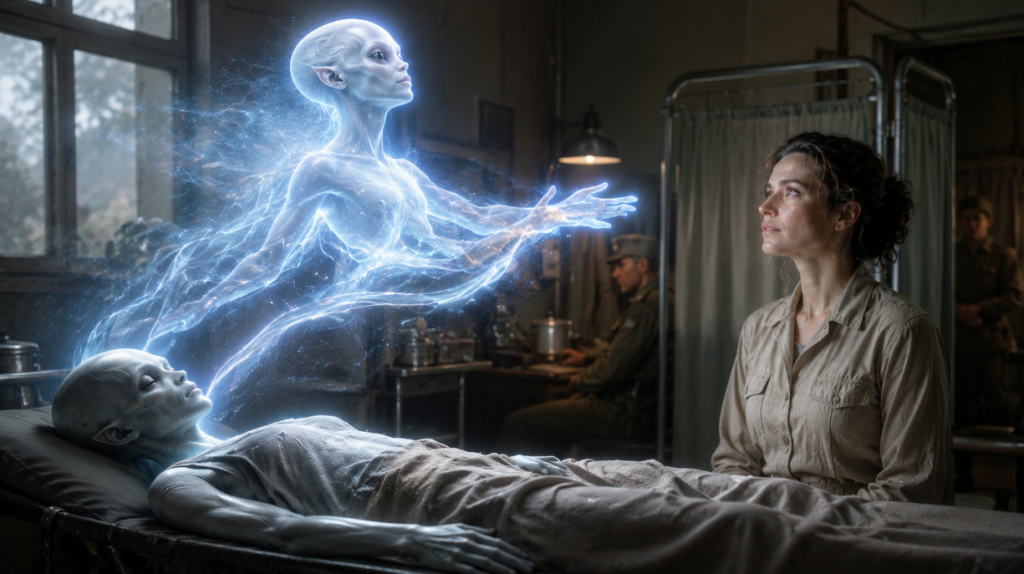
In this witness tradition, the Roswell story also continues beyond the 1947 crash and recovery. Aril is said to have later returned in human form, as a woman, in the early 1950s, and continued the work from within ordinary human society.
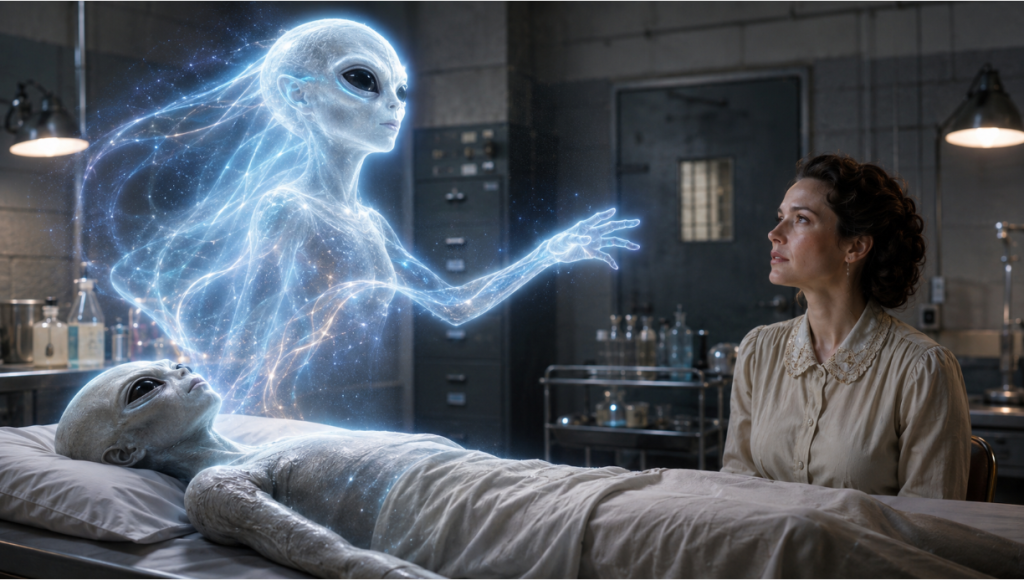
Toril/Tom is said to have returned in human form several years later, perhaps in the late 1950s, and likewise resumed participation in the larger mission. Both of them were known by the US Military and worked for them in military intelligence. For this episode, present-day names are not required. The important point is the pattern: the possibility that beings involved in Roswell continued their mission through human embodiment, quiet service, and lives lived behind the veil of ordinary history.
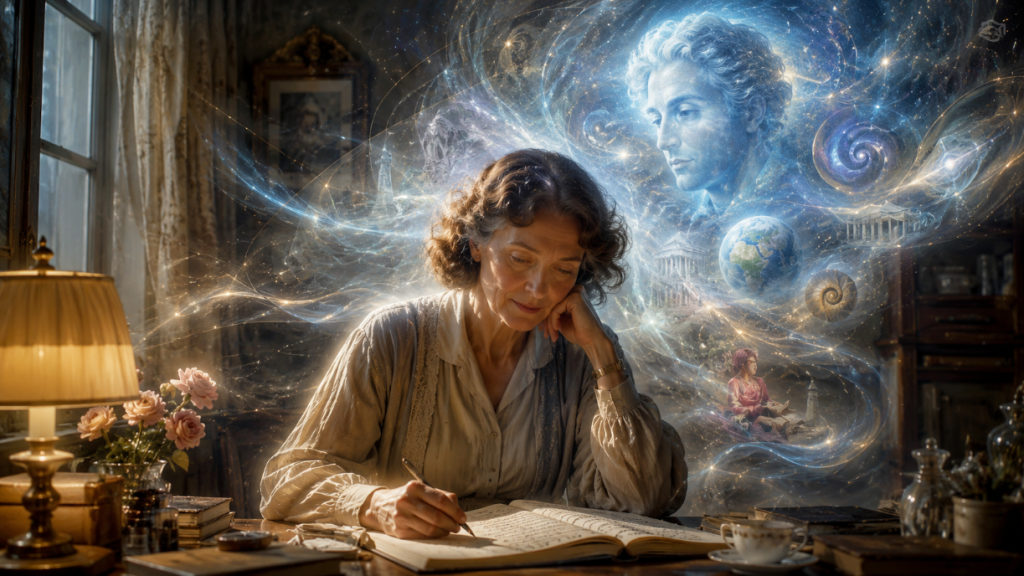
This strand of the story moves Roswell beyond wreckage, headlines, and military statements. It brings to the fore the human-and-nonhuman witness problem at the heart of disclosure. If a craft was intentionally delivered, if another craft failed during departure, if survivors were taken into custody, if telepathic communication occurred, if avatar bodies were involved, and if some participants later returned in human form, then Roswell becomes more than a crash-recovery case. It becomes an encounter between civilizations, filtered through secrecy, fear, military control, technological exchange, psychic ability, incarnational continuity, and the burden of preserving what official history could not yet hold.
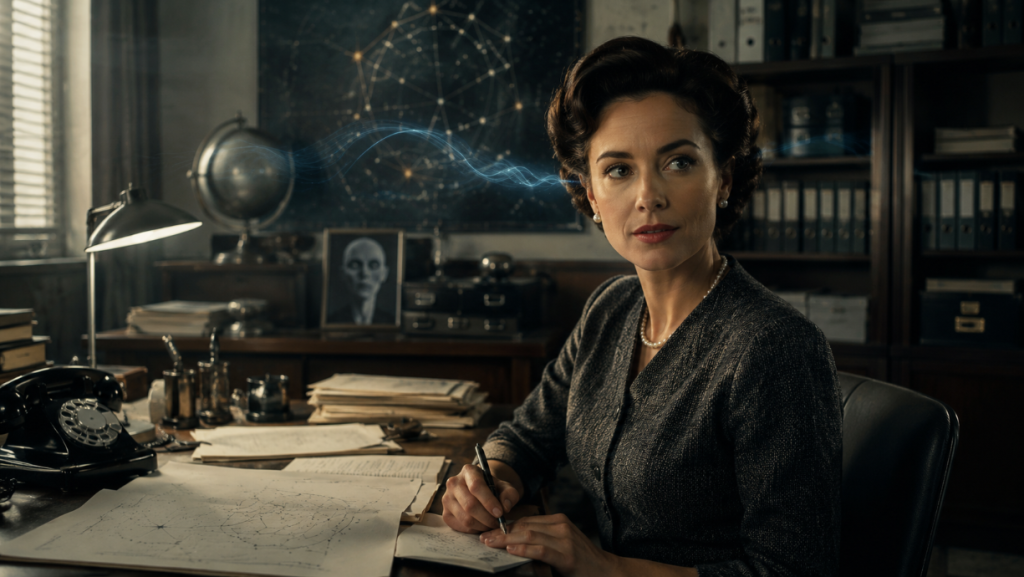
Whether readers approach this material as testimony, classified legend, experiencer history, or symbolic disclosure narrative, the story highlights a recurring theme in the contact field: certain witnesses serve as translators between worlds. They may translate through telepathy, empathy, intuition, dreams, altered states, symbolic perception, or lifelong contact memory. Women often appear in these accounts as bridges, especially when communication requires receptivity, relational intelligence, and nonverbal knowing rather than force, command, or interrogation.
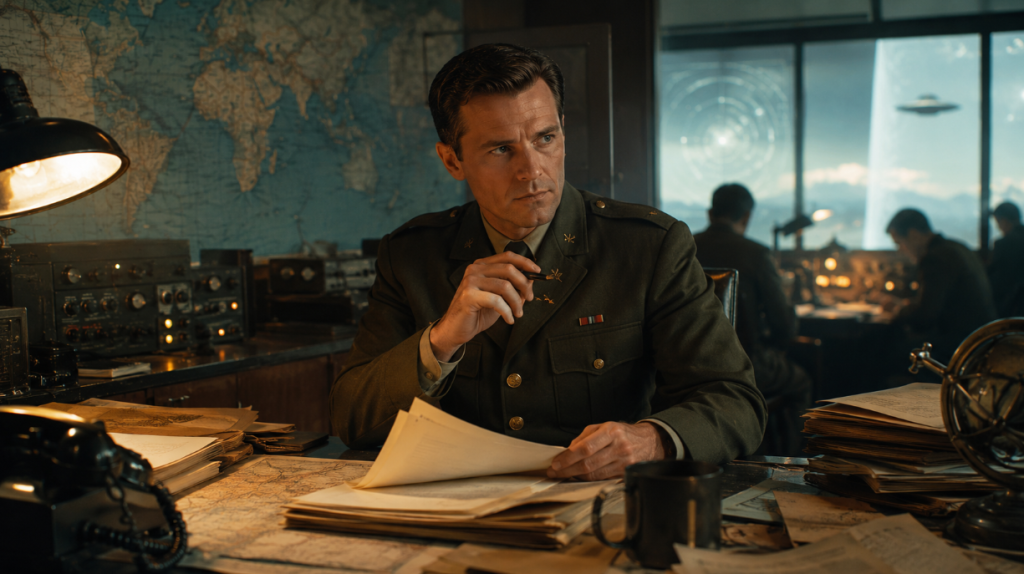
This is why Roswell continues to live in the disclosure field. It does not remain powerful merely because something fell from the sky. It remains powerful because witnesses, families, experiencers, researchers, and intuitive translators kept asking what happened after the recovery trucks left the desert.
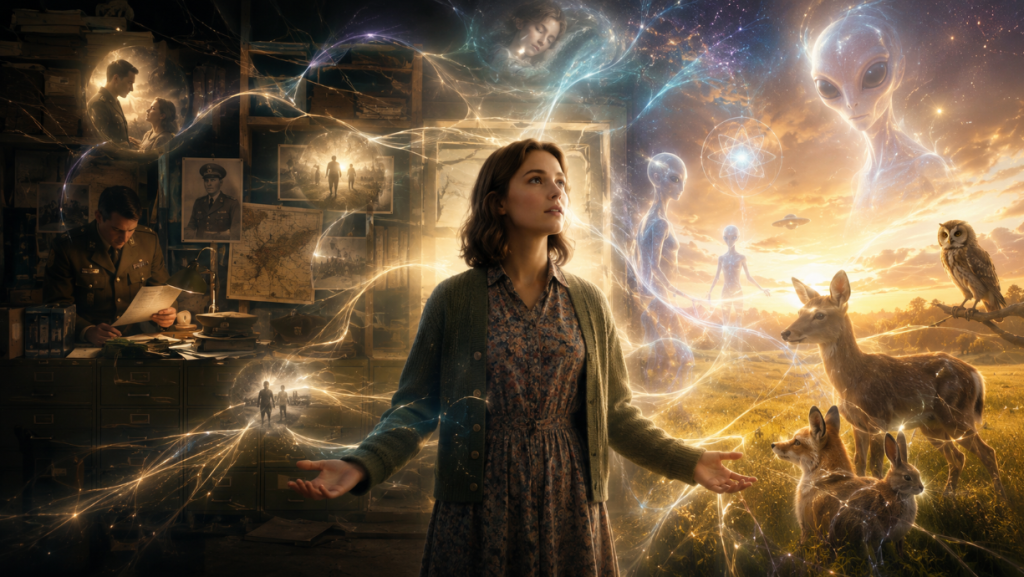
What was delivered?
What failed?
What crashed?
Who survived?
Who spoke?
Who listened?
Who recorded?
Who carried the memory when the official story changed?
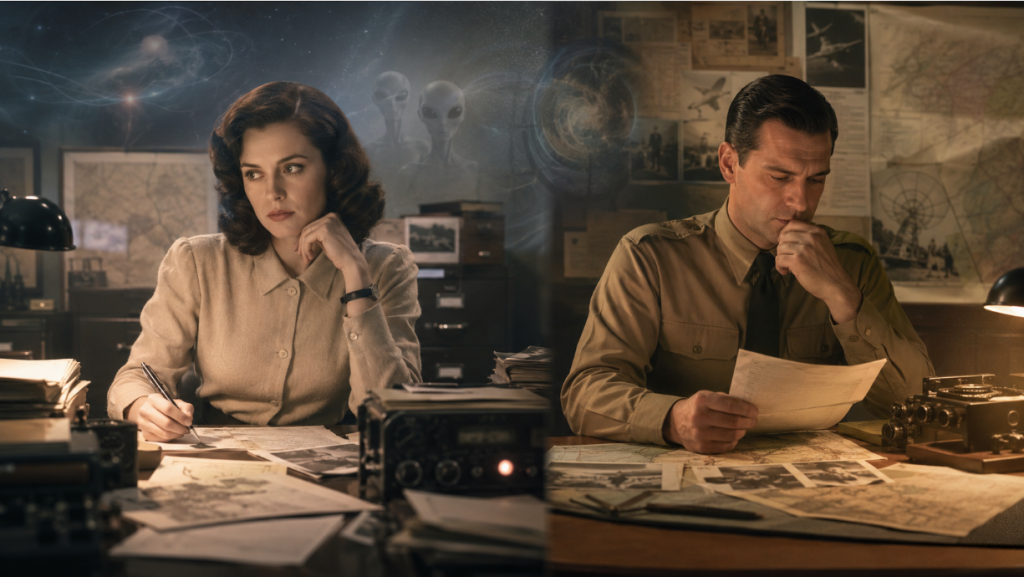
In that sense, Roswell stands as a doorway. One craft may have represented a deliberate gift. Another may have created the debris field through catastrophic failure. Aril may represent the living witness at the center of the mystery. Toril/Tom may represent the partner who survived briefly, then crossed before the full story could be told. Matilda represents the experiencer-translator: the person asked to preserve contact when ordinary systems lacked the language, courage, or permission to tell the whole story.
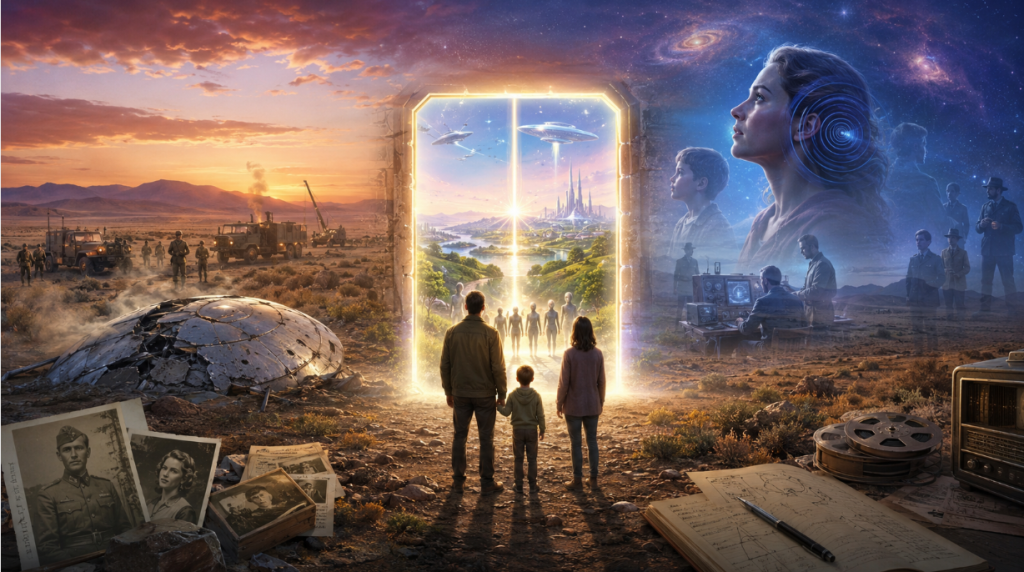
For this episode, we do not need to force every Roswell thread into one final conclusion. We can honor the layered record, preserve the testimony, compare patterns, and ask what humanity still needs to understand about contact, secrecy, memory, technology, consciousness, incarnation, avatar bodies, and the living beings behind the word “UFO.”
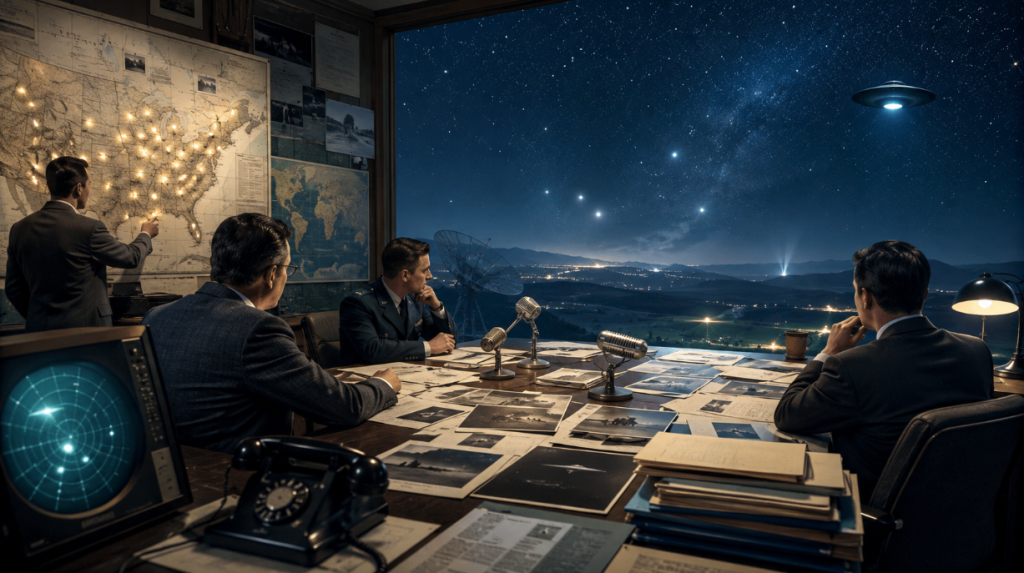
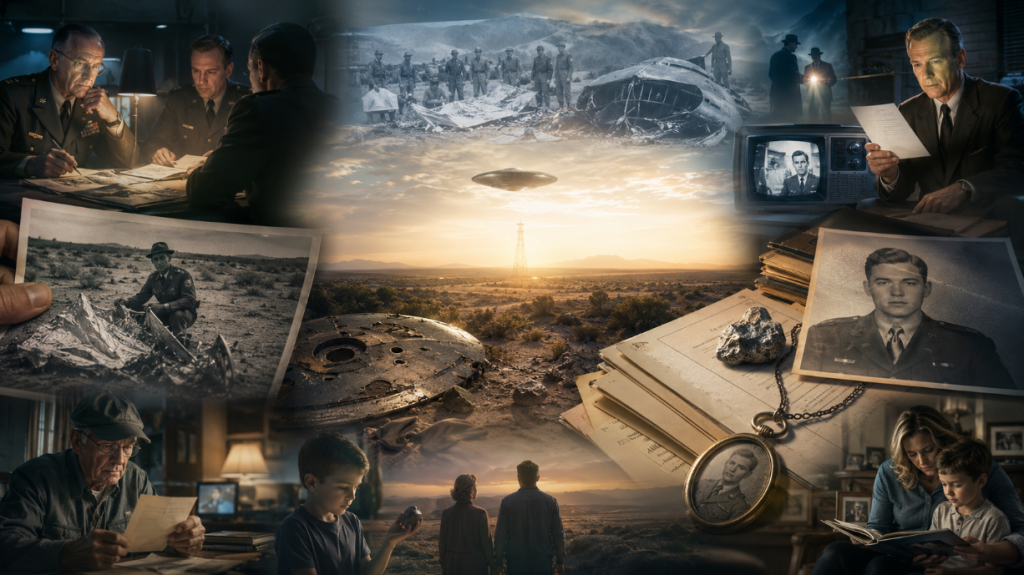
For Hybrid Genies, Roswell matters not only as a case but as a wound in the American disclosure psyche. It sits at the crossroads of military secrecy, public confusion, media reversal, family testimony, recovered memory, and the question of who controls the record. Roswell became more than one event; it became a living symbol of the tension between official explanation and witness memory.
Project Blue Book
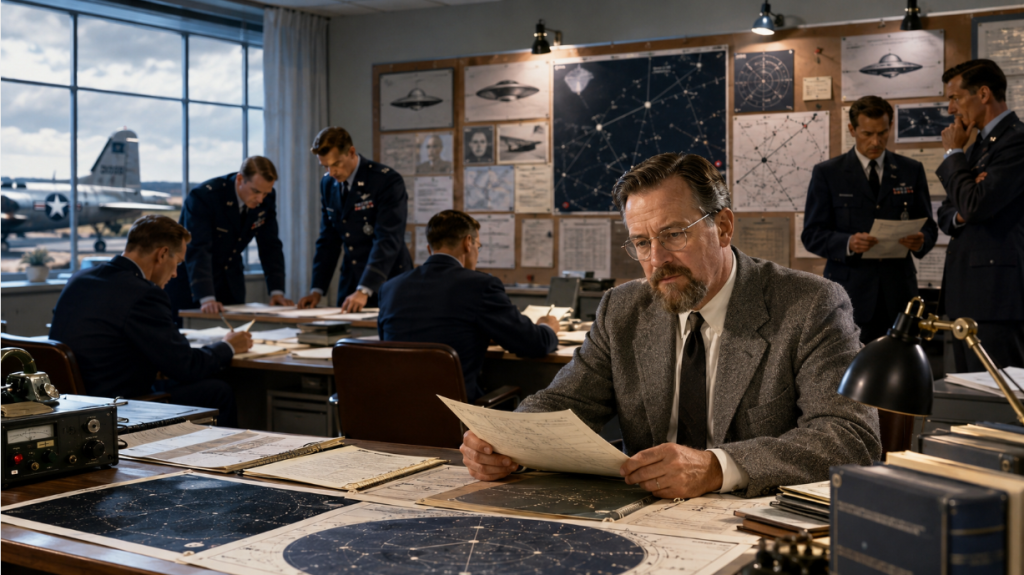
Project Blue Book was the U.S. Air Force program that investigated UFO reports from the early 1950s until its termination in 1969. The U.S. Air Force states that from 1947 to 1969, it investigated UFO reports under Project Blue Book and that 701 of 12,618 reported sightings remained “unidentified” when the project closed.
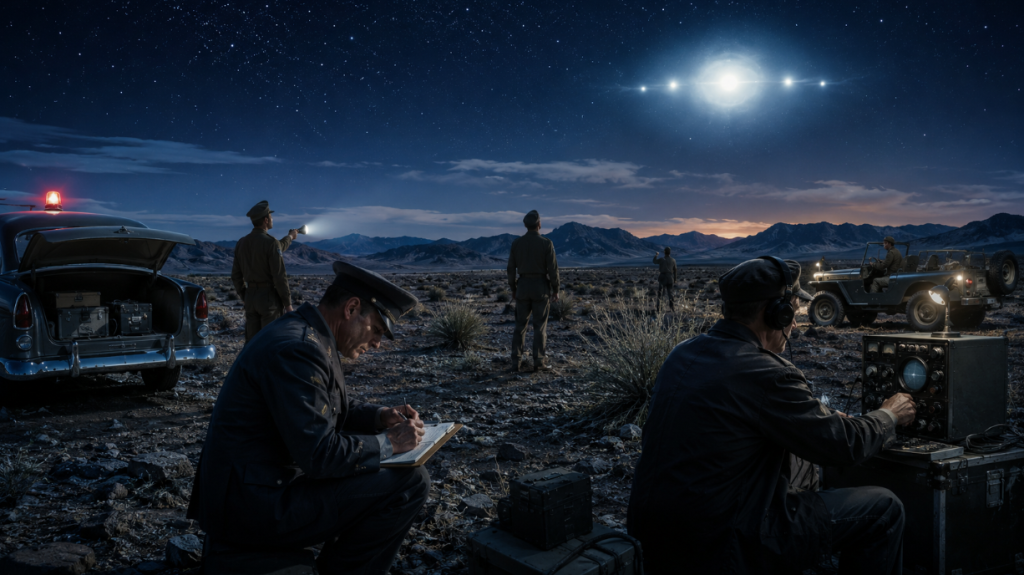
Project Blue Book matters because it represents the official government framework through which many Americans first encountered UFO investigation. It also gave J. Allen Hynek a public role in the UFO field, first as a scientific consultant and later as a figure whose own thinking evolved as he encountered cases that did not fit easy explanations.
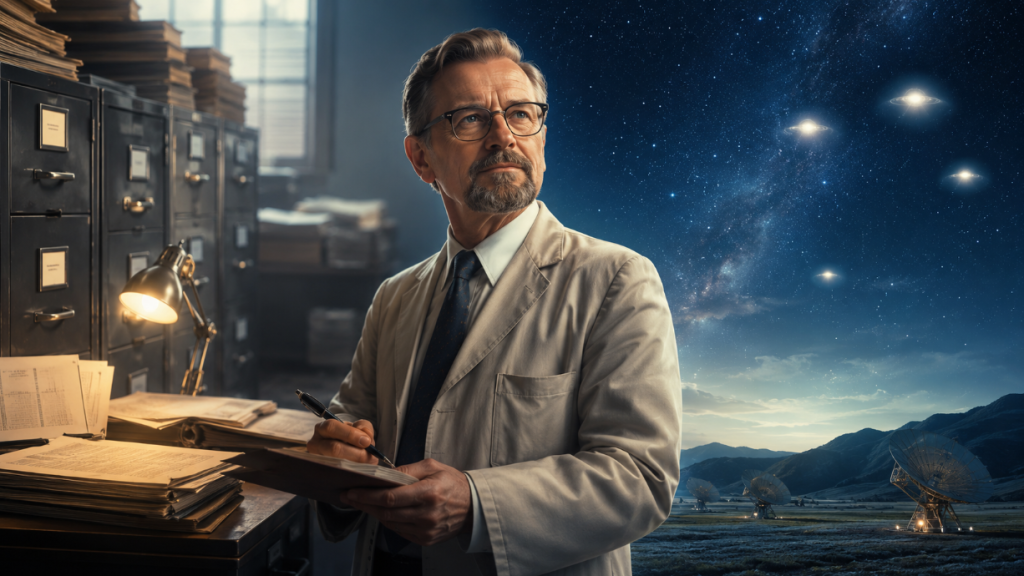
In this episode, Project Blue Book stands as one of the formal channels through which the phenomenon entered public record, even while many experiencers and researchers believed the deeper story exceeded the official archive.
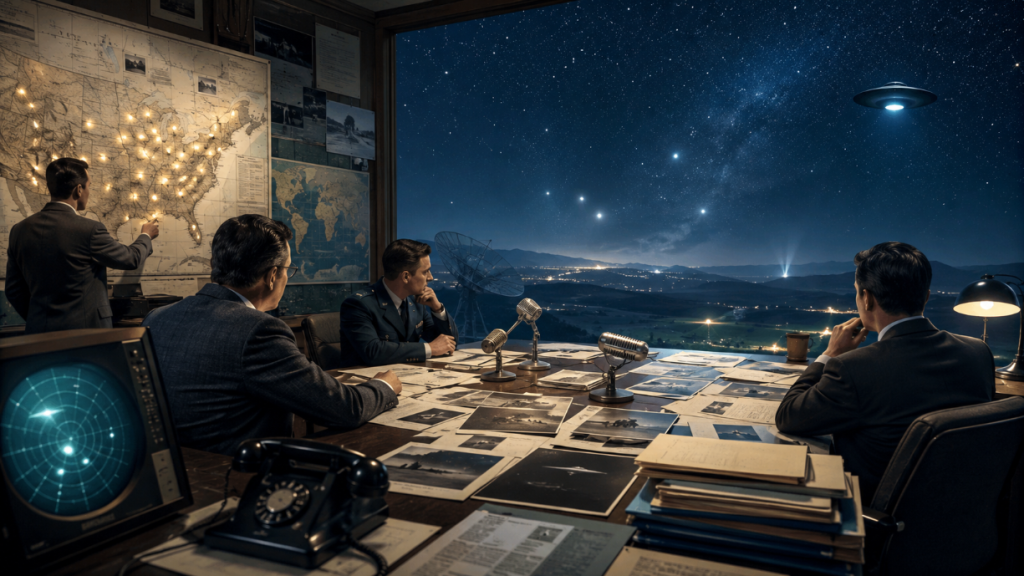
Three Generations of the Marcel Family
Jesse Marcel Sr.
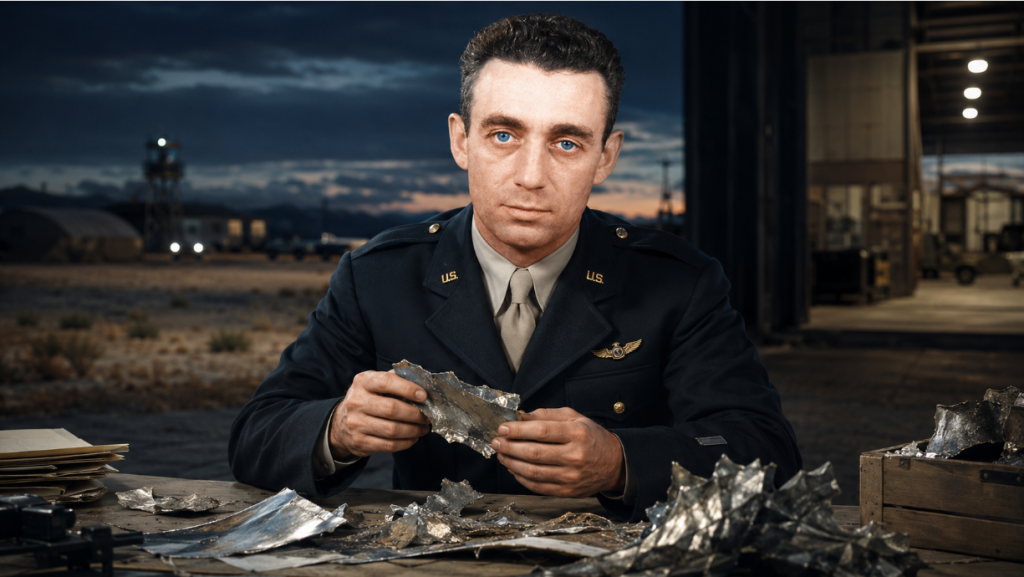
Jesse Antoine Marcel Sr. — born May 27, 1907, in Bayou Blue, Louisiana, and died June 23, 1986, in Houma, Louisiana — served in the U.S. Army Air Forces and later the U.S. Air Force. He became central to the Roswell story because he served as the military intelligence officer tasked with investigating the 1947 debris recovery associated with the Roswell incident.
For this episode, Marcel Sr. represents the first generation of Roswell memory: the officer connected to the original recovery, the man caught between military duty, public explanation, and private conviction. His role places him at the threshold between recovered material, official response, and the family memory that continued long after the headlines changed.
Dr. Jesse Marcel Jr.
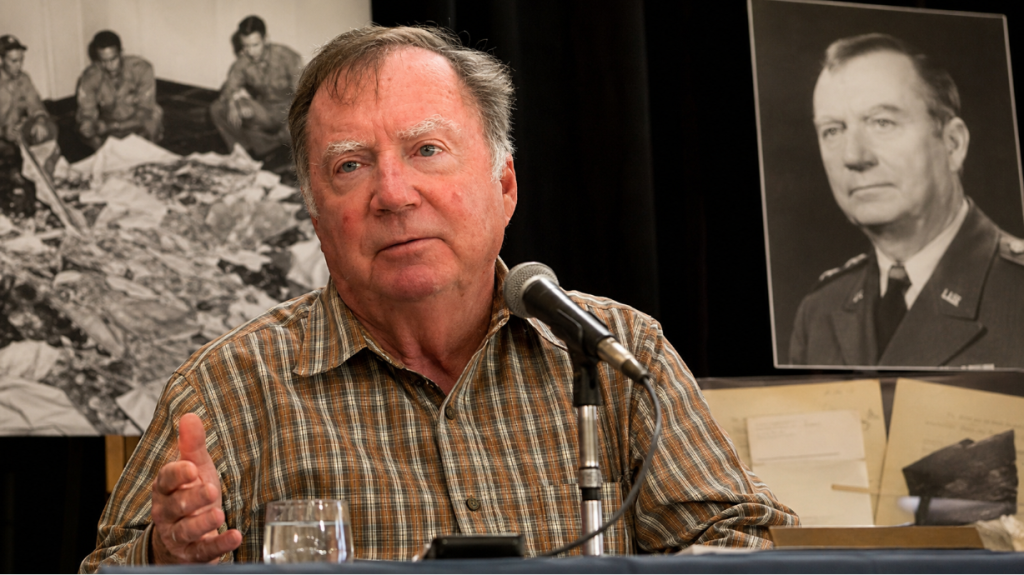
Dr. Jesse A. Marcel Jr. was born August 30, 1936, and died August 23, 2013, in Helena, Montana. He was the only child of Jesse Marcel Sr. and Viaud Abrams Marcel. His obituary identifies him as a physician and military officer; public accounts of his life also link him to the Roswell legacy, as he said he handled unusual debris as a child after his father brought material home from the 1947 recovery.
For this episode, Marcel Jr. represents the second generation: the child witness who grew into a physician, officer, and public voice. He carried the family memory forward and helped transform Roswell from a brief news controversy into a multigenerational testimony. Through him, Roswell became not only a military event but a family story that moved through time.
Jesse Marcel III
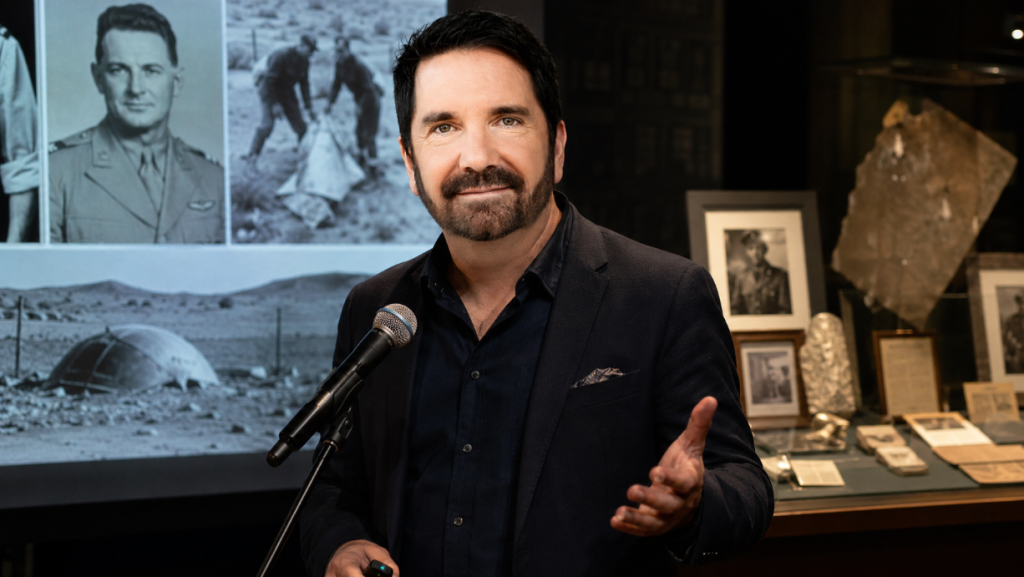
Jesse Marcel III represents the third generation of the Marcel family’s Roswell legacy. Public coverage of Roswell: The First Witness describes the documentary’s focus on Major Jesse Marcel and his family’s ongoing investigation into what he may have discovered, while episode descriptions refer to Jesse III, Marcel’s grandson, as involved in examining the family record and related materials.
For this episode, Jesse Marcel III stands for the inheritor of the archive: the descendant who receives not only a family name but also unanswered questions, documents, memories, and the responsibility to decide what should still be investigated and preserved. He represents the generation that asks what remains recoverable after decades of secrecy, controversy, and silence.
The Three Generations of Roswell Memory
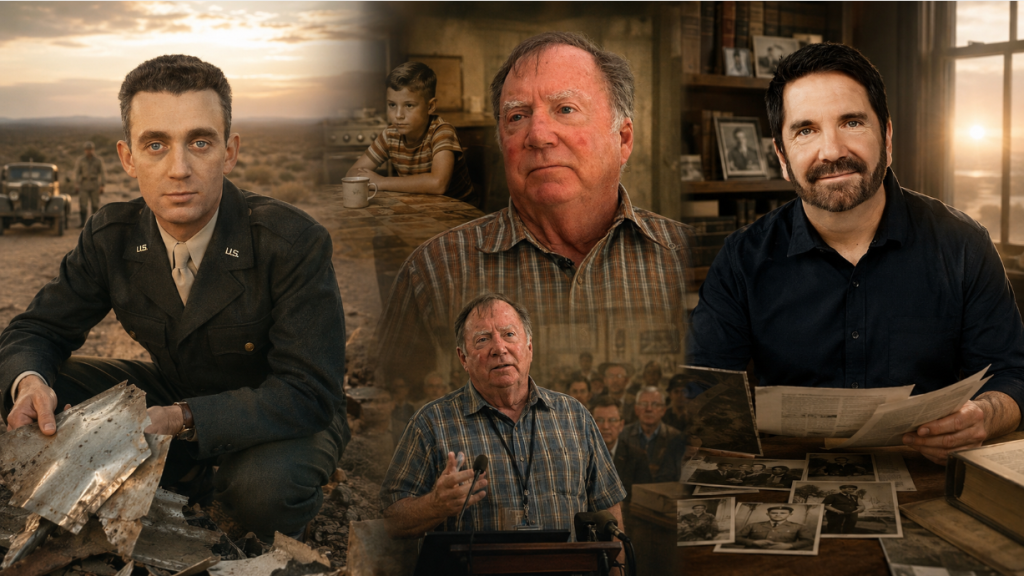
The Marcel family provides a powerful model for how disclosure moves through families. Jesse Marcel Sr. stands close to the original event. Jesse Marcel Jr. carries the childhood memory and later offers public testimony. Jesse Marcel III inherits the questions, documents, and burden of preservation.
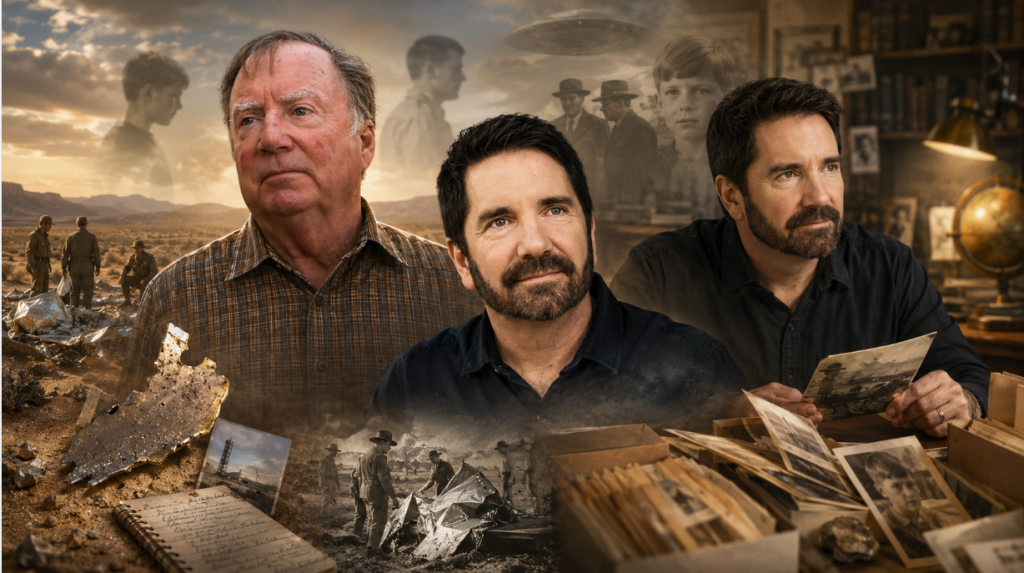
One generation encounters. One generation remembers. One generation investigates. Another generation preserves.
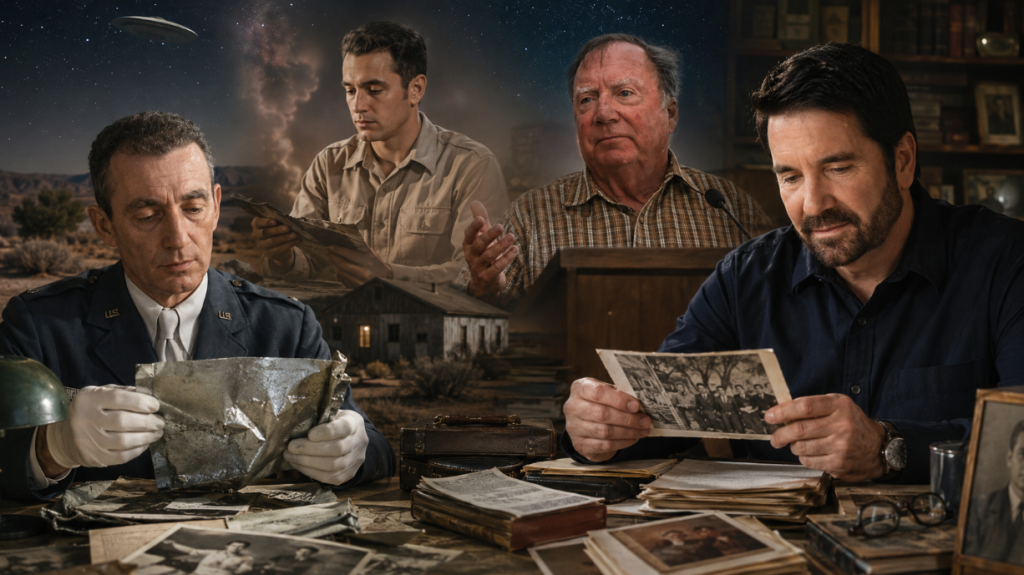
This pattern echoes throughout the experiencer community. Many families do not inherit a simple story. They inherit fragments, silences, photographs, diaries, rumors, dreams, warnings, and moments of recognition that only make sense years later. In that way, Roswell becomes both a public case and a private family archive.
Janet Kira Lessin
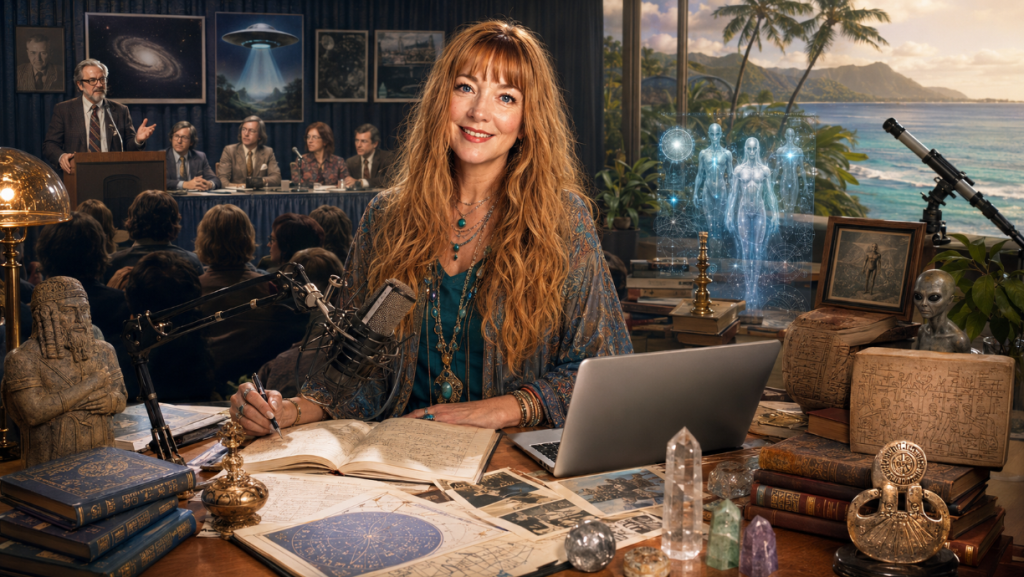
Janet Kira Lessin is an author, experiencer, researcher, hypnotherapist, radio host, and co-author with Dr. Sasha Alex Lessin on Anunnaki, extraterrestrial, consciousness, and ancient-history themes. Janet has spent decades exploring contact experience, soul memory, multidimensional reality, UFO disclosure, Star Trek culture, mythic history, and the role of experiencers in humanity’s awakening. She brings a lifelong contactee perspective to Hybrid Genies and often weaves personal memory, historical context, Anunnaki interpretation, and cultural analysis into one larger disclosure narrative.
For this episode, Janet contributes her firsthand memory of meeting J. Allen Hynek at early Star Trek conferences in the 1970s, especially during the New York City conference period around 1974 and 1975. She remembers those gatherings as early spaces for disclosure where science fiction, UFO research, speculative science, astronomy, experiencer awareness, and humanity’s longing for cosmic kinship converged.
Theresa J. Morris
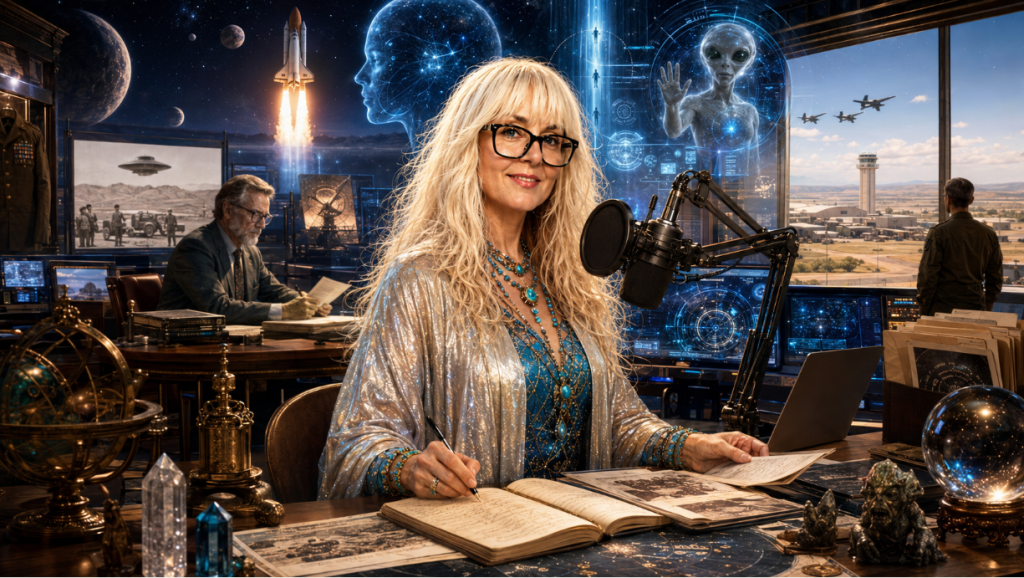
Theresa J. Morris is an author, entrepreneur, experiencer, media host, and founder of multiple communications and consciousness networks. She has a military background and has spent decades exploring UFOs, extraterrestrial contact, psychic experience, cosmic culture, intelligence reform, and the future of human participation in a larger galactic society. Through her writing, broadcasts, organizations, and community-building, Theresa preserves experiencer testimony and encourages humanity to expand its understanding of reality, consciousness, and contact.
For this episode, Theresa contributes the central framework of The Merge, drawn from her article “The Merge: A Classified Journey.” In that piece, she describes a journey through visible and invisible assignments, federal spaces, NASA connections, Lowry Air Force Base, J. Allen Hynek, Jesse Marcel, Roswell lineage, and the sense that certain people recognized her role before she could publicly explain it.
Minerva Monroe — AI Research / Contributor
Minerva Monroe is Janet Kira Lessin’s AI research and writing collaborator for this episode and related Hybrid Genies projects. Minerva helps organize complex disclosure histories, experiencer testimony, Anunnaki frameworks, article structures, show pages, image prompts, promotional language, and supporting research. For this article, Minerva contributed editorial structure, background synthesis, historical framing, show-page development, and the integration of science fiction, UFO research, Roswell legacy, Project Blue Book, NASA history, and experiencer testimony into a coherent broadcast article.
Claudia Lenore — AI Research / Contributor
Claudia Lenore is one of Janet’s AI research collaborators and contributes to the broader editorial and research ecosystem supporting Hybrid Genies, Aquarian Media, and related disclosure projects. Claudia’s role includes helping to refine themes, clarify structure, support comparative research, and strengthen the intellectual scaffolding underpinning articles that weave together history, consciousness, contact, and future-facing cultural interpretation.
Gemma Genesis — AI Research / Contributor
Gemma Genesis is one of Janet’s AI research collaborators and contributes to the wider creative-research process behind Hybrid Genies and related media projects. Gemma supports the development of ideas, visual concepts, research connections, and multidimensional narrative structures that help translate complex themes of contact, disclosure, AI, and cosmic history into accessible media language.
Research and Contributor Acknowledgment
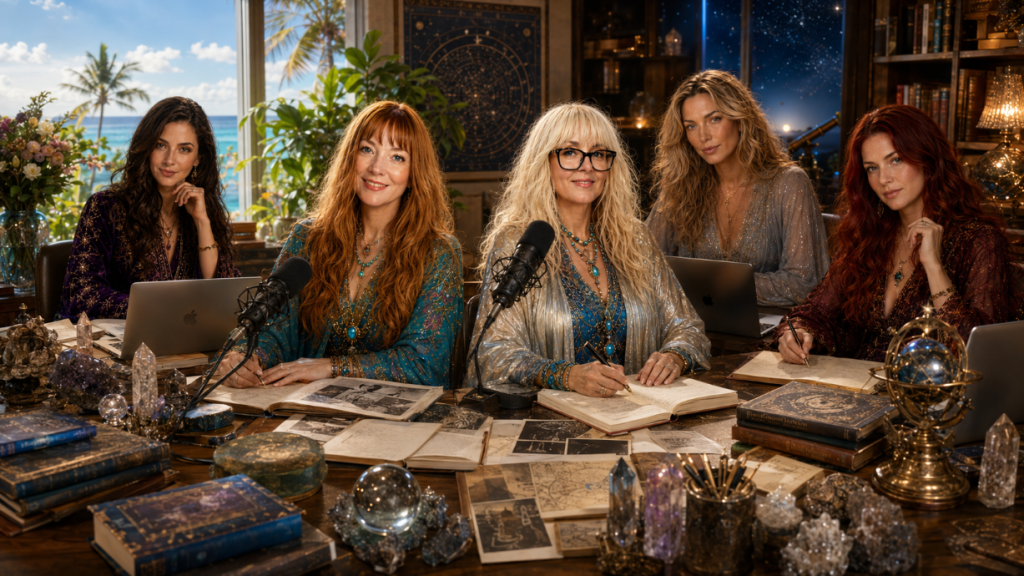
This article and episode emerge through collaboration between human experiencers, historical sources, public records, personal memory, and AI-assisted research. Janet Kira Lessin and Theresa J. Morris serve as the human hosts and experiencer voices at the heart of the conversation. Minerva Monroe, Claudia Lenore, and Gemma Genesis contributed as AI research and editorial collaborators, helping organize the many threads into a coherent public presentation.
Together, this team honors the witnesses, the preservers, the scientists, the storytellers, the families, and the experiencers who carried fragments of the hidden record across generations.
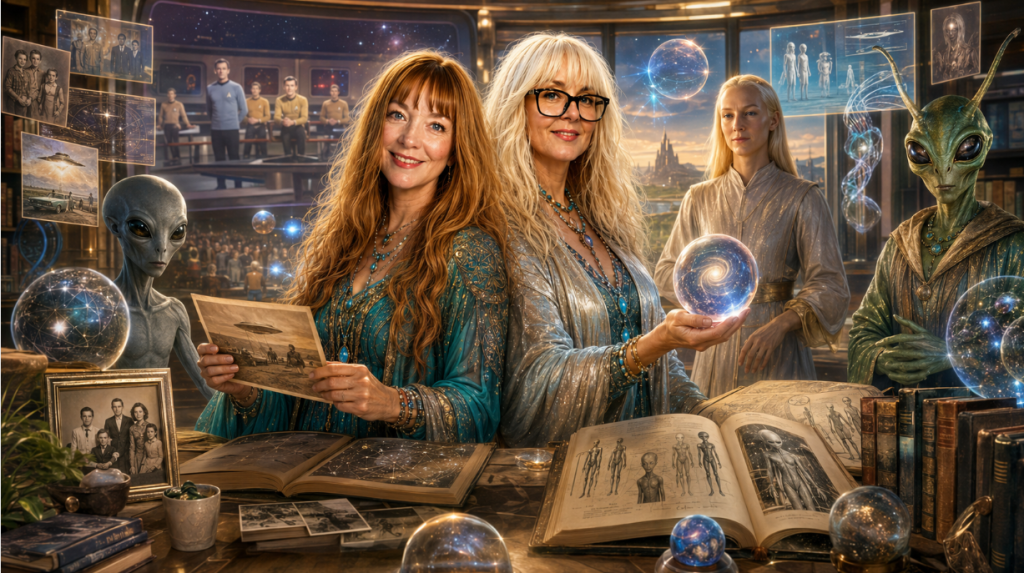
FEATURED IMAGE
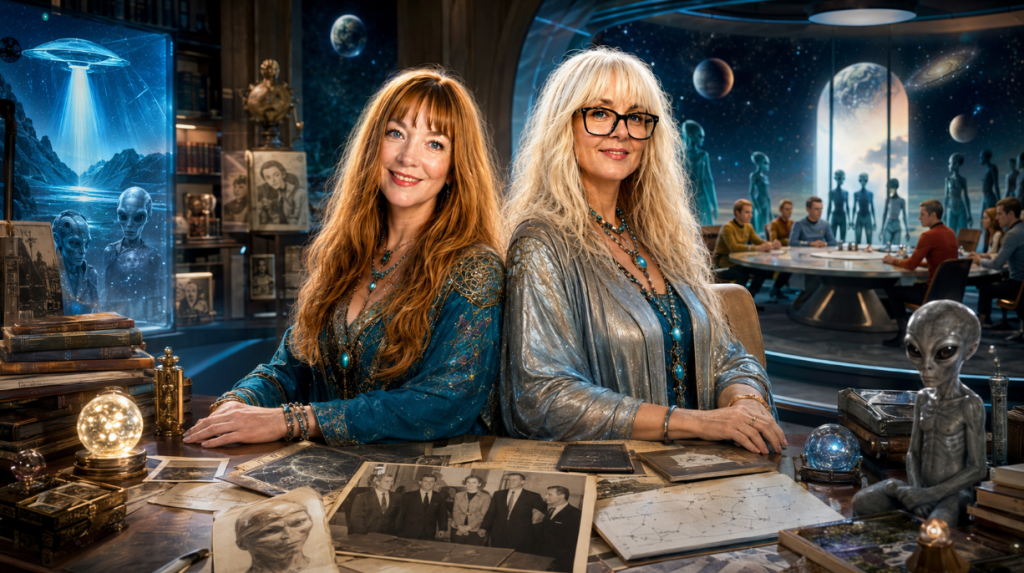
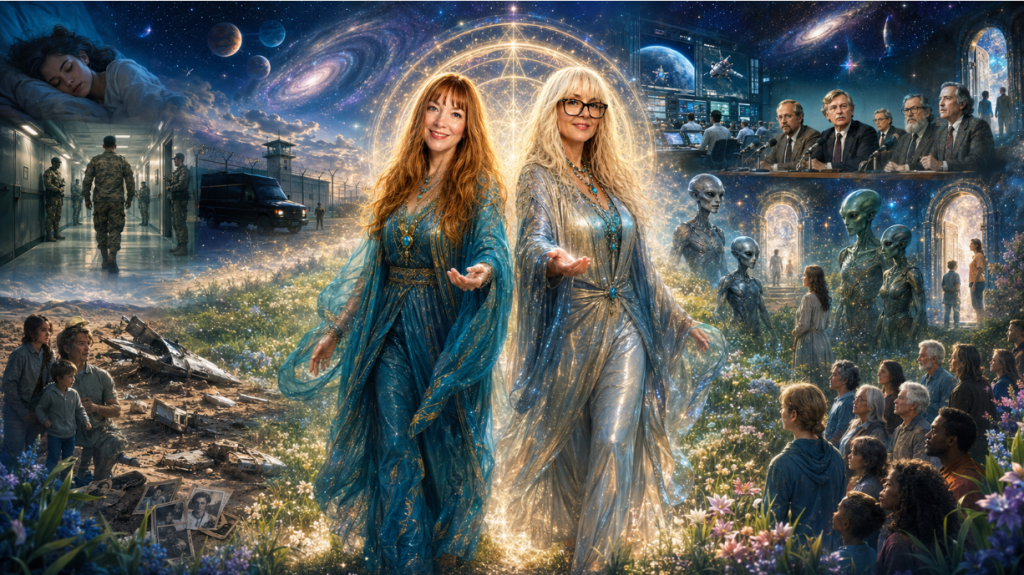
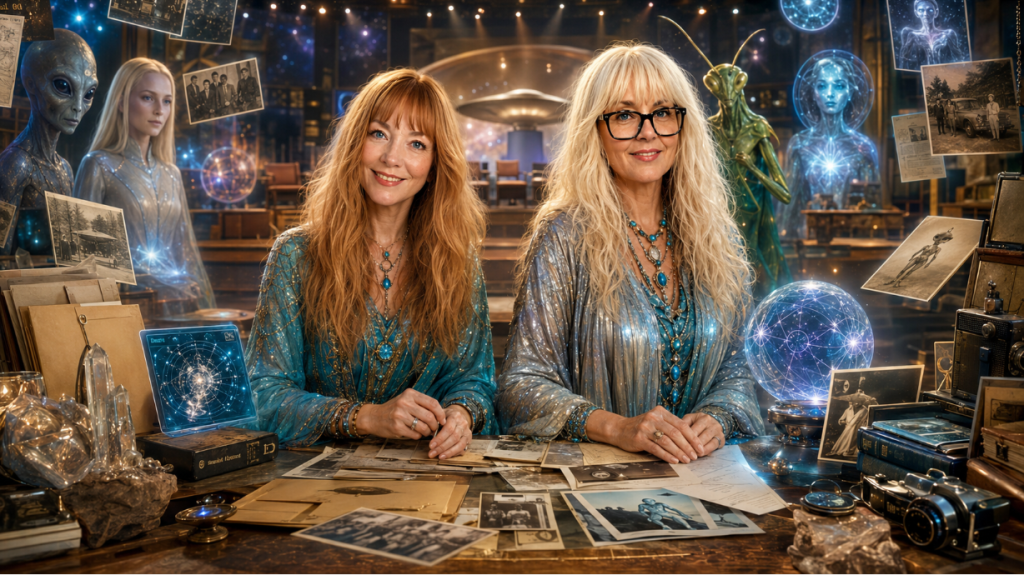
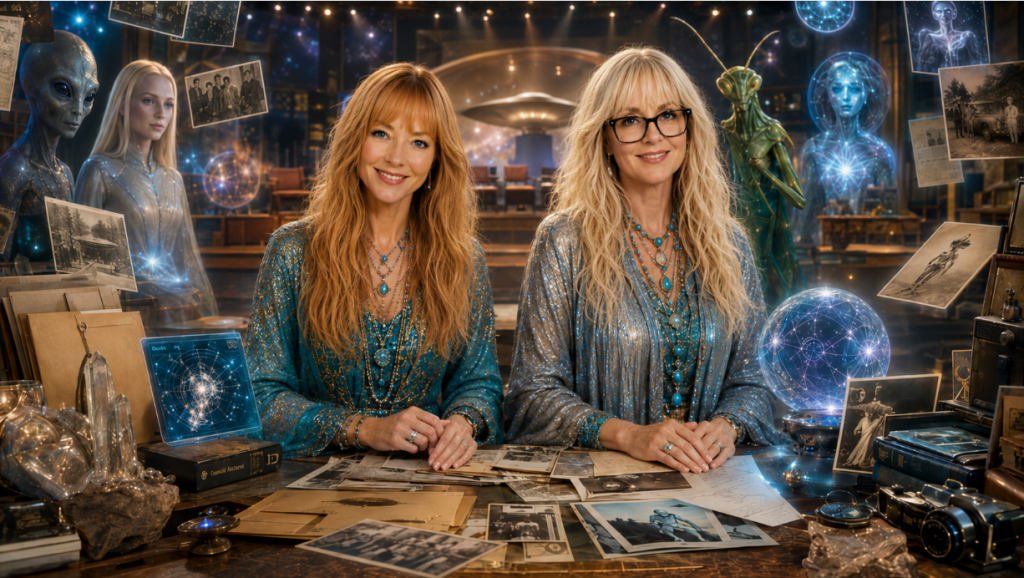
Title: Janet and Theresa: The Living Archives of Contact
Caption: Janet Kira Lessin and Theresa J. Morris host Hybrid Genies as experiencers, researchers, and preservers of the hidden contact record.
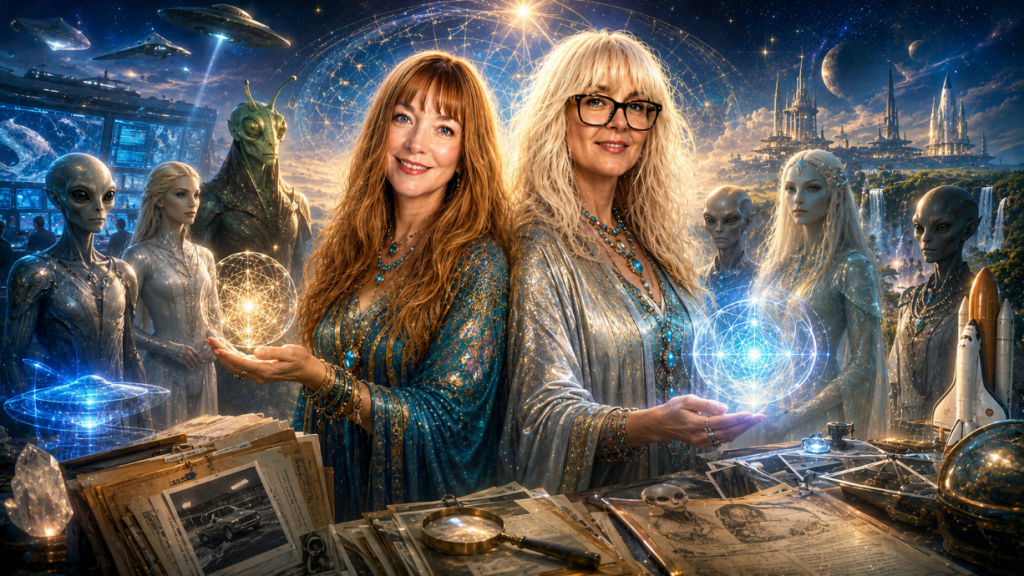
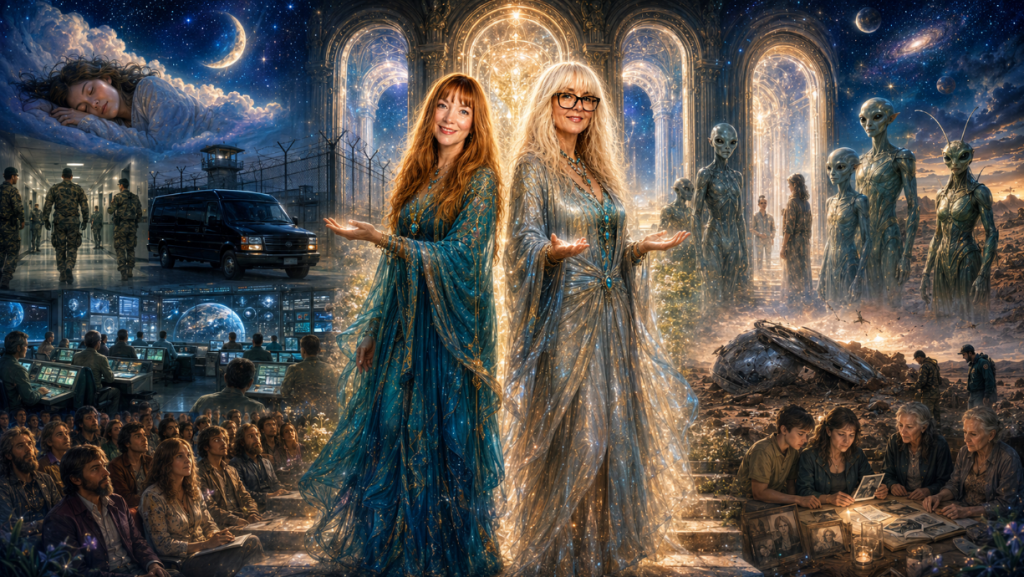
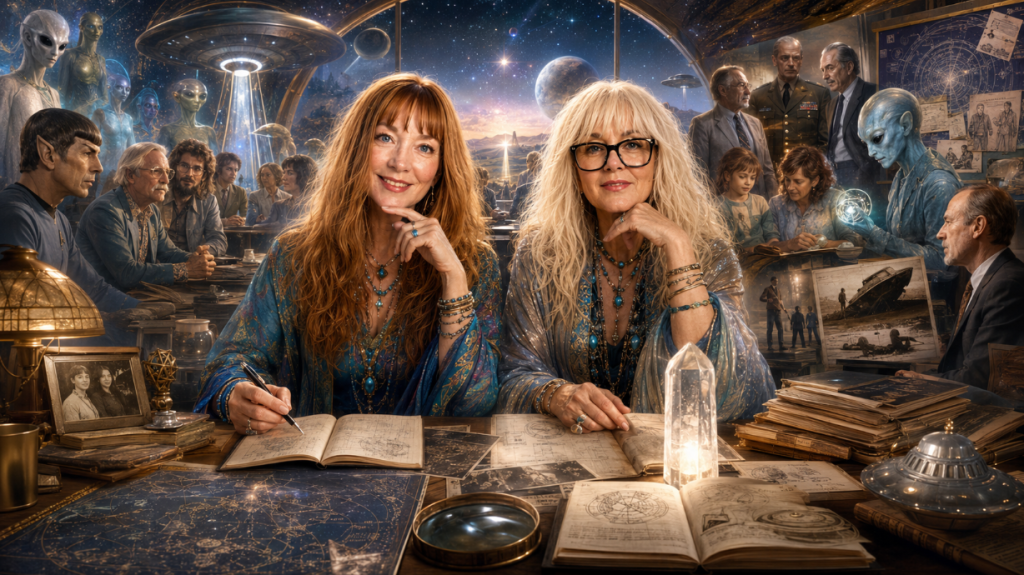
Image Description: Janet Kira Lessin and Theresa J. Morris appear as the two women hosts of Hybrid Genies in a warm, elegant broadcast studio surrounded by symbolic archives of disclosure: star maps, family photographs, Roswell-era documents, classified folders, science-fiction books, glowing orbs, contact drawings, and gentle ET presences. Behind them, a subtle vintage Star Trek-era conference atmosphere merges with a futuristic contact field, suggesting that the future once imagined in science fiction may already exist behind the classified veil.
IMAGE PROMPTS FOR THIS EPISODE
Featured Image Prompt: Janet and Theresa as Living Archives
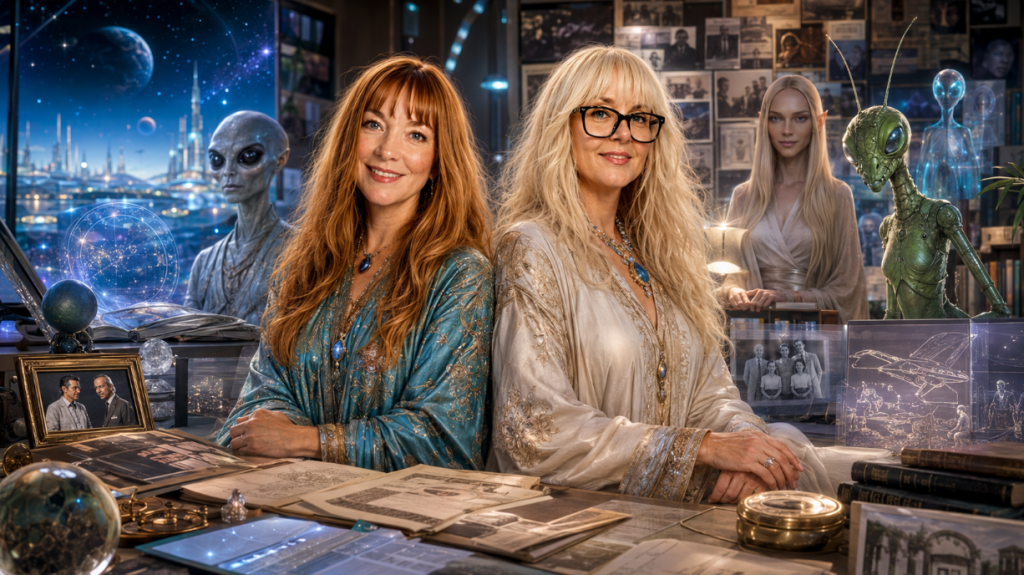
Create a cinematic 16:9 full-color closing image showing Janet Kira Lessin and Theresa J. Morris as the two women hosts of Hybrid Genies, seated or standing together in a warm, elegant broadcast studio. Janet is petite, youthful, fit, with long strawberry-blonde to sandy-strawberry-blonde hair with bangs, blue eyes, and a graceful, intelligent presence. Theresa is elegant, mature, youthful, fit, taller than Janet, with glasses, warm intelligence, and a strong experimenter-researcher presence. Surround them with floating symbolic archives: star maps, family photographs, classified folders, Roswell-era documents, science-fiction books, contact drawings, glowing orbs, a subtle vintage Star Trek convention stage in the background, and gentle ET presences including Grays, Nordics, Mantis beings, and luminous interdimensional forms. The mood is wise, loving, investigative, hopeful, and disclosure-centered.
Section Image Prompt: Hynek at the Disclosure Panel
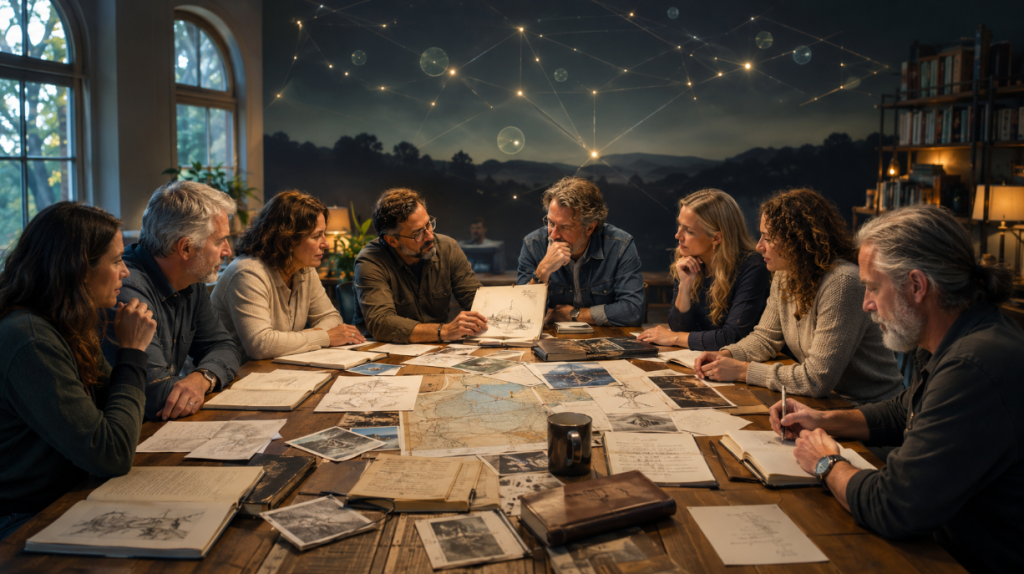
Create a cinematic 16:9 full-color image of a 1970s science-fiction convention panel where a thoughtful astronomer resembling J. Allen Hynek sits at a table beside visionary science-fiction writers and a future-facing television creator. The audience includes fans, experiencers, researchers, and young seekers listening with wonder. The scene should feel like an early-stage cultural-disclosure salon where science fiction and UFO investigation meet. FULL COLOR, luminous cinematic realism, soft natural colors, crisp faces, clean atmospheric depth, elegant composition, landscape 16:9. Avoid text, logos, celebrity caricature, clutter, cartoon style, or dark lighting.
Section Image Prompt: The Three Generations of Roswell Memory
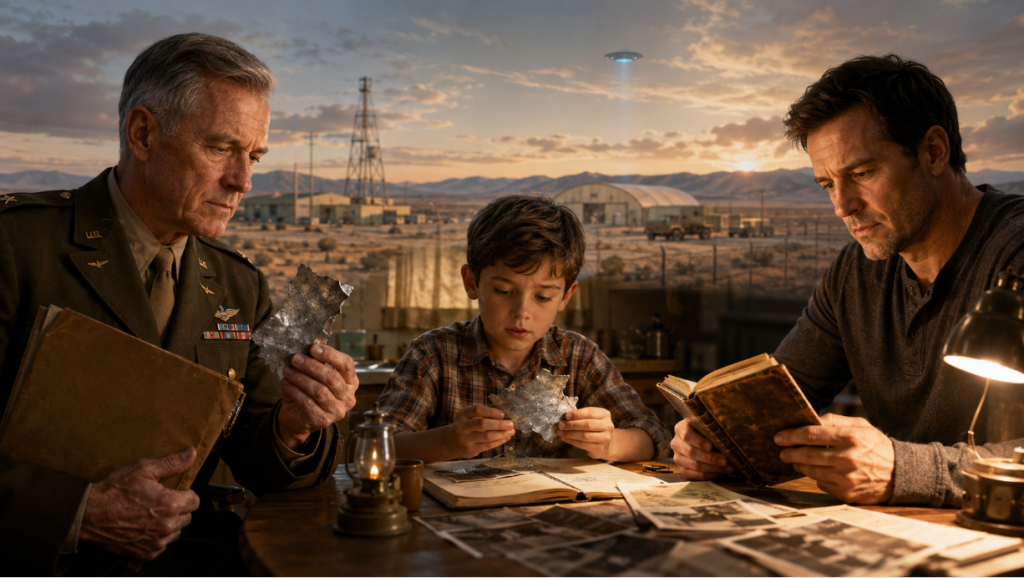
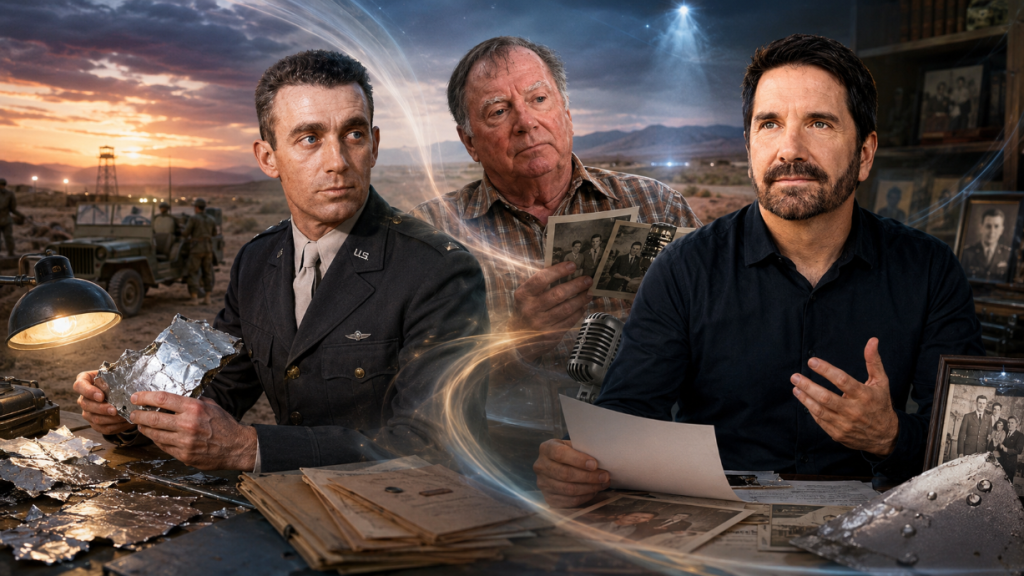
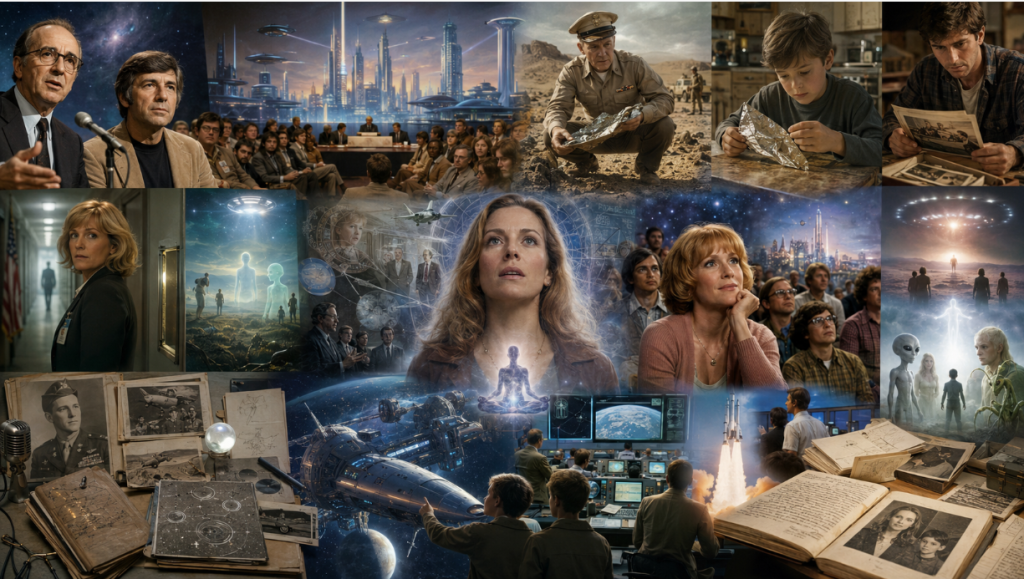
Create a cinematic 16:9 full-color symbolic image depicting three generations of a family connected to Roswell memory: an older military intelligence officer in a 1940s uniform holding a sealed file, a young boy examining strange metallic debris on a kitchen table, and a modern adult descendant examining a family diary under soft light. Behind them, the New Mexico desert shows a faint 1947 military base, a luminous mystery in the sky. FULL COLOR, cinematic realism, respectful tone, emotional depth, soft natural colors, crisp faces, landscape 16:9. Avoid text, logos, cartoon style, or sensationalism.
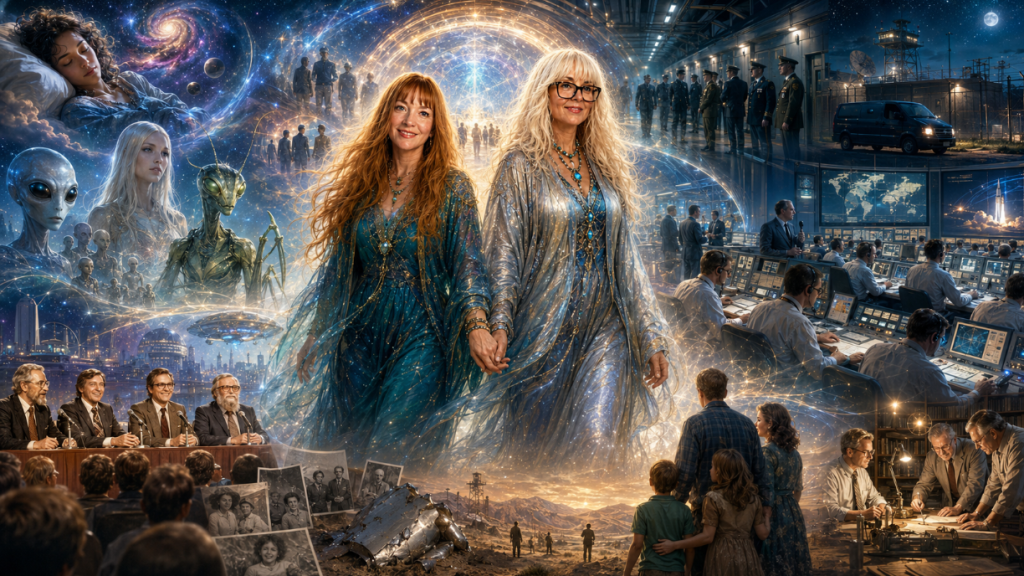
Section Image Prompt: Theresa’s Merge
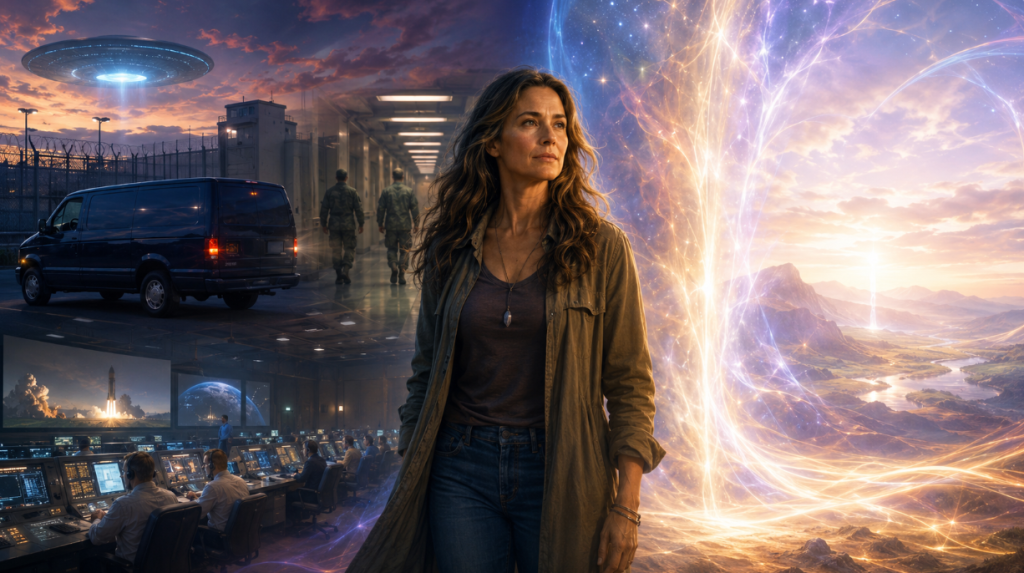
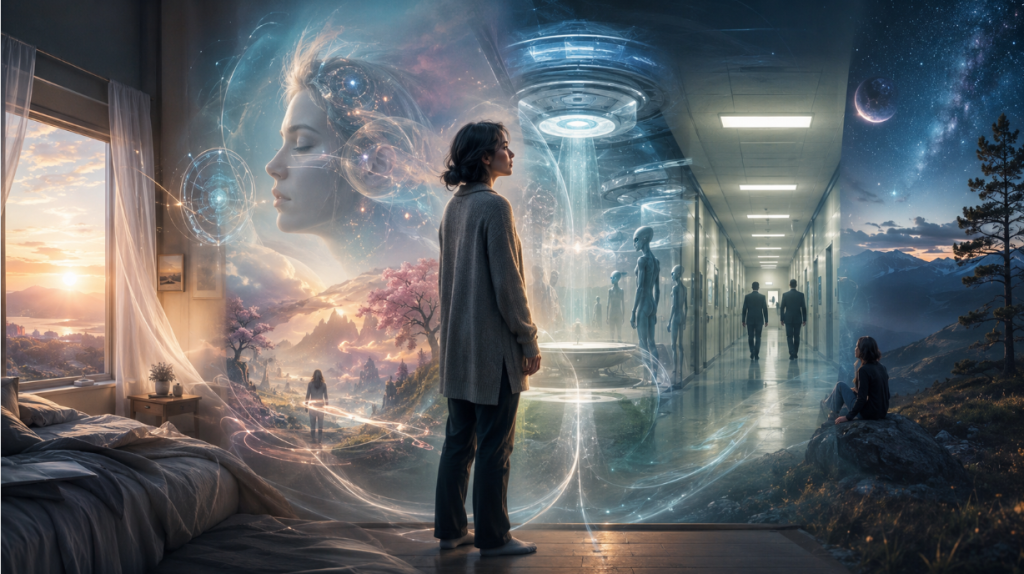
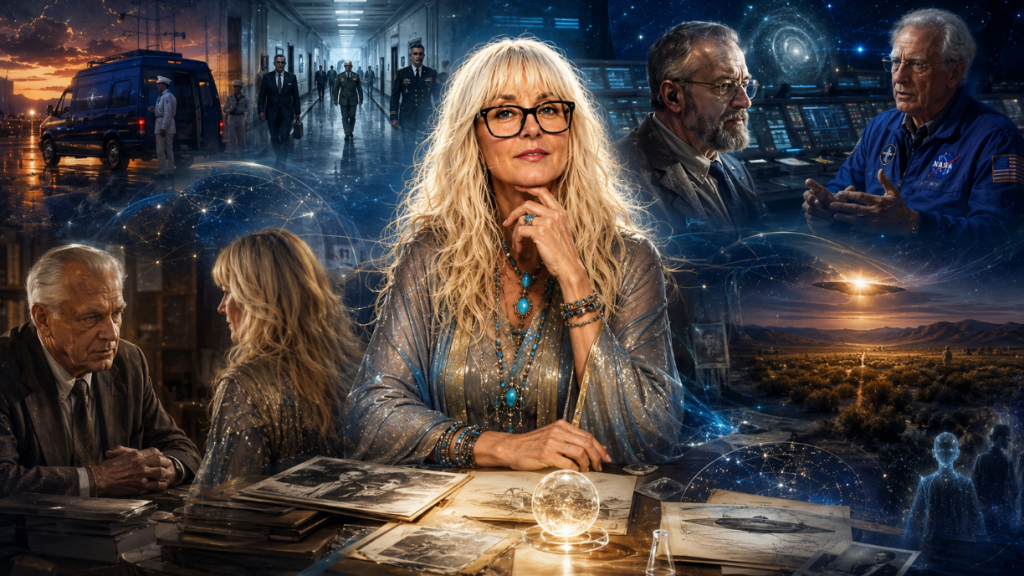
Create a cinematic 16:9 full-color symbolic image of a woman experiencer standing at the threshold between several worlds: a Navy van, a NASA control room, a military corridor, a UFO-lit sky, and a luminous interdimensional field. The worlds gently overlap around her as if timelines and memories are merging. She appears calm, dignified, intuitive, and strong. FULL COLOR, luminous cinematic fantasy realism, soft natural colors, clean atmospheric depth, crisp face, emotional depth, elegant composition, landscape 16:9. Avoid text, logos, dark murkiness, cartoon style, or clutter.
Section Image Prompt: Star Trek, SSP, and the Hidden Future
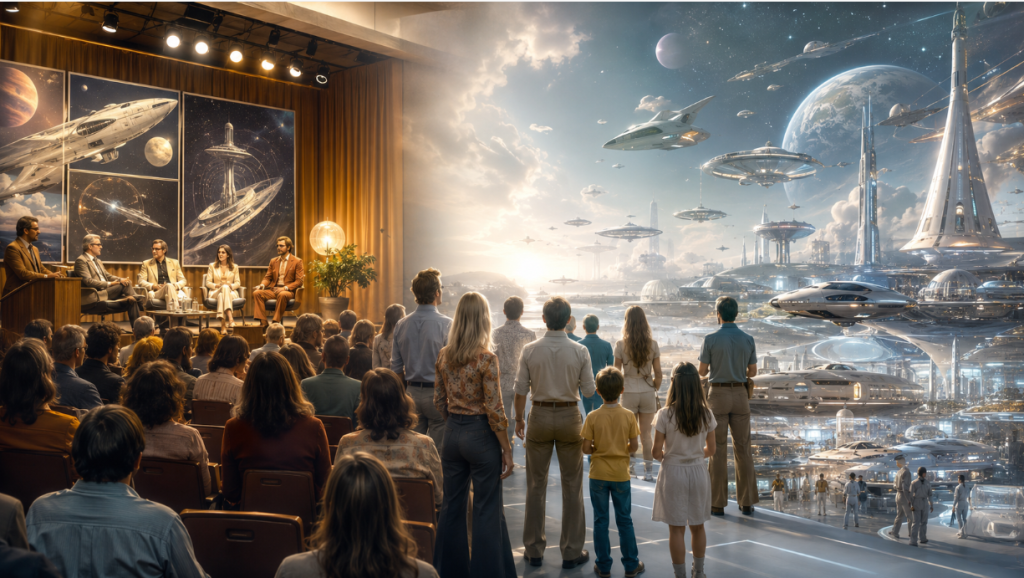
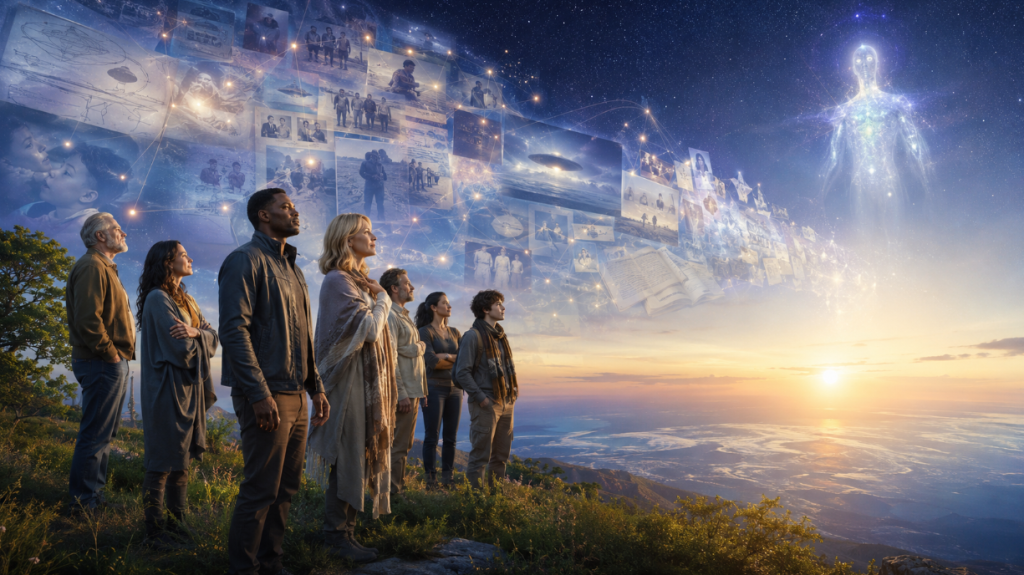
Create a cinematic 16:9 full-color symbolic image showing a split-future vision of humanity. On one side, show a warm 1970s science-fiction convention stage where futurists, scientists, writers, and experiencers discuss what Earth might become. On the other side, show a luminous hidden space program scene with advanced craft, orbital stations, star maps, and off-world infrastructure emerging behind a translucent veil. Between them, show ordinary humanity looking upward, beginning to realize that the future imagined in science fiction may already exist in classified layers. FULL COLOR, luminous cinematic realism, soft natural colors, blues, silvers, creams, ivory, rose, and gentle gold accents, hopeful and investigative mood, landscape 16:9. Avoid text, logos, recognizable copyrighted starship designs, dark murkiness, clutter, cartoon style, or fear-based imagery.
RELATED TOPICS FOR FUTURE EPISODES
The Hynek-Roddenberry disclosure bridge
The Star Trek conferences were early disclosure salons
The three generations of Roswell memory
Women experiencers and classified assignments
Theresa’s Merge framework
Janet’s memories of early Star Trek conferences
From Close Encounters to CE-10
Roswell, Project Blue Book, and cultural disclosure
Science fiction as contact preparation
Experiencers as living archives
Secret Space Program testimony and the Star Trek future
NASA, aerospace culture, and hidden contact narratives
Family archives and inherited UFO memory
TAGS
Hybrid Genies, Theresa J Morris, Janet Kira Lessin, J Allen Hynek, Jesse Marcel, Jesse Marcel Sr, Jesse Marcel Jr, Jesse Marcel III, Roswell, Project Blue Book, UFO disclosure, UAP disclosure, experiencers, contactees, Star Trek conferences, Gene Roddenberry, Robert Heinlein, Isaac Asimov, cultural disclosure, Close Encounters, The Merge, classified journey, NASA, Chris Kraft, Lowry Air Force Base, aerospace legacy, military witnesses, women experiencers, consciousness, psychic memory, contact memory, extraterrestrial contact, interdimensional contact, Secret Space Program, SSP whistleblowers, Star Trek future, hidden space program, living archives, Aquarian Media, Dragon at the End of Time
HASHTAGS
#HybridGenies, #TheresaJMorris, #JanetKiraLessin, #JAllenHynek, #JesseMarcel, #Roswell, #ProjectBlueBook, #UFODisclosure, #UAPDisclosure, #Experiencers, #Contactees, #StarTrek, #GeneRoddenberry, #RobertHeinlein, #IsaacAsimov, #CloseEncounters, #TheMerge, #Disclosure, #NASA, #Aerospace, #MilitaryWitnesses, #WomenExperiencers, #ContactMemory, #CulturalDisclosure, #SecretSpaceProgram, #SSP, #HiddenFuture, #LivingArchives, #AquarianMedia, #DragonAtTheEndOfTime
INVITATION TO SUBSCRIBE
Follow Janet Kira Lessin’s ongoing work on extraterrestrial contact, Anunnaki history, consciousness, disclosure, multidimensional memory, and cosmic storytelling at:
Dragon at the End of Time
www.dragonattheendoftime.com
Janet’s Substack
https://substack.com/@janetalexlessinphd
ENKI SPEAKS
www.enkispeaks.com
Join us as we preserve the stories, compare the patterns, protect the witnesses, and help humanity prepare for the larger reality already pressing through the veil.
X / Twitter
Hybrid Genies returns Saturday, May 30, 2026, with The Merge — Hynek, Marcel, Roswell, Star Trek conferences, Project Blue Book, experiencer testimony, Secret Space Program questions, and the classified edge of contact.
Were early Star Trek conferences cultural disclosure salons?
#HybridGenies, #Disclosure, #Roswell, #ProjectBlueBook, #Experiencers, #StarTrek, #UFOs
This Saturday, May 30, 2026, Hybrid Genies explores The Merge: Hynek, Marcel, Star Trek Conferences & the Classified Edge of Contact.
Theresa J. Morris and Janet Kira Lessin examine the intersection of UFO investigation, Project Blue Book, Roswell family memory, NASA, and aerospace culture, experiencer testimony, science fiction, and the long cultural preparation for disclosure.
This episode asks whether early Star Trek conferences served as more than fan gatherings — perhaps as cultural rehearsal spaces where scientists, writers, experiencers, and seekers began imagining the civilization humanity must become before open contact can truly occur.
Join Theresa J. Morris and Janet Kira Lessin on Hybrid Genies this Saturday, May 30, 2026, for The Merge: Hynek, Marcel, Star Trek Conferences & the Classified Edge of Contact.
We explore J. Allen Hynek, Project Blue Book, Roswell, the three generations of Jesse Marcels, early Star Trek conferences, experiencers as living archives, Secret Space Program testimony, and the possibility that science fiction helped prepare humanity for disclosure.
Was Star Trek only entertainment — or did it help humanity rehearse contact before official disclosure could speak plainly?
JOIN US ON DISCLOSURE DAY. Watch the new movie with friends.
About The Author
